






The lineage of knowledge transfer has historically been charted through human channels. Long before the invention of writing in ancient Mesopotamia—where laws, history, and mythology were preserved via oral storytelling—teaching and learning formed the bedrock of societal advancement. From Socrates instructing Plato to Jesus guiding his disciples, the transfer of accumulated wisdom has always relied on the dynamic between a seasoned mentor and an eager student. In the modern era of deep learning, this ancestral pedagogical model has found a digital equivalent in artificial intelligence through a process known as model distillation.
As the artificial intelligence landscape grows increasingly dominated by massive frontier models containing trillions of internal parameters, the computational and financial barriers to deploying these systems have skyrocketed. Operating state-of-the-art neural networks requires extensive hardware infrastructure and high energy consumption, putting them out of reach for many developers and smaller organizations. To bridge this gap, engineers are turning to model distillation—a compression technique that transfers the learned behaviors, probabilities, and internal representations of a large, high-capacity teacher model into a smaller, computationally efficient student model.
The necessity for model distillation stems directly from the sheer scale of contemporary deep learning architectures. These models rely on trillions of parameters, which are the internal configuration variables automatically adjusted during training on vast corpuses of data. While these massive models achieve extraordinary accuracy, running them in production environments is prohibitively expensive. Distillation offers a viable workaround, allowing smaller networks to inherit the capabilities of frontier systems while maintaining a footprint small enough for practical deployment.

Within the field of machine learning, several distinct techniques have emerged to facilitate this knowledge transfer, each focusing on different layers of information within the neural network.
Response-based distillation, originally pioneered by deep learning pioneer Geoffrey Hinton, represents the classic teacher-student paradigm. Rather than training a student model exclusively on hard labels—fixed categorical targets like a binary designation of dog or cat—this method utilizes soft labels. Soft labels convey probabilistic outputs, indicating not just the primary classification, but also the nuanced similarities a given input shares with other categories. This additional context, often referred to as dark knowledge, equips the smaller model to mimic the behavior and generalization capabilities of the larger teacher without requiring equivalent architectural complexity.
Beyond focusing solely on final outputs, researchers also employ feature-based distillation, which compels the student model to replicate the internal feature representations of the teacher. By leveraging mathematical measures such as mean squared error, the student network is penalized not just for missing the final prediction, but for diverging from the hidden layer activations generated by the teacher during processing. While this provides a deeper transfer of knowledge, particularly in convolutional neural networks and vision transformers, it also introduces substantial memory and power overhead during the training phase.
Attention distillation targets another critical component of modern architectures, particularly transformer models. Instead of attempting to mirror all individual neurons, the student model observes and replicates the attention maps of the teacher. These maps designate which specific input tokens or regions the model prioritizes when executing tasks. By learning where the larger model directs its focus, the student acquires a structured approach to problem-solving, though this method similarly demands significant computational resources to compute divergence metrics across massive tensors.
Self-distillation further expands the methodological toolkit by enabling a network to transfer knowledge either from an earlier training iteration to a later one, or between different internal layers. This approach enhances overall model performance without necessitating an increase in architectural size or reliance on an external, compute-heavy teacher network.
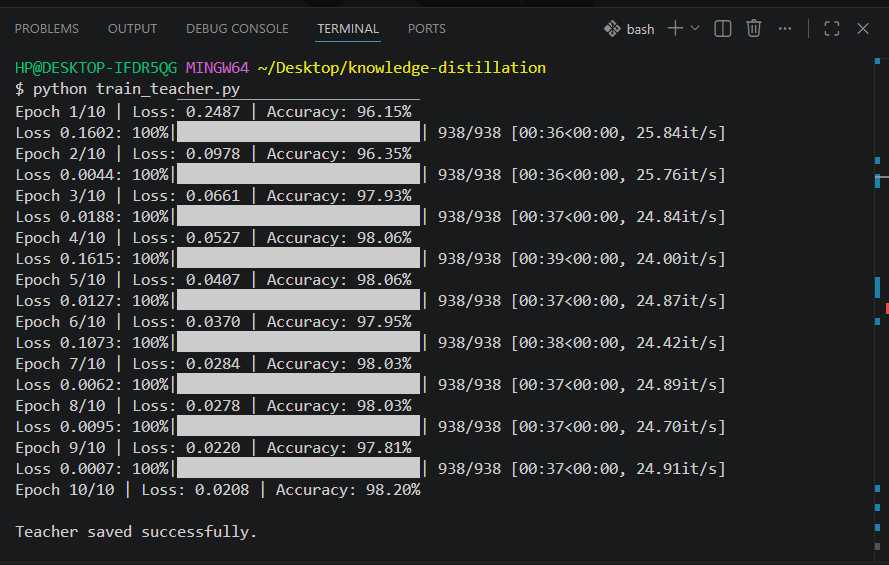
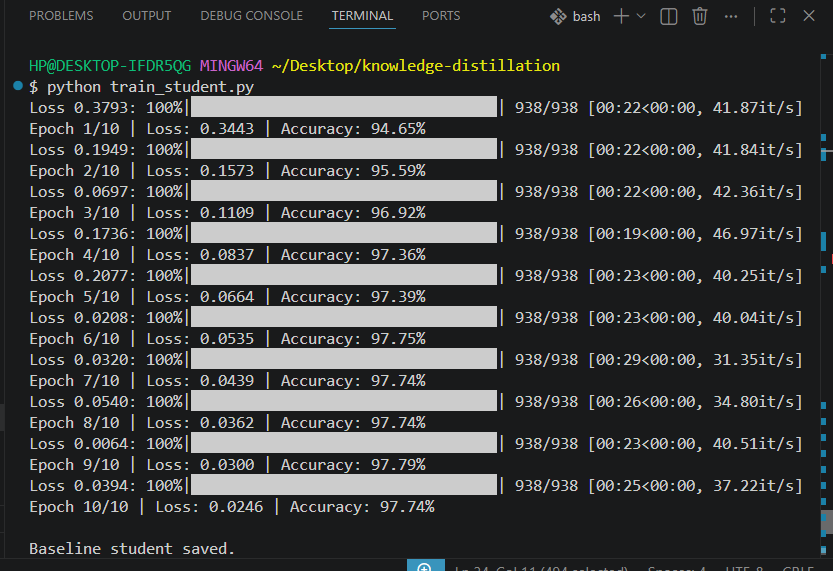
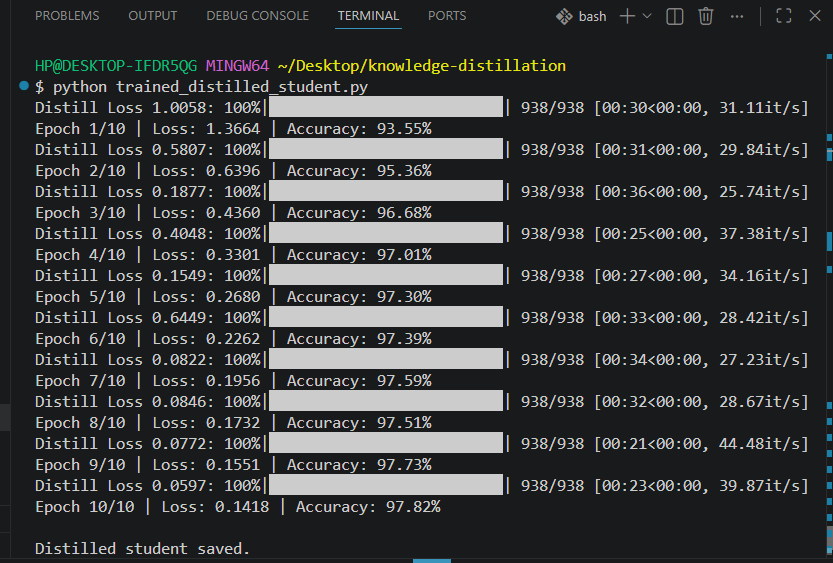
To evaluate the practical application of these concepts, developers frequently turn to standardized benchmarks such as the MNIST dataset, which contains tens of thousands of grayscale images of handwritten digits. By establishing a baseline performance with a standalone student network, and subsequently training a separate student using response-based distillation guided by a frozen teacher network, engineers can empirically measure the efficiency gains. Experimental implementations utilizing frameworks like PyTorch demonstrate that distilled student models consistently outperform baseline networks of identical size that were trained without teacher guidance, successfully closing the performance gap between compact architectures and their larger counterparts.
Despite the proven efficacy of model distillation, it remains just one of several strategies developers employ to optimize neural networks for edge devices, mobile hardware, and consumer-grade infrastructure. Alternative optimization techniques address different systemic bottlenecks in machine learning deployment.
Quantization achieves efficiency by reducing the bit-width of numerical weights and activations within the network, effectively targeting memory bandwidth limitations by compressing a standard 32-bit floating-point representation into lower-precision formats like 8-bit integers. This significantly shrinks file sizes without fundamentally altering the model’s architectural blueprint.
Pruning operates on the premise that large language models often contain redundant or negligible parameters. By systematically identifying and removing weak or inactive connections, developers can reduce the overall scale and computational latency of the network.
Low-rank factorization utilizes linear algebra to simplify the complex matrix multiplications that govern deep learning architectures, substituting heavy computational blocks with streamlined mathematical equivalents.
Ultimately, the choice of optimization strategy depends on the specific hardware constraints and performance bottlenecks a development team faces. While quantization primarily mitigates memory limitations, pruning and model distillation offer targeted solutions for reducing computational overhead, ensuring that advanced artificial intelligence capabilities remain deployable across diverse and resource-constrained environments.