









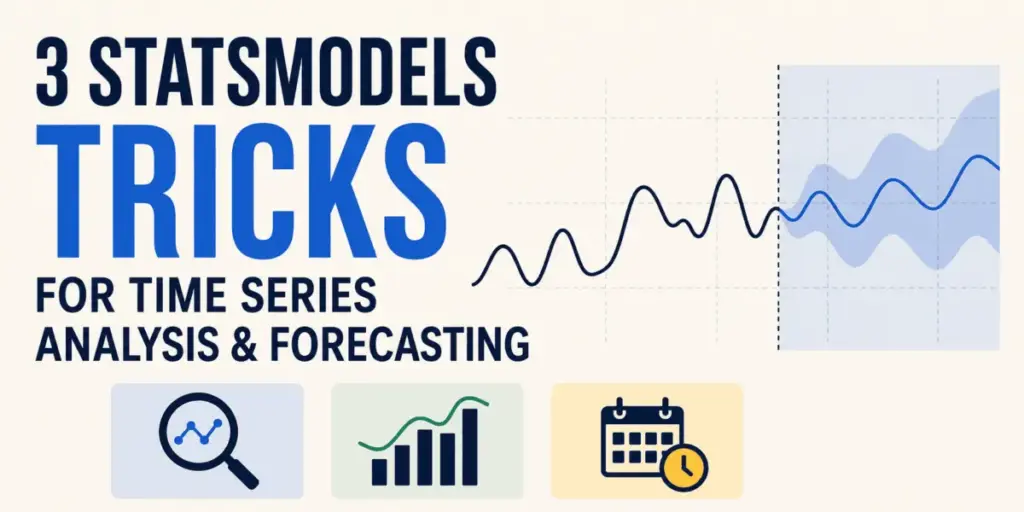
In the world of statistical modeling and data science, practitioners frequently spend valuable time reinventing the wheel. When working with time series data, standard programming habits often lead developers to extract a bare array of numbers from a fitted model, only to manually calculate confidence intervals, concatenate and refit datasets from scratch, or decouple seasonal components through error-prone custom loops. However, mature statistical libraries like Python’s statsmodels are often far more robust than many developers realize. A fitted model object computes a wealth of underlying information that extends well beyond a simple point forecast, offering built-in methods that eliminate redundant code and streamline forecasting pipelines.
Recent examinations of statsmodels 0.15.0 highlight several underutilized features that allow data scientists to interact more intelligently with results objects. By leveraging methods that already exist within the framework, analysts can avoid tedious hand-rolled solutions that are not only slower and more complex, but also statistically more prone to human error. Instead of treating a model’s output as a static array of predictions, data scientists are increasingly encouraged to query the results object directly for the comprehensive statistical insights it has already calculated during the fitting process.
To understand how these built-in capabilities operate in practice, developers can examine a standard monthly time series workflow utilizing a classic dataset. By applying the same underlying monthly series and a fitted ARIMA model across multiple techniques, analysts can observe how shifting the called method on the results object transforms the depth of the output without requiring an overhaul of the underlying architecture. Getting started requires a straightforward installation of the package via standard pip commands, ensuring the environment is aligned with version 0.15.0 or later.
The first major inefficiency in many standard time series workflows involves the isolation of point forecasts from their associated uncertainty. When code executes a standard call to retrieve predictions over a designated horizon, it frequently yields a flat array of numbers. While these figures provide the baseline trajectory, publishing or acting upon a forecast without its corresponding confidence interval represents a significant loss of analytical context.
Rather than relying on basic prediction methods that discard uncertainty estimates, analysts can utilize specialized retrieval functions that return comprehensive prediction results objects. These objects natively carry the variance and uncertainty already estimated by the model during its training phase. Developers can easily access predicted means for individual data points, extract confidence interval bounds, or generate an encompassing summary frame that encapsulates both metrics simultaneously. Crucially, these intervals do not require extra computational overhead; they are a direct byproduct of the primary model computation. The shorter, more basic methods simply throw this valuable data away.
By shifting from basic point estimation calls to comprehensive prediction retrieval functions, analysts gain immediate visibility into lower and upper bounds across future timestamps. This same conceptual approach applies equally when evaluating historical or in-sample periods, allowing data scientists to analyze past model performance and future projections with the exact same underlying statistical rigor.
A second common bottleneck arises when fresh observations arrive in a production environment. As new temporal data becomes available, the instinctive reflex for many practitioners is to concatenate the incoming observations directly onto the original training dataset and execute a complete refitting of the model from scratch. This brute-force approach forces the algorithm to re-estimate every parameter across the entire historical timeline, consuming unnecessary computational resources and potentially altering stable parameter configurations unnecessarily.
To address this, the library provides specialized update and append mechanisms designed to handle incoming data streams far more efficiently. Instead of rebuilding the entire architecture, these methods recreate the results object over the combined dataset while preserving the parameters that were previously estimated. By default, the routine bypasses the heavy lifting of parameter re-estimation, utilizing the existing configuration established during the initial training phase.
Of course, flexibility remains built into the core API. If a sufficiently large volume of new data accumulates over an extended period, analysts retain the option to trigger a full re-estimation of the parameters. However, for routine monthly or periodic updates, leveraging non-refitting append methods ensures that operational pipelines remain agile, responsive, and computationally lightweight.
The third area where developers frequently encounter friction involves the handling of seasonality. Seasonality can severely distort time series models if left unaddressed, prompting many analysts to construct manual, multi-step decomposition procedures. A typical hand-rolled approach involves isolating the seasonal component through decomposition techniques, manually subtracting that component from the original data, training a separate model on the deseasonalized figures, and finally attempting to re-introduce the seasonal pattern back into the ultimate forecast.
Unfortunately, this third manual step is notoriously fragile. Index misalignments, sign errors, and timeline mismatches frequently creep into custom loops, undermining the integrity of the final projections. To eliminate these pitfalls, the library integrates specialized forecasting wrappers that encapsulate the entire seasonal adjustment loop into a single, cohesive object.
These integrated wrappers operate by first extracting and estimating seasonality using robust decomposition techniques, subsequently forecasting the remaining deseasonalized data using a chosen time series model such as ARIMA, and finally synthesizing the results seamlessly. When implementing this integrated approach, developers must ensure they pass the model class itself rather than a pre-fitted instance, pairing it with argument dictionaries to handle configuration parameters correctly. This specific API design choice often trips up newcomers, but once understood, it provides a clean and elegant solution to what is otherwise a complex data transformation pipeline.
Ultimately, these techniques underscore a broader principle in applied statistics and software engineering: reading the results object provided by a framework is almost always superior to rewriting its underlying logic. The hand-rolled alternatives constructed by developers are routinely longer, slower, and statistically more vulnerable to oversight. By fully exploring the capabilities embedded within modern data science libraries, practitioners can write cleaner, more resilient code that respects both computational efficiency and statistical accuracy.