










There has been a palpable wave of confusion, anxiety, and panic across the tech and design sectors regarding reports of "huge fines," "drastic measures," and "sweeping new AI rules" taking shape in the European Union. Headlines have suggested an impending regulatory apocalypse for digital product teams, marketers, and developers utilizing machine learning tools. In reality, the legal reality is much more narrow, pragmatic, and grounded in common-sense principles. At its core, the regulatory shift is simply about making artificial intelligence obvious when transparency is genuinely required—particularly regarding AI-generated content that could easily be mistaken for human work.
Beginning on August 2, 2026, formal AI labelling obligations become a strict legal requirement for any corporation, enterprise, or startup serving citizens within the European Union. Much like the European Accessibility Act (EAA) and the General Data Protection Regulation (GDPR) before it, the jurisdiction of these rules is not confined strictly to domestic EU entities. Instead, the mandate casts a wide global net, affecting any company worldwide operating with EU-based customers or users, provided that the resulting AI outputs are consumed by people residing inside the bloc. To navigate this landscape successfully, product teams must understand precisely what obligations the legislation imposes, where the boundaries lie, and how common interface practices may need to change.
What Actually Needs Labelling
The foundational philosophy behind the European Union’s AI labelling requirements is to ensure that anyone interacting with artificial intelligence content can immediately, clearly, and unmistakably recognize that the material has been artificially generated or systematically manipulated. According to Article 50(4) of the landmark EU AI Act, specific transparency obligations are triggered across several distinct categories of synthetic media and machine-assisted interactions.
Under the law, both the primary providers who build or supply underlying AI systems and the deployers who integrate those systems into consumer-facing applications carry direct legal responsibilities. Echoing the strict accountability models of GDPR and the EAA, a company cannot escape compliance under Article 50 simply by licensing an external, off-the-shelf AI engine from a third-party vendor. If your product serves it to an EU citizen, your organization shares the burden of transparency.

However, a widespread misconception is that this means every single instance of AI-assisted output across the web must bear an explicit label. That is far from the case. The vast majority of everyday AI-assisted work remains exempt from these mandatory transparency disclosures.
Not All AI-Generated Content Must Be Labelled
Outside of the strictly regulated use cases specified by the European Commission, the vast majority of AI-assisted productivity and content creation simply is not covered by the new rules. Most notably, the statutory disclosure obligation does not apply in scenarios where AI-generated text has been thoroughly reviewed, edited, and shaped by a human being, with a named individual or legal entity taking formal editorial responsibility for the final publication.

Some ongoing ambiguity still surrounds the precise definition of matters concerning the "public interest." Broadly interpreted, public interest domains encompass health, safety, the environment, economic stability, financial systems, politics, science, and culture. If an organization deploys AI-generated product claims, public communications, or material that touches directly upon these sensitive areas, the disclosure rule applies forcefully.
Consequently, legal experts and specialized law firms recommend labelling realistic AI-generated illustrations, photographs, and video assets as a proactive compliance precaution for advertising, marketing campaigns, and commercial promotions. Any AI-generated product illustration, marketing poster, or visual asset that closely resembles a real person, physical place, tangible object, or historical event requires a visible disclosure notice.

The Fine Line Between "Edited" and "AI-Generated"
A central question facing product designers and content managers is where the boundary lies between edited AI content and genuinely original AI generation. For instance, if an enterprise web form is pre-filled using an AI model, but a user subsequently goes in and modifies the fields, does the output retain its classification as AI-generated? Guidance published by the European Commission addresses this with nuanced distinctions, though some gray areas remain.
Small, assistive edits—such as automated spellchecking, grammar corrections, standard text formatting, image cropping, basic color correction, and AI-driven translation—do not cross the threshold into AI generation. These are treated as standard digital tooling utilities. Conversely, AI-generated text summaries, composite imagery, substantive paragraphs of rewritten prose, or adding and removing elements from a photograph via generative fill are firmly categorized as AI generation. In practical terms, polishing a sentence that a human writer drafted is permissible without a label, but generating an original sentence entirely from a prompt requires disclosure.

Furthermore, a superficial editorial pass—such as a human quickly skimming an entirely machine-written article before clicking publish—does not satisfy the legal definition of editorial review. The European Commission is explicit that human intervention must be substantive, with a designated person taking ownership of the editorial control. The fundamental dividing line rests between intentional manual intervention and automated generation, with the latter requiring explicit disclosure outside of closed business-to-business environments.
AI Sparkles Probably Not Enough
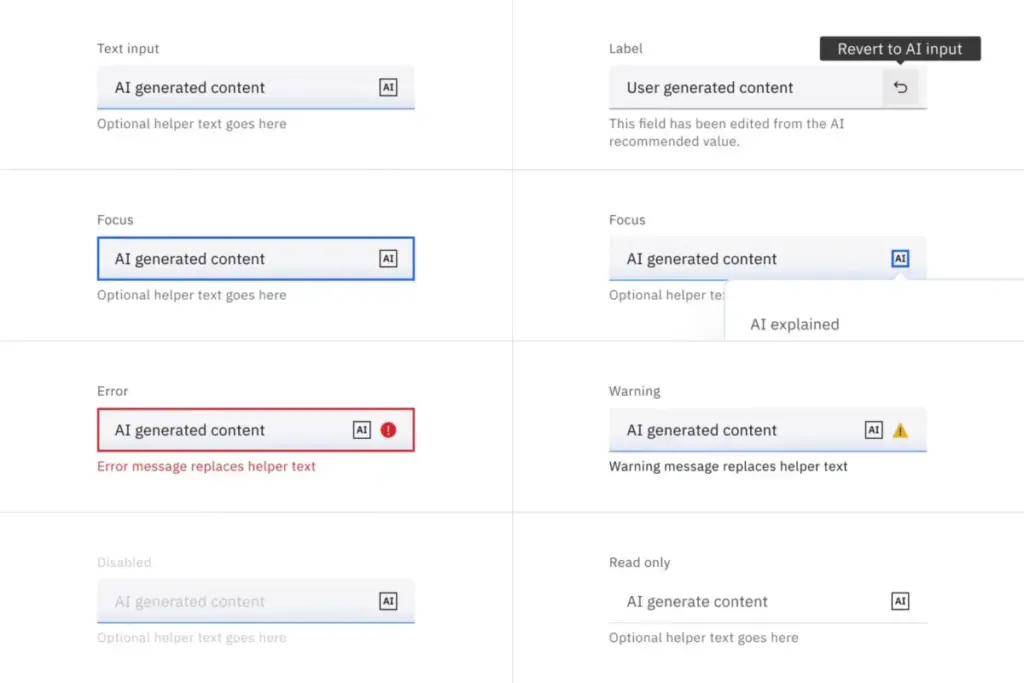
As part of its broader Code of Practice, the European Commission has introduced an official EU AI icon set. This includes a standardized, highly specific "AI mark"—similar to structured patterns found in enterprise design systems like Carbon—rather than the generic multi-point sparkle symbol that numerous tech products have historically adopted to signify machine intelligence. The regulatory standard dictates that any transparency signal must be clear and distinguishable.

The ubiquitous sparkle icon is increasingly viewed by regulators and UX researchers alike as too ambiguous to reliably signal AI-generated content. Because the sparkle has been widely co-opted to represent general "AI-powered features"—such as an intelligent sidebar or a predictive text button—it fails to clearly communicate whether a specific piece of content on the screen was actually generated by an algorithm. That exact ambiguity is what the EU guidelines aim to eliminate.
The European Commission has made it clear that simply dropping an icon onto a page does not establish legal compliance by itself. A barely legible icon, a subtle disclosure note buried deep in a website footer, or a label that flashes for a brief moment before disappearing will fail regulatory scrutiny. Compliance requires icons to be clearly visible, paired with plain-language text such as "AI-generated," and made fully accessible to assistive technologies. Crucially, these markers must persist even when the underlying asset is downloaded, shared, or republished across external platforms.

A Global Regulatory Pattern
While European digital regulations often feel like isolated administrative burdens to international technology companies, the EU AI Act is part of a much broader global legislative movement. Similar transparency obligations, synthetic media restrictions, and disclosure mandates have emerged rapidly across various international jurisdictions. These legislative actions reflect a broader regulatory pattern rather than an isolated coincidence. Organizations shipping software, marketing campaigns, or AI-driven features globally must evaluate their compliance strategies across multiple markets concurrently.
These emerging international rules generally focus on preventing consumer deception in areas like synthetic human performers, political advertising, and high-stakes commercial claims. Despite regional variations in scope, the underlying philosophy is remarkably consistent across borders. When artificial intelligence generates content that can easily be mistaken for human creation, creators and deployers must say so explicitly, unambiguously, and clearly. Interface elements that rely on automated generation must disclose their nature to the end user.

Ultimately, these transparency mandates are designed to help everyday consumers navigate the digital landscape, separating authentic human craftsmanship from unverified automated output. Far from signaling an insurmountable regulatory hurdle, the rules encourage clearer design practices that benefit both creators and audiences alike.