









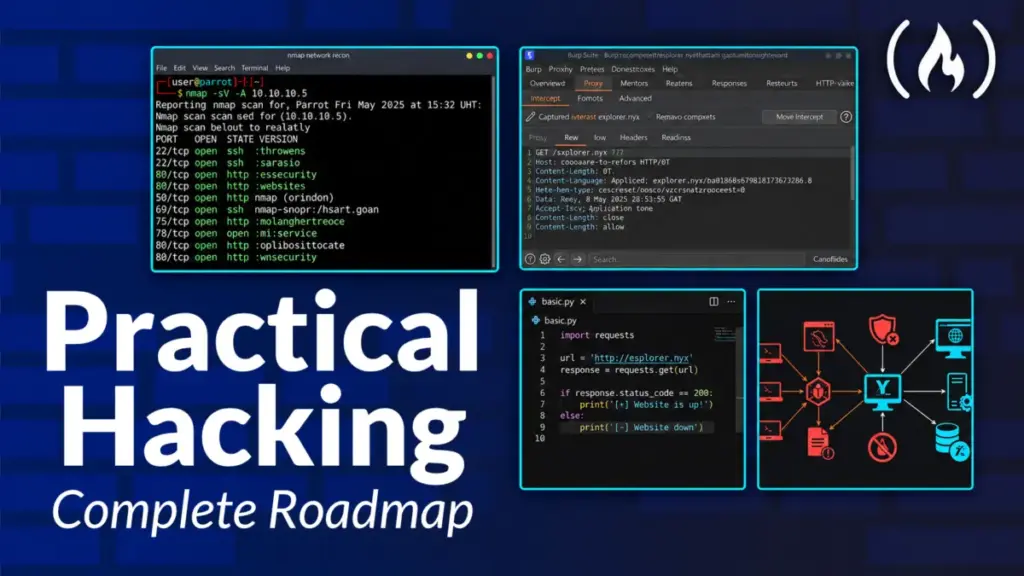
Understanding how malicious actors infiltrate corporate networks and digital infrastructure remains one of the most effective strategies for defending modern systems against sophisticated cyber threats. To help software developers, system administrators, and aspiring security professionals learn the fundamentals of offensive security legally, safely, and from the ground up, freeCodeCamp.org has announced the release of a new, comprehensive educational resource. The organization has published a two-and-a-half-hour crash course titled How Ethical Hackers Actually Break Into Systems directly to its widely followed YouTube channel.
The educational video is taught by cybersecurity instructor Declan Middleton, who brings practical, hands-on experience to the digital classroom. Designed for individuals who want to move beyond theoretical concepts and gain actionable skills in cybersecurity, the course provides a thorough walkthrough of the methodologies and techniques utilized by penetration testers and ethical hackers. By operating within controlled environments, learners can observe and execute the exact phases an attacker takes when evaluating a network or application for security weaknesses.
In the rapidly evolving landscape of information technology, the boundary between building software and securing it has grown increasingly thin. Security experts frequently emphasize that developers who understand how vulnerabilities are exploited write inherently more resilient code. However, finding structured, legal, and accessible pathways to learn offensive security can often prove challenging for newcomers who lack formal training or institutional access. The freeCodeCamp crash course aims to bridge this gap by offering a guided introduction to the foundational pillars of ethical hacking, completely free of charge.

Throughout the intensive video session, Middleton guides viewers through a carefully structured sequence of procedures that mirror real-world security assessments. The curriculum begins with the fundamentals of terminal navigation, ensuring that students who may be entirely new to command-line interfaces feel comfortable executing essential commands. From there, the course transitions into target reconnaissance, teaching learners how to gather intelligence about a system before attempting any form of interaction. Reconnaissance is a critical phase in both authorized penetration testing and unauthorized cyber attacks, as it allows security analysts to map out the digital terrain and identify potential entry points, running services, and architectural configurations.
Following the reconnaissance phase, the curriculum shifts its focus toward vulnerability assessment. Students learn how to analyze the gathered data to pinpoint specific flaws, outdated software components, or misconfigurations that could be leveraged by an adversary. The course then delves into web exploitation techniques, examining common security vulnerabilities that frequently affect modern web applications. By understanding how these flaws manifest in code and how attackers manipulate input fields, parameters, and application logic, learners gain a clearer perspective on how to remediate such vulnerabilities in their own development projects.
A significant portion of the crash course is dedicated to automation scripting. In professional cybersecurity engagements, efficiency is paramount, and repetitive tasks are routinely automated using scripting languages to save time and uncover deeper insights. Middleton demonstrates how automation plays a role in the broader scope of ethical hacking, equipping students with the mindset needed to streamline their security testing workflows.
Crucially, all of these concepts are demonstrated against a dedicated Capture The Flag virtual machine. CTF environments are widely recognized within the cybersecurity community as safe, gamified, and highly effective platforms for practicing technical skills. By utilizing a dedicated virtual machine, learners can follow along with the instructor step by step, testing their newly acquired techniques in an isolated lab environment without risking damage to production systems or violating legal boundaries. This hands-on approach ensures that the knowledge imparted during the video is not merely theoretical, but immediately applicable and reinforced through active practice.
The release of this crash course aligns with freeCodeCamp’s broader mission to make technical education accessible to everyone, regardless of their financial background or geographic location. Over the years, the open-source learning platform has expanded its curriculum far beyond basic web development, encompassing data science, machine learning, information security, and various other technical domains. Millions of learners worldwide utilize freeCodeCamp’s resources to build foundational skills, transition into new careers, or enhance their existing professional capabilities.
The cybersecurity industry continues to face a significant talent shortage, with organizations across all sectors struggling to recruit qualified professionals capable of defending against increasingly complex cyberattacks. Educational initiatives that lower the barrier to entry for aspiring security analysts and software developers play a crucial role in addressing this workforce gap. By providing high-quality, practical training on core offensive security concepts, resources like Middleton’s crash course empower a new generation of technologists to approach software development and network administration with a security-first mindset.
The full tutorial is currently available for streaming on the freeCodeCamp.org YouTube channel. Viewers interested in setting up their own isolated labs and practicing ethical hacking techniques from scratch can access the complete video, which runs for approximately two and a half hours, directly through the platform’s online library.