








The architecture of modern language models has long been dominated by autoregressive token generation, a paradigm that, while powerful for creative writing and conversational tasks, introduces significant computational bottlenecks. When engineers need a machine learning system to execute a structured classification, parse an intent, or make a routing decision, traditional models are often forced to generate text sequentially, token by token. This process is notoriously slow and memory-intensive, consuming valuable computing resources for tasks that ultimately require little more than a single label or a binary choice.
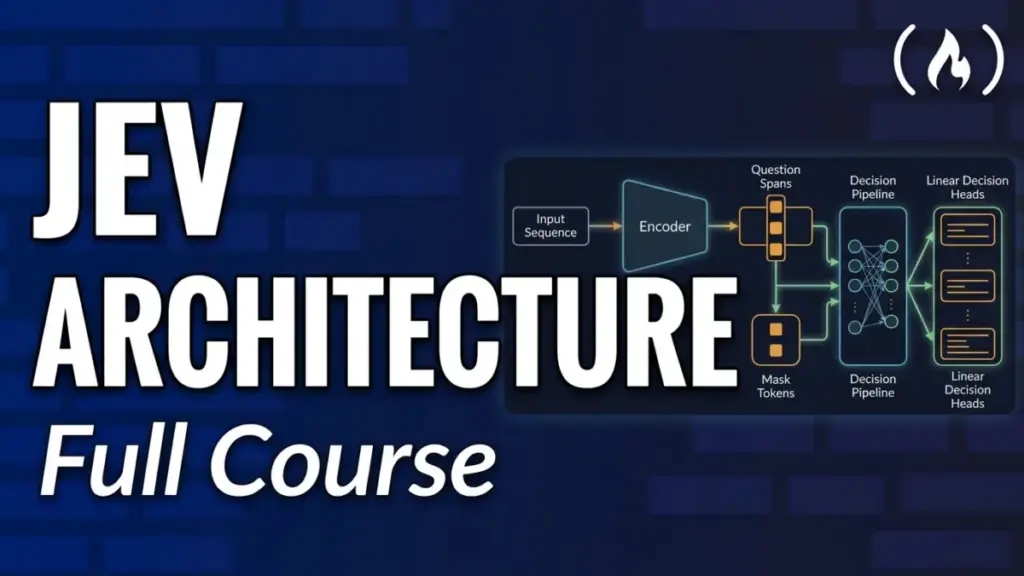
To address these inefficiencies and provide developers with alternative pathways for high-speed computation, educational platform freeCodeCamp has released a comprehensive new educational resource. The organization published a dedicated program titled the Jev Course: Prefill-Only Inference and Decision Models from Scratch, designed to help software engineers and machine learning practitioners bypass the traditional autoregressive generation bottlenecks that plague modern language processing workflows.
The newly released PyTorch guide focuses on constructing specialized, decision-oriented architectures that eliminate the generation phase entirely. Instead of waiting for a model to produce sequential outputs, these architectures process inputs completely within the initial prefill stage, radically accelerating inference times for classification and decision-making tasks. By shifting the operational paradigm away from autoregressive token generation, developers can achieve unprecedented throughput for routing engines, data pipelines, and automated categorization systems.

The Bottleneck of Autoregressive Generation
To understand the significance of prefill-only inference, it is necessary to examine how standard large language models operate. During standard inference, a model processes an input prompt in what is known as the prefill stage, computing the key-value caches for the entire input sequence in parallel. Once this initial phase is complete, the model transitions to the generation stage, producing tokens one by one in an autoregressive loop. Each newly generated token must be appended to the context window, requiring repeated memory bandwidth accesses and serial processing steps.
For applications requiring nuanced text synthesis, such as drafting emails, writing code, or holding open-ended conversations, this serial generation phase is unavoidable. However, a vast class of enterprise software tasks utilizes language models merely as advanced decision engines. Systems that route customer support tickets, classify incoming security alerts, extract structured metadata from raw text, or determine API endpoints based on natural language queries do not need to generate paragraphs of prose. They require a definitive classification or a structured routing decision.
Forcing an autoregressive model to generate text for these tasks results in wasted computational cycles and high latency. Memory bandwidth limitations frequently become the primary performance bottleneck, severely restricting the number of requests a server can handle per second. By bypassing the generation stage entirely and extracting decisions directly from the prefill computations, engineers can dramatically reduce latency, lower operational costs, and streamline deployment architectures for high-throughput production environments.
Building Decision-Oriented Architectures from Scratch
The newly launched curriculum provides a deep technical dive into constructing these streamlined pipelines using PyTorch, one of the most widely adopted deep learning frameworks in the research and engineering communities. Rather than relying on pre-packaged, high-level abstractions that obscure underlying mechanics, the instructional material guides learners through building optimized decision-making models from the ground up.
This foundational approach ensures that developers gain a thorough understanding of tensor operations, attention mechanisms, and architectural modifications required to tailor neural networks specifically for prefill-only execution. By examining the mechanics of the transformer stack during the initial processing phase, practitioners learn how to capture semantic intent and classification boundaries without ever invoking the downstream token generation loops.
The release aligns with a broader industry trend toward specialization in machine learning hardware and software. As organizations increasingly deploy artificial intelligence systems at scale, the economic and latency pressures of serving general-purpose models for narrow tasks have become unsustainable. Specialized architectures, distilled models, and optimized inference pipelines are rapidly becoming standard tools for engineering teams seeking to balance performance, accuracy, and infrastructure expenditure.
Optimizing Custom Machine Learning Workflows
The availability of the Jev course offers developers an accessible pathway to integrate these advanced optimization techniques into their own custom workflows. Because the curriculum emphasizes building from scratch, engineers gain the flexibility to adapt the architectural patterns to specific domain requirements, whether that involves optimizing a proprietary document-processing pipeline or building a high-frequency intent-recognition system.
The comprehensive video resource, spanning approximately two hours of technical instruction, is now available for public viewing on YouTube. Through detailed code walkthroughs and architectural explanations, the material bridges the gap between theoretical transformer research and practical systems engineering.
As the machine learning ecosystem continues to mature, innovations that decouple task requirements from legacy generative paradigms will play a critical role in scaling intelligent applications. By equipping developers with the knowledge to implement prefill-only inference and decision models, resources like the freeCodeCamp course contribute to the ongoing evolution of efficient, high-performance artificial intelligence infrastructure.