










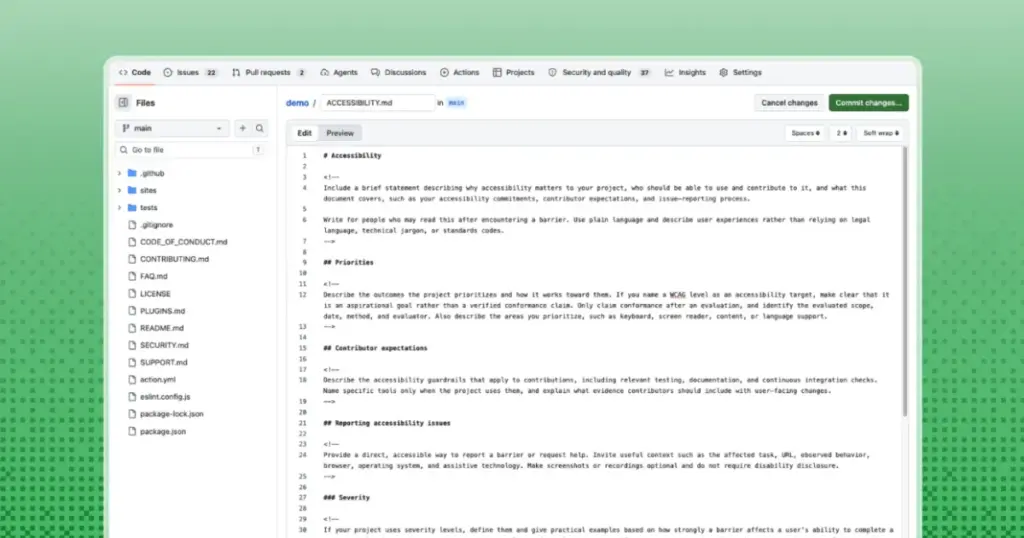
In a significant move to improve the inclusivity of the open-source ecosystem, GitHub has announced native support for ACCESSIBILITY.md files. This update allows project maintainers to centralize critical accessibility information, making it easier for users to identify project goals, known limitations, and reporting procedures. By providing a dedicated, durable home for these documents, GitHub aims to shift accessibility from a fragmented afterthought to a core component of project management and community standards.
For years, accessibility documentation in open-source software has existed in a state of professional limbo. Information regarding screen reader compatibility, keyboard navigation, or known UI barriers has typically been scattered across disparate issue trackers, buried in lengthy contribution guidelines, hidden within audit reports, or locked away in the tacit knowledge of long-term maintainers. When this information lacks a predictable location, users encountering accessibility barriers are forced into a difficult and often discouraging search process. Furthermore, as projects change hands and contributors move on, the institutional knowledge surrounding a project’s accessibility status often erodes, leading to regression and a loss of momentum.
The introduction of the ACCESSIBILITY.md file addresses this by giving every project a standardized, highly visible space to communicate its current accessibility posture. GitHub now recognizes this file when placed in a repository’s root, its .github/ directory, or its docs/ directory. Furthermore, the platform allows for the inheritance of accessibility statements from an organization-level .github/ repository, ensuring that large organizations can set consistent standards across dozens or hundreds of individual projects.

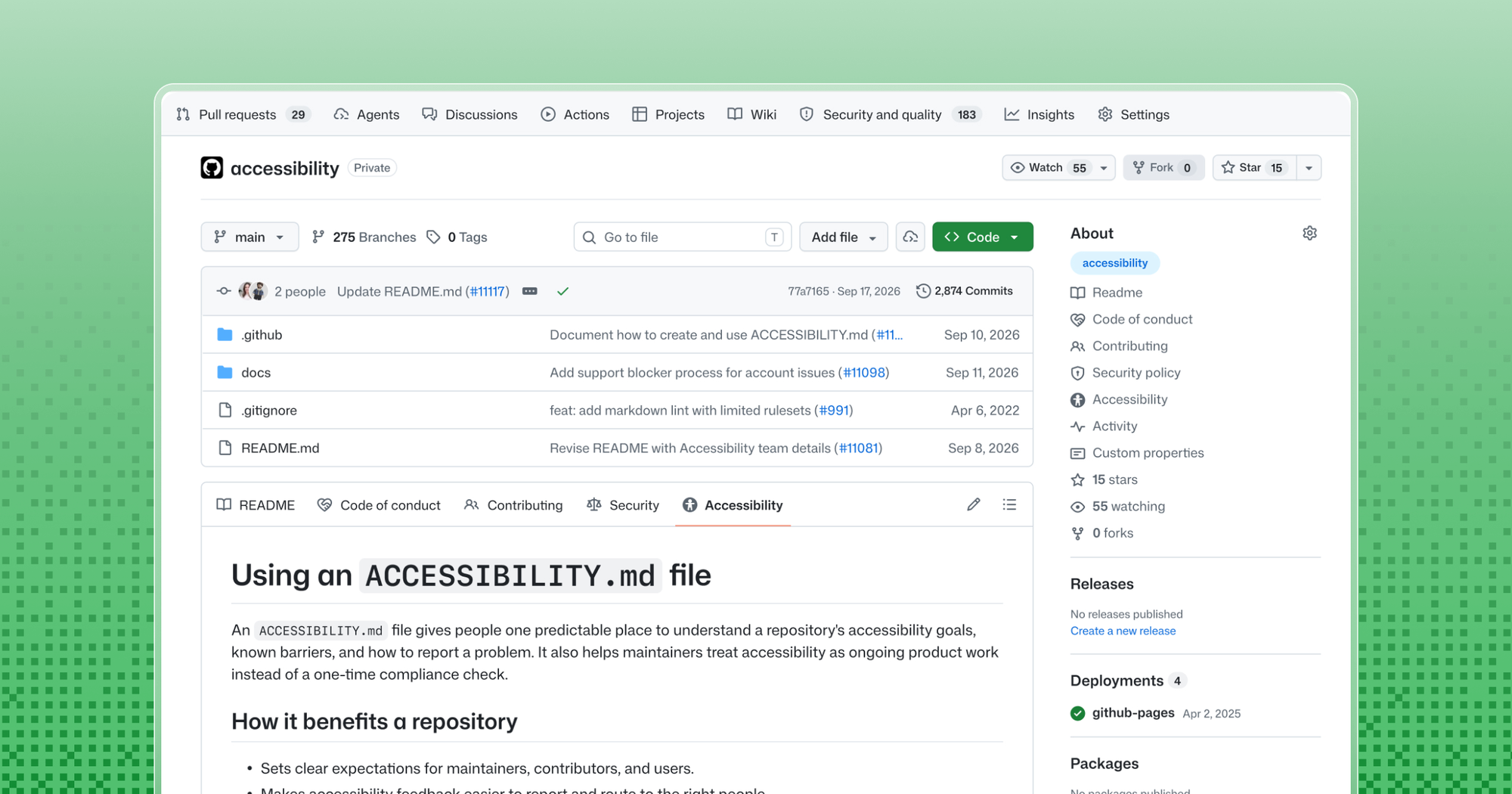
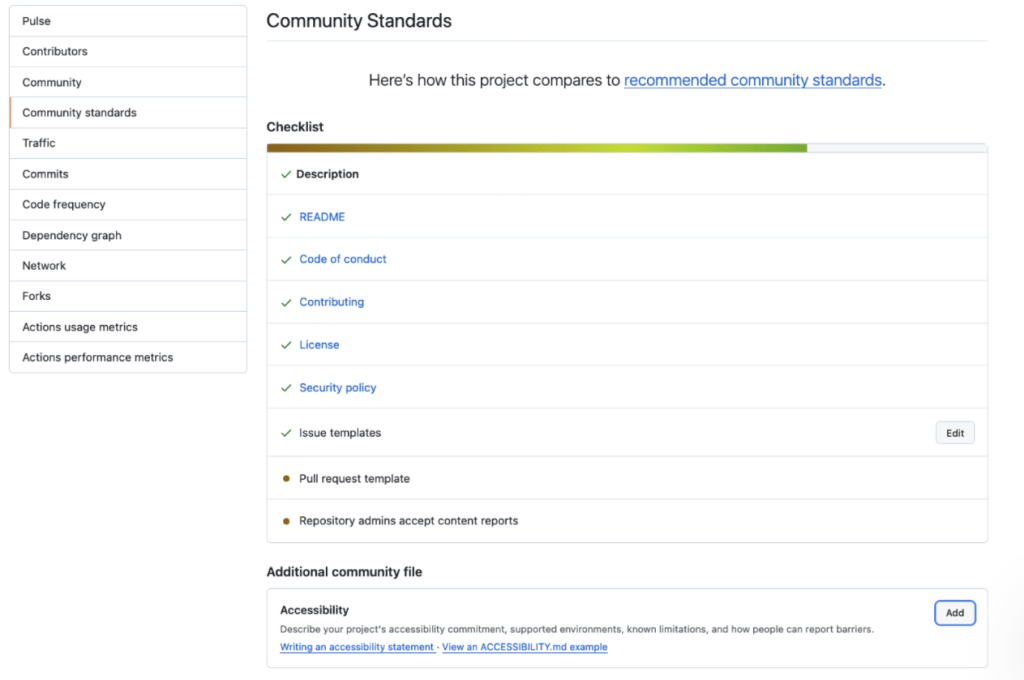
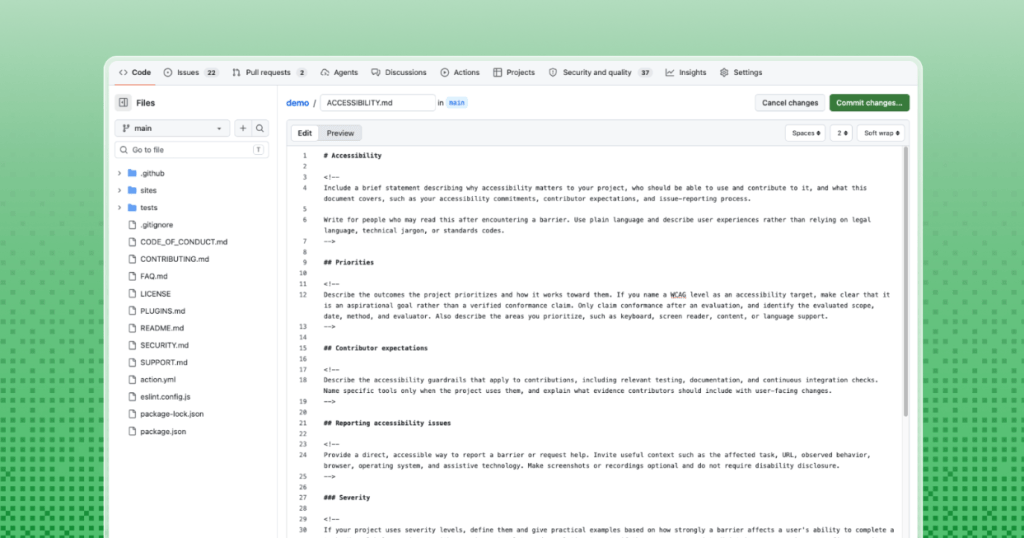
For maintainers, the process of creating this documentation has been streamlined. Public repository owners can now navigate to the "Insights" tab, select "Community Standards," and utilize a new, concise starter document to generate their initial accessibility statement. This workflow integrates seamlessly with existing community health practices, placing accessibility documentation alongside established files like README.md, CODE_OF_CONDUCT.md, and CONTRIBUTING.md. To further assist in managing these efforts, GitHub now includes an accessibility issue label by default in all new repositories, providing a consistent mechanism for tracking reports, audits, and remediation tasks.
The utility of these statements is perhaps best illustrated by the real-world examples already emerging on the platform. The GitHub CLI team, for instance, has implemented an ACCESSIBILITY.md file that directly addresses the challenges users may face when navigating command-line output with assistive technologies. By documenting that table-based output can be difficult for screen readers to parse, the team provides a specific, actionable workaround: a command flag that reformats pull request data into a linear, more accessible list. Crucially, the document also sets clear expectations for contributors, asking that any changes to CLI prompts or output formats be validated with accessibility settings enabled. This creates a bidirectional benefit: users gain immediate, practical help, while contributors gain clear guidance on how to maintain that accessibility moving forward.
Similarly, the GitHub Annotation Toolkit has utilized this new feature to address the inherent limitations of its visual-heavy Figma library. Because the library relies on spatial relationships, such as canvas positioning and connecting lines, to convey meaning, it presents a significant hurdle for users who cannot rely on visual cues. The project’s accessibility statement acknowledges this limitation transparently and provides a concrete alternative for collaborators: the requirement to provide structured text descriptions for each annotated element. This documentation does more than just identify a problem; it provides a roadmap for how developers should handle design handoffs, ensuring that accessibility is considered at the very beginning of the development lifecycle.
These examples underscore a vital reality of open-source development: there is no one-size-fits-all approach to accessibility. A small, independent library, a sprawling web application, and a documentation-heavy site each face different risks, user bases, and maintenance capacities. GitHub’s design philosophy for the ACCESSIBILITY.md file reflects this, avoiding rigid templates in favor of flexibility. The platform encourages maintainers to start with accurate, honest information that they can realistically keep current.
A common pitfall in accessibility documentation is the tendency to conflate "targets" with "conformance." GitHub’s guidance clarifies this distinction: while a project may define its goals in terms of specific Web Content Accessibility Guidelines (WCAG) versions and levels, simply naming a standard does not constitute a verified conformance claim. A legitimate conformance claim requires a rigorous evaluation process that identifies the specific scope, date of testing, the methodology employed, and the evaluator. By encouraging projects to name their gaps and document what they can maintain rather than promising impossible perfection, GitHub is fostering a culture of transparency that is more sustainable than one built on aspirational but unverified compliance claims.
The most effective accessibility statements are those designed for users who have already encountered a barrier. When a user is struggling to interact with a tool, they need clear, plain language, direct links, and a straightforward path to report their experience. The documentation should focus on the essentials: what is the nature of the barrier, what environment (browser, OS, assistive technology) is being used, and what specific task was being attempted. By making screenshots and recordings optional and explicitly avoiding any request for users to "prove" their disability, projects can cultivate a more welcoming and respectful reporting process.
Equally important is the need for maintainers to set expectations that they can reliably meet. A well-constructed accessibility statement should outline what a reporter can expect once they submit an issue, including timelines for acknowledgement, the potential for status updates, and opportunities for the reporter to verify any subsequent fixes. This level of communication builds trust within the community and ensures that accessibility work is viewed as an ongoing, iterative process rather than a one-time audit.
For projects looking for a starting point, the Open Source Accessibility Toolkit offers a robust example of a detailed, comprehensive accessibility statement. However, for most projects, the goal should be to start small and iterate. The starter templates provided in the GitHub Community Standards workflow are designed to be adapted, allowing maintainers to replace boilerplate text with project-specific details as their accessibility practices mature.
By normalizing the inclusion of accessibility statements across the open-source ecosystem, GitHub is attempting to move the needle on digital inclusion. When accessibility information is discoverable, it changes the way communities plan their work, build their features, report their bugs, and ultimately improve their software. As Jan Maarten, an accessibility specialist at GitHub, notes, this initiative is about bridging the gap between design and engineering to create resources that serve the wider community. As more projects adopt these practices, the barrier to entry for users with disabilities will continue to lower, ensuring that the fruits of open-source innovation remain accessible to everyone, regardless of how they interact with technology.