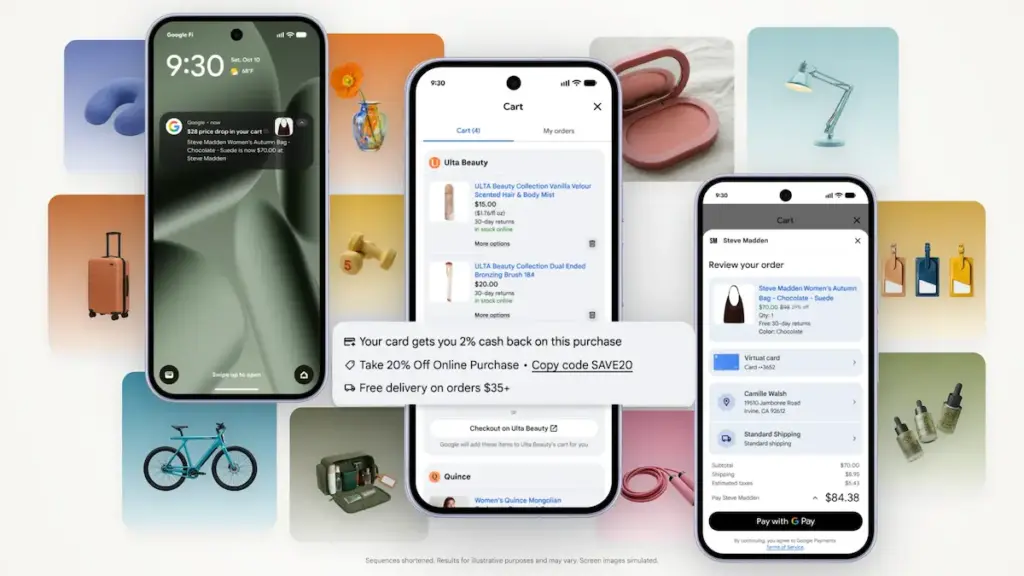
Google officially expanded its footprint in the e-commerce sector on Thursday, announcing the U.S. launch of "Universal Cart." The tool, which was first teased during the Google I/O developer conference in May, is designed to act as a centralized hub for consumers to monitor and manage products discovered across various Google services, including Search and the Gemini app. By aggregating shopping interests into a single, cohesive interface, Google aims to reduce the fragmentation that often plagues the modern online shopping experience.
The core premise of Universal Cart is to alleviate the "tab fatigue" and memory burden often associated with browsing for products across multiple retailers. In the current digital landscape, a shopper might start their journey on a social media platform, move to a search engine, and eventually land on several disparate retail websites. Keeping track of these potential purchases—and remembering why they were saved in the first place—can become a chore. Google’s new tool allows users to save items from across the internet into one persistent cart. When a user returns to Google later, their items and overall shopping progress are preserved, eliminating the need to re-search for products or navigate back to the original retail pages to confirm details. By acting as a central dashboard, Universal Cart simplifies the browsing process, essentially creating a persistent "wishlist" that bridges the gap between discovery and checkout.
Beyond simply acting as a bookmarking service, Universal Cart is integrated with proactive monitoring features designed to assist users in making informed purchasing decisions. Google has equipped the tool to track price fluctuations and inventory status, sending automated notifications to users when the price of a saved item drops or when an out-of-stock product returns to the shelves. This functionality moves the shopping experience from a passive, manual process to a more proactive, assistant-led workflow.

Furthermore, the tool is designed to leverage Google’s vast data ecosystem to provide personalized shopping guidance. This includes analyzing a user’s saved payment methods to account for specific credit card perks—such as cash-back offers or point-multipliers—that might influence which card is optimal for a particular purchase. Additionally, the tool is capable of surfacing relevant promotional codes, potentially saving users money without requiring them to visit third-party coupon websites.
The underlying infrastructure that powers this seamless transition from browsing to purchasing is Google’s Universal Commerce Protocol (UCP). Introduced earlier this year as an open standard, UCP is designed to serve as the connective tissue between AI agents and retailers. In the context of e-commerce, the protocol standardizes how information is exchanged, ensuring that AI-driven tools can interact with a retailer’s backend systems to facilitate transactions more effectively. By utilizing UCP, Google aims to foster an ecosystem where the shopping journey—from the initial query to the final checkout—is fluid and interoperable, regardless of the specific retailer involved.
The introduction of Universal Cart is the latest step in Google’s broader strategy to integrate artificial intelligence into every facet of the consumer shopping journey. The company has been aggressively developing "agentic" shopping tools, which are designed to act on behalf of the user rather than simply providing a list of links. This includes conversational product discovery within Search’s AI-powered modes, which allow users to refine their shopping queries through natural language. Another notable effort in this space is the "Let Google Call" tool, an AI-driven feature that autonomously contacts local physical stores to verify if a specific item is in stock, sparing the user from making multiple phone calls themselves.
However, Google is far from alone in its pursuit of AI-integrated commerce. The race to capture the "agentic" shopping market has intensified as major technology companies look for ways to make their generative AI models more utility-focused. Amazon, for instance, has been actively developing AI agents capable of navigating third-party stores to complete purchases for users, signaling an ambition to maintain its dominance in e-commerce by evolving its storefront into a more interactive, intelligent platform. Similarly, OpenAI has been working on its own agentic shopping systems, aiming to leverage the conversational capabilities of models like GPT to compete directly with search-engine-based shopping experiences.
These moves represent a significant shift in how tech giants view the role of the chatbot. For years, the primary goal of AI development in consumer tech was to provide better answers to questions. Now, the focus has shifted toward "agentic" behavior—the ability of an AI to perform multi-step tasks across different websites, platforms, and services. As these companies refine their agents, the competition will likely center on which platform can provide the most frictionless experience, the most accurate price data, and the most reliable checkout process.
For Google, Universal Cart serves as a strategic bridge. By keeping users within its ecosystem for the duration of the research and monitoring phase, Google ensures it remains a vital touchpoint in the consumer journey, even if the final transaction eventually occurs on a retailer’s own site. The reliance on the open-standard UCP also suggests a desire to build a broader coalition of retailers willing to participate in this AI-led future, which could be critical for the tool’s long-term success.
The integration of these features into the Gemini app and Search highlights how Google plans to leverage its existing user base to drive adoption. As consumers become accustomed to using AI to research products, the expectation for a "one-click" or "centralized" experience is likely to grow. Google’s bet is that by solving the fragmentation problem through a centralized cart and automated deal-tracking, it can capture a larger share of the intent-based traffic that drives modern retail.
While the current launch is limited to U.S. users, the rollout of such a significant tool signals a shift in the standard expectations for online commerce. If successful, the Universal Cart could standardize the way consumers interact with the web, turning the open, decentralized nature of the internet into a more curated, managed experience. For retailers, the challenge will be to adapt to this new layer of intermediation, ensuring their products remain visible and easily accessible to these AI agents while maintaining control over their own brand and checkout experience.
As the industry moves toward this new era of agentic commerce, the battle lines are being drawn between the major platform holders. Whether consumers will ultimately prefer a shopping experience mediated by an AI agent—one that tracks their preferences, manages their carts, and seeks out the best deals across the entire web—remains to be seen. However, with the launch of Universal Cart, Google has made its intentions clear: it plans to be the primary interface through which the next generation of online shopping is conducted.
The ongoing development of these tools underscores a broader trend in the tech industry, where the value of a platform is increasingly determined by its ability to perform tasks on behalf of the user. As AI models become more capable of navigating the complex, often messy infrastructure of the internet, the line between a search engine and a personal shopping assistant continues to blur. For now, Google is positioning Universal Cart as the solution to the friction of modern retail, offering a glimpse into a future where the internet acts less like a library of links and more like a single, responsive marketplace.