









Readers visiting Opensource.com lately may have noticed a distinct quietness across the platform. After twelve years of continuous publication under the umbrella of a corporate supporter, the prominent hub for open-source stories, advocacy, and community discussion is preparing for a significant transition. While concrete details regarding the upcoming project remain under wraps, community members and contributors have plenty to discuss as the platform gears up for a major evolution.
To understand the magnitude of this upcoming shift, one has to look back at the fundamental nature of the internet itself, how networks are structured, and what open source truly represents at its core. Starting this new chapter requires looking at the broader digital landscape and the very fabric of how people connect online—beginning with the entire internet.
The Internet, and Top-Level Domains
To appreciate where Opensource.com is heading, it is helpful to examine where the digital world began. Most internet users know that the internet is, fundamentally, a network. By definition, a network is simply a group of connections linked together to share information. In fact, the word "internet" is a portmanteau combining "interconnected" and "network."

In its earliest days, the internet was a much smaller, more restricted entity. It originally consisted of just two primary networks: a military network designed for resilient defense communication and an academic network intended for research institutions to share data. As digital technology advanced and personal computing began to take off, the internet expanded rapidly beyond those two initial groups.

As the network grew to encompass society at large, it quickly became apparent that different designations were necessary to organize and differentiate various types of entities inhabiting the digital space. For example, users needed a way to instantly tell the difference between a commercial business entity, a charitable organization, a university, or a governmental department.
These organizational designations are formally known as top-level domains, or TLDs. Today, internet users can choose from a vast and diverse array of TLDs reflecting every imaginable niche, geographic region, and industry. However, for a long time during the web’s formative years, there were only a handful of available options.
Those original top-level domains remain remarkably popular and culturally embedded in the architecture of the web. Most internet users intuitively understand their distinctions. When navigating to an address ending in .com, for instance, visitors instantly recognize that they are visiting a commercial site meant for business. Conversely, when visiting an address ending in .org, users know they are interacting with a non-profit organization dedicated to a cause, community, or public interest. These suffixes act as digital signposts, immediately communicating the intent, structure, and backing of the organization behind the screen.
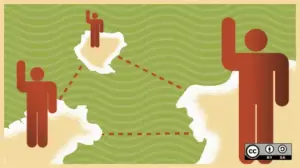
Open Source Is a Network
The concept of a network extends far beyond technical cables, servers, and domain suffixes. Open source, in all its various manifestations, is itself a deeply collaborative network. Open source can take many different forms depending on the context in which it is applied. It can be commercial, driving enterprise software and modern corporate infrastructure. It can be non-profit, fueling public interest technology and digital rights advocacy. It can be academic, supporting university research and scientific discovery. It can also be cultural, shaping how creators share art, writing, and media.

No matter what form it ultimately takes or what industry it serves, open source is always fundamentally a network. Sometimes, that network consists of computers exchanging data packets across vast distances, but that is merely the technical scaffolding. More importantly, open source is a network of people.
Human connection is the beating heart of the open-source movement. Whether individuals are gathering in person at a massive international conference, chatting over drinks at a local pub, or collaborating asynchronously in an online chat room, open source is, at its core, a community of living, breathing people working toward common goals.
For the past twelve years, the website Opensource.com has been supported by a commercial entity, providing a steady platform for publishing stories about creating, adopting, and sharing open source solutions. Yet, a crucial distinction lies in the makeup of the ecosystem. The people—meaning the writers, editors, developers, advocates, and readers who make up the Opensource.com community—are not commercial entities. They are individuals, driven by curiosity, a passion for collaboration, and a belief in the power of shared knowledge.
The upcoming transition aims to better align the platform with the organic, human-centric nature of the community it serves. While specific announcements are still forthcoming, the shift promises to resolve the recent quietude on the site. In just one month, Opensource.com is set to resolve that long-standing bug and unveil what the community has been working on behind the scenes. Stay tuned for further updates as the next chapter of the platform begins to unfold.