Large language models have established themselves as remarkable text generators across industries, yet they remain fundamentally constrained by a well-documented vulnerability: the tendency to hallucinate. Without immediate access to verified, up-to-date information, these models often produce plausible-sounding answers that are factually incorrect. To combat this limitation, Retrieval-Augmented Generation, commonly known as RAG, emerged as the industry standard. By grounding model outputs in external knowledge sources, RAG dramatically reduced hallucinations, unlocking widespread adoption for enterprise applications, customer service bots, and internal document search tools.
However, as organizations push these artificial intelligence systems into increasingly complex workflows, a new operational bottleneck has surfaced. Standard RAG pipelines are inherently linear, executing a single retrieval pass, passing those results directly to the model, and generating a final answer. While this approach functions effectively for simple queries with well-structured knowledge bases, it begins to fracture when confronted with complex scenarios. When a query demands multi-step reasoning, cross-referencing multiple disjointed sources, or synthesizing information that simply does not exist within a single document, the traditional pipeline falters.
This architectural limitation has driven the rise of Agentic RAG. Rather than treating retrieval as a single, fixed procedural step, this advanced paradigm grants the system the autonomous capacity to reason about how to search, evaluate the relevance of what it uncovers, and iterate continuously until it arrives at a comprehensive and verified answer. Industry experts, including AI educator Vinod Chugani, have highlighted the shift from rigid pipelines to adaptive loops as a defining evolution in how enterprises deploy language models for high-stakes tasks.
The Baseline: Understanding Naive RAG
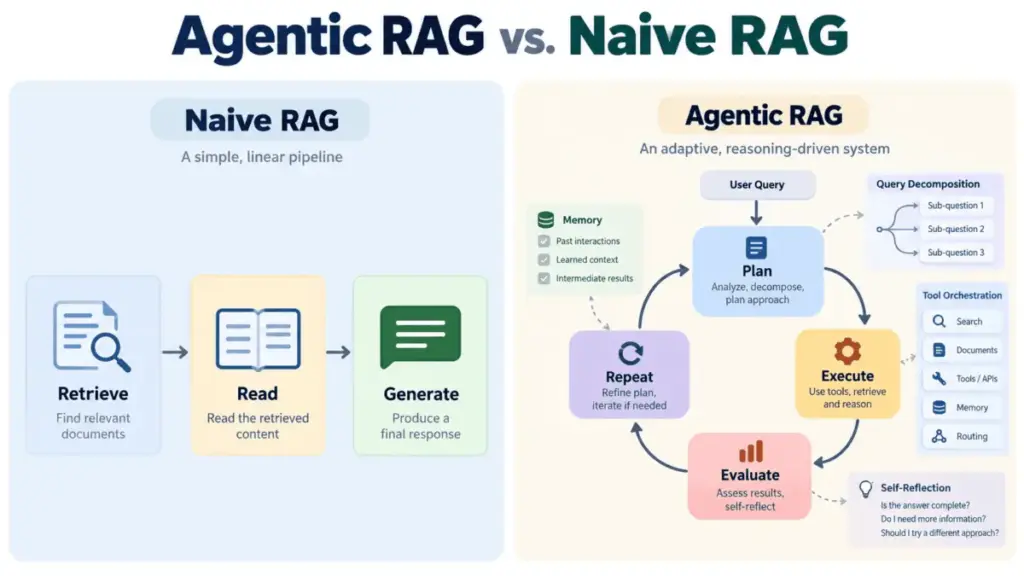
Before examining the trajectory of modern retrieval systems, analysts emphasize the importance of understanding the baseline architecture where the technology originated. Naive RAG, frequently referred to as standard RAG, follows a rigid, three-stage pipeline consisting of retrieval, reading, and generation. In this setup, a user submits a query, the system transforms it into a vector embedding, and runs a similarity search against a vector database. The system then retrieves the top-k most relevant document chunks and passes them directly to the large language model as context, allowing the model to generate a response based strictly on the provided text.
Industry observers often compare this mechanism to a student preparing for an examination within a vast library by typing a single keyword into a catalog, grabbing the first three books on the shelf, and writing an essay relying exclusively on those materials without checking whether they actually address the core question.
Under the hood, the technical process relies on document ingestion, where large bodies of text are divided into smaller chunks and converted into dense vector representations through specialized embedding models. These vectors are subsequently stored in databases optimized for approximate nearest-neighbor searches. At inference time, the user’s query undergoes the same embedding process, and the database surfaces the chunks whose vectors reside closest in high-dimensional space. These retrieved fragments are then injected into the model’s context window as a reference point.
This mechanism represented a genuine breakthrough for enterprise technology. Naive RAG enabled organizations to construct reliable question-and-answer platforms, internal knowledge assistants, and automated document summarizers that remained anchored in verifiable source materials. For many straightforward applications, this foundational approach remains an efficient and cost-effective choice.
The Bottleneck: Where Naive RAG Breaks Down
Despite its initial success, the architecture suffers from a core vulnerability rooted in its linearity. A single retrieval pass either succeeds or fails. If the initial query is poorly formulated, if the necessary information is scattered across disparate files, or if the correct answer demands multi-step reasoning, the pipeline lacks any mechanism for recovery.
The single-pass limitation means the system gets only one opportunity to fetch relevant data. If the embedding of a user query fails to surface the correct chunks, the language model is forced to generate a response using incomplete or entirely irrelevant context. The system cannot recognize its own retrieval failure, nor can it dynamically alter its search strategy.
This structural weakness becomes glaringly apparent during multi-step reasoning tasks. Consider a complex inquiry such as determining the regulatory policies followed in the European Union by the company that acquired WhatsApp. Answering this accurately requires at least two distinct steps: first identifying the acquiring entity, and second retrieving the specific regulatory framework governing that specific entity within the European Union. A standard vector search targeting WhatsApp European Union regulatory policies directly will frequently fail to establish that connection, particularly if the corporate acquisition history and the regulatory documentation reside in entirely separate corporate repositories. Naive RAG possesses no native capability to decompose this prompt into sequential sub-questions, execute an intermediate retrieval, and apply that finding to a secondary search.
Furthermore, the architecture remains highly susceptible to bad retrieval results. When the top-k retrieved documents prove irrelevant, the language model faces an impossible dilemma. It must either generate a response that ignores its grounding context—thereby triggering hallucinations—or output an honest but unhelpful notification that it lacks sufficient information. In demanding enterprise environments where financial, legal, or operational accuracy is paramount, neither outcome satisfies business requirements.
Agentic RAG: Giving the System a Brain
To overcome these structural roadblocks, Agentic RAG reimagines the retrieval problem from the ground up. Instead of treating the language model as a passive text generator that simply receives context and outputs a response, the agentic framework positions the model as an autonomous reasoning engine that actively orchestrates the entire information-gathering lifecycle.
Where naive implementations function as rigid pipelines, agentic systems operate as dynamic loops characterized by planning, execution, evaluation, and iteration. Returning to the library analogy, a dedicated professional researcher does not merely grab the first three texts and begin writing. Instead, that researcher evaluates initial sources, identifies missing evidence, consults alternative databases, reconciles conflicting claims, and only produces final documentation when fully confident in the completeness of the material. Agentic RAG builds this investigative behavior directly into the artificial intelligence architecture.
In this environment, the language model ceases to be a mere consumer of retrieved context and assumes the role of an orchestrator. It decides what information to seek, where to search for it, whether the initial results meet quality thresholds, and how to proceed if they fall short. This transforms retrieval from a fixed pre-processing step into a continuous, self-correcting operation. While naive systems expose the model to retrieved context exactly once, agentic systems empower the model to reason about the retrieval process itself, determining when enough reliable information has been gathered to generate a trustworthy answer.
Four Mechanisms That Make RAG Agentic
The functional divide between naive and agentic pipelines is defined by the integration of four distinct mechanisms, each engineered to resolve specific failure modes inherent to linear retrieval.
The first mechanism, query routing, acknowledges that not all questions belong to a single data source. While financial inquiries may require structured SQL databases, corporate policy questions often demand semantic search across unstructured document repositories, and current events require live web searches. Query routing equips the system with the ability to determine the optimal search destination before executing any retrieval. The language model analyzes the incoming prompt and selects the appropriate tool or data source from a predefined registry, avoiding the common failure mode of forcing every query through a single retrieval mechanism regardless of fit.
The second mechanism, query decomposition, addresses complex questions that naturally contain multiple sub-questions. An agentic system systematically breaks down the original prompt into smaller, independently addressable components before initiating retrieval. Returning to the corporate acquisition example, the system avoids searching for the entire compound phrase at once. Instead, it first identifies the parent company behind WhatsApp, retrieves that preliminary answer, and subsequently uses that intermediate finding to construct a precise, secondary query regarding regulatory compliance in the European Union. Each sequential answer informs the next search, building toward a comprehensive final response through targeted retrieval chains.
The third mechanism involves self-reflection and critique, representing arguably the most consequential capability in the agentic toolkit. Following retrieval, the system pauses before forwarding results to the generation phase. It evaluates whether the retrieved chunks genuinely answer the query or merely introduce noise. If the model determines that the context is insufficient, contradictory, or off-target, it automatically rewrites the query and initiates a new retrieval pass. This evaluation-and-retry loop continues until the system reaches a satisfying confidence threshold or encounters a predefined iteration limit designed to prevent runaway processing loops. This capability allows the system to intercept retrieval failures in real time rather than silently passing flawed context downstream.
The fourth mechanism centers on tool use and function calling, which expands agentic systems beyond querying static text databases. Through function calling, the language model can invoke external utilities mid-reasoning, such as calculators for arithmetic computations, live web search application programming interfaces for current events, SQL executors for structured datasets, or custom internal application programming interfaces for domain-specific lookups. The model dynamically selects the appropriate tool for each sub-task, merging retrieved text with live computation and structured queries into a unified, coherent response.
Making the Choice: When to Use Which
Organizations evaluating these architectures face a fundamental trade-off between operational cost and analytical capability. Naive RAG relies on a single embedding operation and one language model invocation, resulting in low latency, predictable costs, and straightforward debugging. Conversely, Agentic RAG introduces multiple reasoning steps, each adding computational latency and token consumption. A query that mandates three iterative retrieval passes and multiple tool calls will inevitably incur higher operational costs than a single-pass retrieval.
Industry guidelines suggest deploying naive RAG for high-volume, straightforward applications where domain documents are exceptionally well-structured, queries are simple, and tolerance for minor retrieval imperfections is manageable. Conversely, organizations should deploy agentic RAG when facing complex, multi-hop reasoning tasks, heterogeneous data sources spanning structured and unstructured formats, or high-stakes environments where factual accuracy is non-negotiable.
For many production environments, a hybrid strategy offers an optimal balance. By routing high-volume, simple queries through a fast naive pipeline while reserving resource-intensive agentic loops for complex or high-stakes prompts, enterprises can optimize both performance and cost. As framework documentation matures, understanding the specific operational problem remains the primary key to selecting the appropriate architectural approach for modern artificial intelligence deployments.