







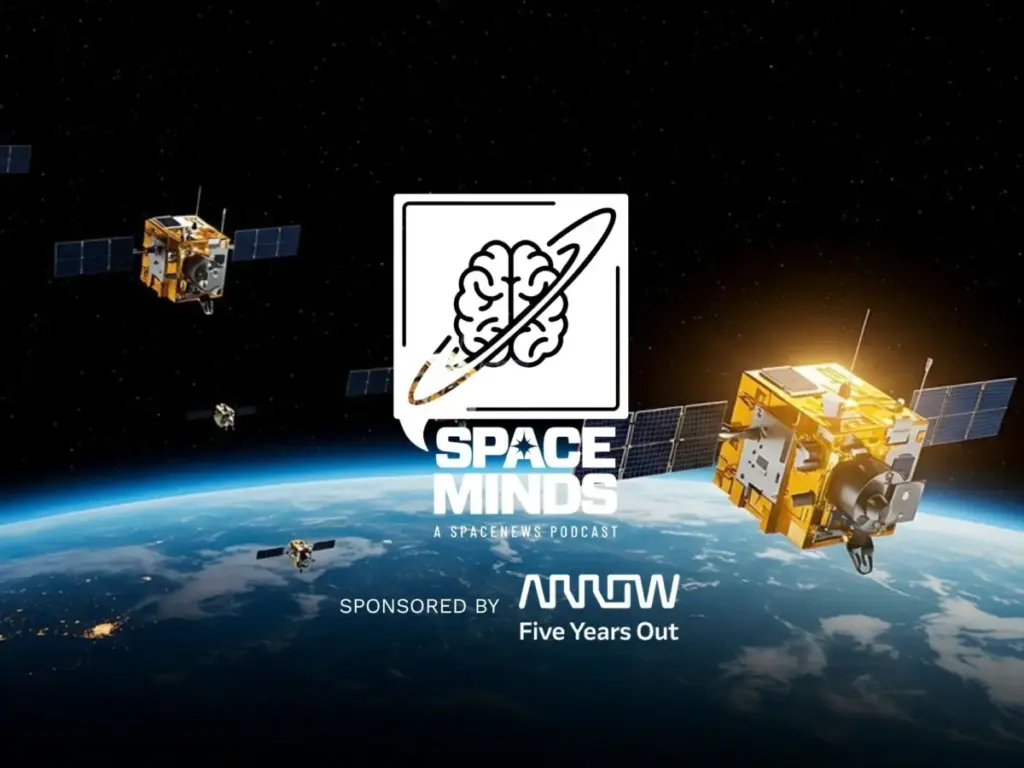
The commercial space industry is undergoing a profound structural and philosophical transformation, driven by an exponential surge in demand for satellite connectivity, the deployment of massive megaconstellations, and the growing necessity for on-orbit artificial intelligence. Traditional approaches to building spacecraft—long governed by extreme risk aversion and multi-year validation cycles—are rapidly giving way to a more pragmatic, agile mindset. This shifting paradigm in aerospace manufacturing, component sourcing, and supply chain management forms the core of the latest discussion featured on Space Minds, a prominent audio and video podcast series produced by SpaceNews.
In a recent episode of the show, SpaceNews journalist Mike Gruss sat down with Ken Stoler, the space business development lead for Arrow Electronics. The conversation offers a deep dive into the modern aerospace landscape, exploring how spacecraft designers and operators have fundamentally altered their attitudes toward risk. Furthermore, the dialogue examines how the relentless push toward large-scale orbital constellations has begun to reshape purchasing behaviors across the entire space supply chain, while shedding light on the unique engineering challenges and constraints involved in integrating high-performance, AI-enabling computing power into orbit.
Shifting Attitudes Toward Risk in Modern Spacecraft Design
Historically, the space sector operated under a zero-failure philosophy. Because launching payloads into orbit was extraordinarily expensive and repairing hardware in space was virtually impossible, every single component used on a satellite had to undergo exhaustive radiation testing, custom manufacturing, and rigorous vetting. This heritage approach, often referred to as high-reliability or "rad-hard" engineering, ensured that spacecraft could survive the harsh vacuum, thermal extremes, and radiation fields of space for decades. However, it also meant that space missions took years to conceptualize, build, and launch, while costing hundreds of millions of dollars per unit.

Today, the emergence of the commercial New Space economy has disrupted this traditional playbook. With the rise of low Earth orbit (LEO) megaconstellations comprising hundreds or even thousands of satellites, operators can no longer afford the time or capital required to build every individual spacecraft as a bespoke masterpiece. Instead, the industry is increasingly embracing a philosophy of managed risk.
As Ken Stoler discussed with Mike Gruss, spacecraft designers are shifting toward a more commercial-off-the-shelf (COTS) mindset. By accepting a slightly higher component failure rate—mitigated by constellation redundancy and shorter satellite lifespans—operators can launch vastly more capable systems at a fraction of the traditional cost. This cultural shift within engineering teams has forced a complete rethinking of how hardware is selected, tested, and integrated into modern space architectures, enabling companies to iterate rapidly and respond to shifting market demands at unprecedented speeds.
The Impact of Megaconstellations on the Space Supply Chain
This evolution in design philosophy has sent shockwaves through the aerospace and defense supply chain, fundamentally altering purchasing behavior. In the past, component manufacturers and distributors dealt primarily with government space agencies and large prime contractors who ordered specialized, low-volume hardware tailored to exacting, proprietary specifications.
The proliferation of commercial megaconstellations has turned this traditional model on its head. Today’s satellite operators demand high-volume availability, supply chain resilience, and the ability to scale production rapidly to support aggressive launch schedules. Component sourcing is no longer just about raw technical performance in a vacuum; it is increasingly about lead times, volume scalability, cost-efficiency, and supply chain predictability.
Companies operating within the electronic components and enterprise computing sectors have had to adapt to these new demands, bridging the gap between traditional high-reliability aerospace standards and the rapid scalability of commercial electronics. This changing dynamic underscores the critical role played by major global distributors who possess the deep technical expertise and extensive product portfolios necessary to help innovators navigate complex supply chain constraints.

Integrating AI-Enabling Computing Power into Spacecraft
Compounding these supply chain and design shifts is the relentless push to bring advanced computing capabilities—particularly artificial intelligence and machine learning—directly onto spacecraft. For decades, satellite data was primarily gathered in orbit and beamed back down to massive ground station networks for processing, analysis, and distribution.
However, as constellations grow in size and the volume of generated data skyrockets, downlink bandwidth has become a critical operational bottleneck. Transmitting raw imagery, hyperspectral data, and telemetry back to Earth requires immense power and spectrum allocation. To overcome this limitation, space operators are increasingly looking to deploy AI-enabling computing power directly on the spacecraft, allowing satellites to process data autonomously at the edge, identify anomalies, filter out unnecessary information, and transmit only actionable intelligence.
While the benefits of on-orbit AI are immense, implementing high-performance computing architectures in space introduces profound engineering challenges and constraints. Spacecraft operate within severely constrained power envelopes, meaning that advanced processors must deliver unprecedented computing performance while consuming minimal electrical energy. Furthermore, thermal management in the vacuum of space is notoriously difficult, as heat cannot be dissipated through convection and must instead rely entirely on radiation and conduction.
Compounding these physical hurdles is the persistent threat of space radiation, which can cause single-event upsets, memory corruption, and permanent hardware damage. Balancing the need for high-powered, data-intensive AI processors with the rigorous demands of spacecraft reliability represents one of the most formidable frontiers in modern aerospace engineering.
About Space Minds and Arrow Electronics
The conversation between Mike Gruss and Ken Stoler is part of Space Minds, an audio and video podcast series created by SpaceNews to highlight the most inspiring leaders, transformative technologies, and emerging commercial opportunities across the global space ecosystem. Released weekly on Thursdays, the podcast features in-depth interviews with industry founders, visionary scientists, and engineering experts, offering listeners a comprehensive look at the news, trends, and innovations shaping the future of space exploration and commercialization.
The series is produced in partnership with Arrow Electronics, a Fortune 500-ranked global provider of electronic components and enterprise computing products. Arrow works alongside thousands of leading manufacturers and service providers to transform technology concepts into market-ready solutions across diverse sectors, including aerospace and defense, artificial intelligence, industrial automation, robotics, and connected devices. By combining deep engineering expertise with comprehensive supply chain services and expansive product portfolios, the company helps innovators accelerate their time to market and overcome complex design challenges.
Listeners and space enthusiasts can access new episodes of Space Minds every Thursday on the SpaceNews website, as well as across major streaming platforms including YouTube, Spotify, and Apple Podcasts.