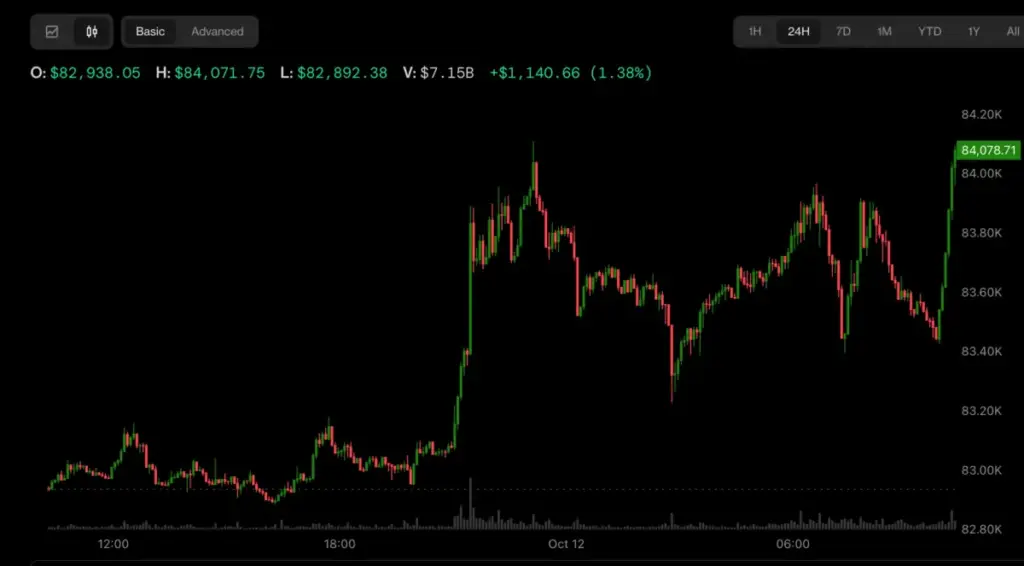
Bitcoin is demonstrating resilience at the start of the week, maintaining its weekend gains and pushing back above the $84,000 threshold. The premier cryptocurrency’s ability to stabilize comes even as the market grapples with a significant wave of capital exiting U.S.-listed spot Bitcoin exchange-traded funds (ETFs). While institutional sentiment appears to be shifting toward caution, the broader crypto market is showing signs of renewed appetite, aided in part by a cooling in energy prices that has provided a brief respite for risk assets.
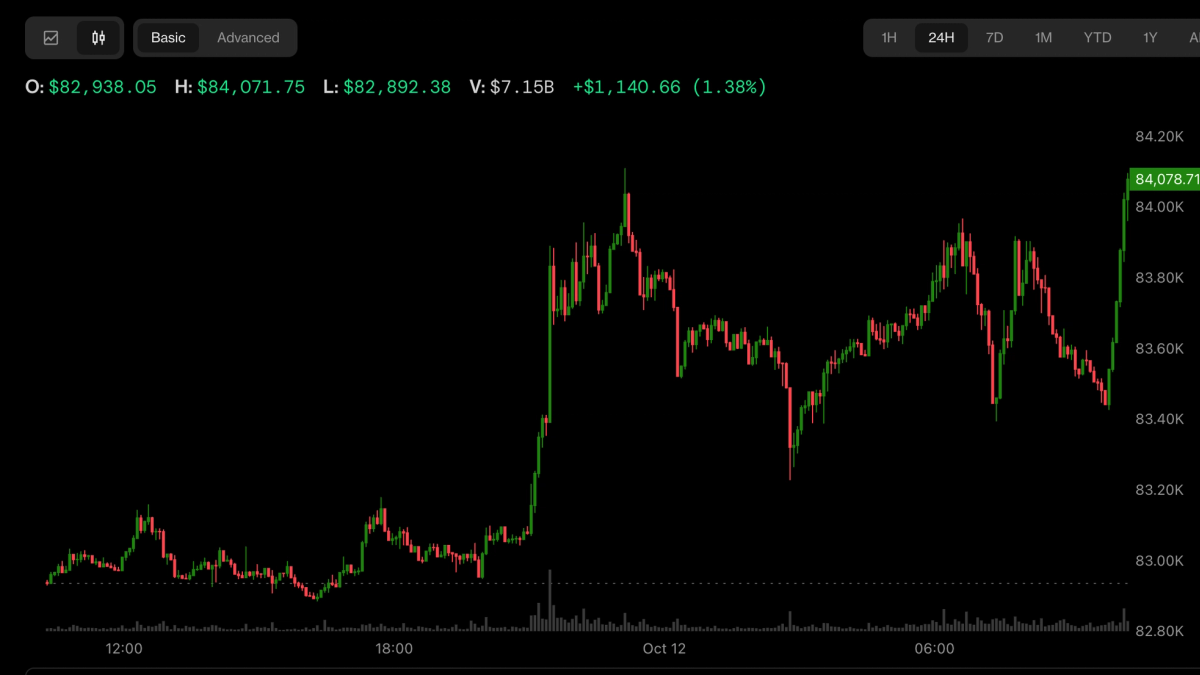
As of early Monday, Bitcoin was trading near $84,050, according to data from CoinDesk. This marks a recovery from a brief dip to approximately $83,500 observed earlier in the day, placing the asset comfortably close to its Sunday peak of $84,145. This price action suggests that despite the heavy selling pressure seen in the ETF space last week, there remains a sturdy floor of support among market participants, preventing a deeper retracement.
The strength in Bitcoin is being mirrored across other segments of the digital asset landscape. Major alternative coins, including Ether (ETH) and XRP, have seen positive bidding activity. This shift indicates a potential rotation of investor interest, with market participants exploring opportunities beyond the two largest cryptocurrencies by market capitalization.

Broadened Recovery and Altcoin Momentum
The current market environment suggests a widening recovery. While Bitcoin often acts as the primary bellwether for the entire digital asset ecosystem, the recent performance of smaller-cap tokens points to a healthy, albeit volatile, diversification of sentiment.
"The recovery broadened across major virtual digital assets, with nine of the top ten advancing during the last 24 hours," observed Purvang Mashru, lead analyst at BitDelta India. The uptick in activity is particularly notable among layer-one blockchains and utility tokens. Avalanche, for instance, led the charge with a 5.1% gain to reach $10.91, while Chainlink saw a 2.4% increase to $13.35. Other major assets, including Solana, BNB, XRP, Dogecoin, and Cardano, also posted gains, signaling that the broader market is currently in a risk-on mode, despite the macro headwinds that have persisted throughout the month.
The Macro Influence: Oil and Geopolitics
One of the primary drivers of the recent market movement is the softening of energy prices. West Texas Intermediate (WTI) futures began the new week on a defensive note, falling 1.8% to $90.28 per barrel. This decline is a notable reversal of the sharp spike observed last Thursday, which had injected considerable uncertainty into global markets and sparked fears of renewed inflationary pressures.
The cooling in oil prices follows a high-profile announcement from President Donald Trump on Friday. The administration confirmed that an agreement had been reached for Russia to supply 300,000 metric tons of diesel fuel to both international and domestic markets. This development represents a partial easing of U.S. sanctions on Russian oil imports, a move designed to alleviate supply constraints and stabilize energy costs.
However, the geopolitical landscape remains complex. President Trump also claimed that an "energy ceasefire" had been brokered between Russia and Ukraine, intended to halt attacks on critical energy infrastructure. Despite these claims, the situation on the ground remains dire. Ukrainian officials have explicitly stated that they were not consulted regarding such an agreement, and reports have confirmed that Russian military strikes on Ukraine’s power grid have continued unabated. While the market has reacted positively to the prospect of increased diesel supply, the underlying geopolitical tension remains a significant risk factor that could easily reverse the current downward trend in energy prices.
The ETF Conundrum: A Warning Sign?
While the price of Bitcoin remains robust, analysts are keeping a close watch on the institutional segment of the market. The most pressing concern stems from the performance of U.S.-listed spot Bitcoin ETFs, which endured a difficult week. According to data provided by the tracker SoSoValue, these funds registered an aggregate outflow of $681 million last week, marking the most significant withdrawal of capital since June.
The bulk of this selling pressure was concentrated on Wednesday and Thursday, periods that coincided with heightened anxiety regarding broader economic indicators. "ETF flows remain volatile," said Vikram Subburaj, CEO of the India-based Giottus Exchange. "US spot Bitcoin ETFs saw heavy outflows on October 7 and 8, signaling cautious institutional sentiment."
These outflows are particularly concerning to market watchers who view institutional participation as a key driver of Bitcoin’s long-term value. When institutional investors pull capital from these vehicles, it often suggests a defensive posture in anticipation of unfavorable macroeconomic data or a lack of conviction in the immediate price direction of the underlying asset.
Navigating the Road Ahead
The market is currently operating in a climate of "demanding" conditions, according to Purvang Mashru. Beyond the volatility of crypto-specific flows, the traditional financial markets are exerting significant pressure. Mashru highlighted that Treasury yields reached 24-year highs during the week ending October 9, a factor that traditionally creates a headwind for non-yielding assets like Bitcoin. Higher yields typically increase the opportunity cost of holding risk-on assets, making them less attractive compared to the "risk-free" returns offered by government bonds.
As traders look to the coming days, the consensus among experts is that the $82,000 level serves as the critical line in the sand. Bulls are expected to defend this support zone with intensity; failure to do so could trigger a cascade of liquidations and potentially lead to a deeper correction.
Market participants are now turning their attention to the next major catalyst: the U.S. inflation data scheduled for release on October 14. This report is expected to play a decisive role in determining the trajectory of both the crypto markets and traditional equities. With inflation still a primary concern for the Federal Reserve and global investors, any deviation from expectations could lead to significant volatility.
For now, the digital asset market finds itself in a precarious balance. It is buoyed by a momentary easing in energy costs and a resilient price floor, yet constrained by cautious institutional behavior and an increasingly complex macroeconomic landscape. As the week progresses, investors will be monitoring both the stability of the $82,000 support level and the upcoming inflation prints to gauge whether the current optimism can be sustained in the face of persistent global challenges.