









DAEJEON, Republic of Korea — South Korean space electric propulsion startup Cosmo Bee has announced a major milestone in its commercialization roadmap, securing a service agreement with orbital logistics provider D-Orbit to conduct an in-orbit flight test of its 10 mN-class Honeybee Hall thruster system. Scheduled to take place in October 2027, the mission will mark a critical step for the young enterprise as it looks to establish crucial flight heritage and break into the competitive global market for small satellite propulsion.
The Honeybee system is a specialized 10 mN-class Hall thruster currently under development by Cosmo Bee, engineered specifically to meet the rigorous demands of small satellites operating within low Earth orbit (LEO) constellations. As the global smallsat market continues to expand at an unprecedented pace, reliable and efficient electric propulsion has become a cornerstone technology for station-keeping, collision avoidance, and orbital maneuverability.
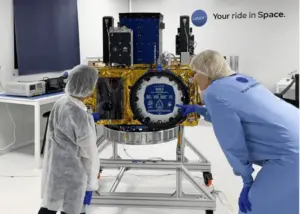
For technology developers, transitioning from laboratory testing to real-world deployment is often the steepest hurdle in the aerospace sector. Recognizing this challenge, Cosmo Bee has turned to D-Orbit and its established ION satellite carrier platform to validate its hardware in the harsh environment of space.

"In-orbit validation is an essential step as we prepare to bring Honeybee to the commercial market," said Dongha Park, co-founder and CEO of Cosmo Bee, highlighting the strategic importance of the upcoming flight. "D-Orbit is an ideal partner to help us achieve that goal."
Under the terms of the service agreement, D-Orbit will host the Honeybee thruster aboard its ION spacecraft, providing comprehensive support throughout the mission lifecycle. The collaboration is designed to give the propulsion startup access to real-world performance metrics that cannot be fully replicated in ground-based vacuum chambers.
"Hosting in-orbit demonstrations is one of the core services we offer aboard ION," explained Matteo Lorenzoni, Director of the Orbital Access Business Unit at D-Orbit. "Honeybee will operate in the real space environment, with our mission operations team supporting the test throughout, so Cosmo Bee comes away with the performance data it needs to take the thruster to market."
During the scheduled October 2027 mission, the test campaign will rigorously evaluate the Honeybee system’s key performance parameters under various operating conditions. Engineers will closely monitor vital metrics such as thrust levels and specific impulse to confirm the system’s efficiency, durability, and operational stability in orbit.

Industry experts note that flight heritage remains the single most influential factor for satellite operators when selecting a propulsion system for their spacecraft. Without a demonstrated track record in actual orbital conditions, even the most promising propulsion technologies often struggle to secure commercial adoption.
"For satellite operators choosing a propulsion system, flight heritage is often what decides the purchase," commented Matteo Zeni, Head of Sales of D-Orbit’s Orbital Access Business Unit. "Our in-orbit demonstration service gives technology developers like Cosmo Bee a direct route to space and the data they need to move from qualification to a commercial product. We look forward to flying Honeybee next year."
Through this strategic partnership, Cosmo Bee aims to bypass traditional barriers to entry by acquiring verified flight data ahead of the system’s planned commercial introduction in 2027. The company intends to position the Honeybee system as a premier option for commercial satellite operators and mission developers searching for advanced electric propulsion solutions tailored for small spacecraft architectures.
The roots of Cosmo Bee extend back to academic research excellence. Founded in July 2023, the company operates as a spin-off from the prestigious Korea Advanced Institute of Science and Technology (KAIST). Its foundational technology is built upon decades of advanced electric propulsion research conducted since 2003 by the research team led by Professor Wonho Choe.
The startup has maintained a rapid development tempo since its inception. In November 2025, Cosmo Bee achieved a major technical milestone by launching its inaugural space mission, designated K-HERO. The mission utilized a 3U CubeSat to demonstrate the operational capabilities of a 150 W-class Hall thruster in orbit, with the spacecraft successfully reaching space aboard South Korea’s indigenous KSLV-2 launch vehicle.
Momentum continued to build for the company in mid-2026. In June of that year, the Korea AeroSpace Administration (KASA) officially designated Cosmo Bee’s 10 mN-class Hall thruster and hollow cathode technologies as recognized "New Space Technologies." The regulatory endorsement underscored the national strategic value of the startup’s innovations. Capitalizing on this momentum, Cosmo Bee successfully closed a $5 million Series A funding round during the same month, securing the financial runway necessary to accelerate its research, development, and commercialization schedules.
"Cosmo Bee is growing alongside the rapidly expanding demand for LEO satellite constellations in South Korea," Park stated, reflecting on the broader economic and industrial trends driving the company’s growth. "We hope Honeybee can support customers developing the next generation of small satellite constellations."
As the aerospace industry moves closer to the October 2027 flight date, the collaboration between Cosmo Bee and D-Orbit highlights the growing accessibility of orbital demonstration services. By leveraging commercial rideshare and hosted payload platforms, specialized subsystem developers are increasingly able to bridge the gap between laboratory innovation and global commercial success, paving the way for advanced propulsion technologies to power the future of low Earth orbit infrastructure.