










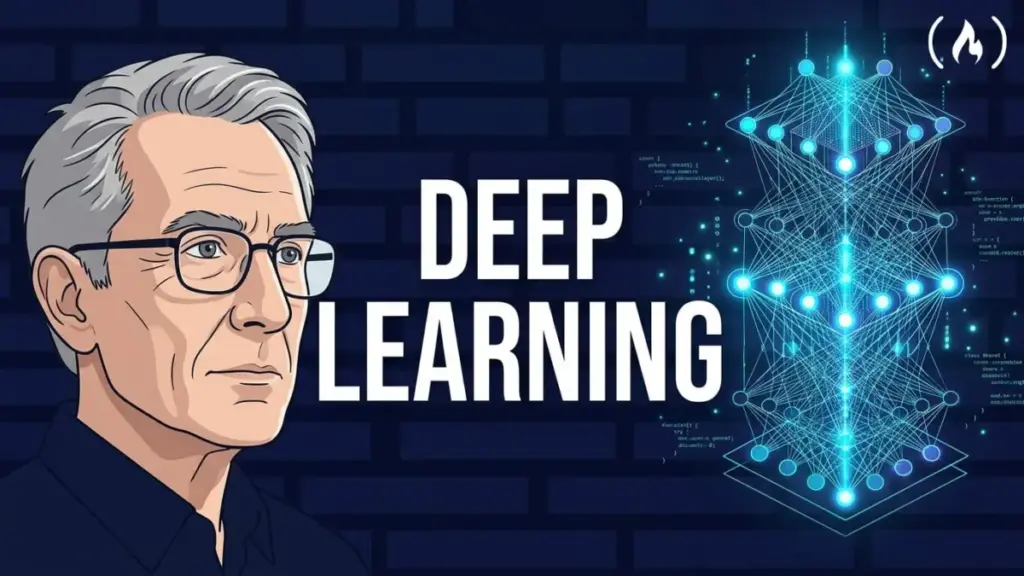
The newly published course, instructed by Mohammed Abrah, offers a deep dive into the foundational research that shaped contemporary machine learning and artificial intelligence. Rather than approaching deep learning solely from a modern perspective, the curriculum walks learners through decades of breakthroughs by examining Hinton’s most influential academic papers. Students are guided step-by-step through the historical progression of ideas, observing how early challenges in computational intelligence inspired architectures that eventually enabled today’s advanced generative AI and deep learning systems.
Throughout the extensive 27-hour runtime, Abrah explores the direct motivations behind each major milestone in Hinton’s research career. The curriculum breaks down the specific problems researchers faced during different eras, the core theoretical mechanisms introduced in landmark papers, and how those abstract concepts translate into practical code. To bridge the gap between historical theory and contemporary application, every theoretical module is paired with an educational implementation written in PyTorch, one of the most widely used machine learning frameworks in the industry today.
The curriculum spans a vast timeline of artificial intelligence history, examining Boltzmann Machines and the principles of backpropagation that allowed multi-layer neural networks to learn effectively by calculating gradients and adjusting weights. It covers Deep Belief Networks, which revolutionized unsupervised feature learning, and t-SNE, a popular technique for visualizing high-dimensional data in lower-dimensional spaces. Students also study AlexNet, the convolutional neural network architecture that catalyzed the modern deep learning boom by dominating the ImageNet competition in 2012, along with regularization techniques like Dropout that prevent overfitting in complex models.

Further exploring the breadth of Hinton’s contributions, the course tackles Knowledge Distillation—a method for transferring knowledge from a large, cumbersome model to a smaller, more efficient one—as well as Capsule Networks, which were proposed to overcome some of the spatial limitations inherent in traditional convolutional networks. The syllabus also incorporates Layer Normalization, a crucial technique for stabilizing the training of deep neural networks, and concludes with an examination of the Forward-Forward Algorithm, an alternative to backpropagation designed to learn without the backward pass of information.
Geoffrey Hinton’s legacy in computer science spans multiple decades, during which his persistence in pursuing artificial neural networks—at times when the broader scientific community was skeptical of their potential—fundamentally transformed the technological landscape. His recent accolades include receiving the Nobel Prize in Physics alongside John Hopfield for foundational discoveries and inventions that enable machine learning with artificial neural networks. By examining the trajectory of his work, the freeCodeCamp course aims to provide developers with a robust theoretical foundation and practical coding skills that demystify how modern AI systems process information, recognize patterns, and learn from data.