








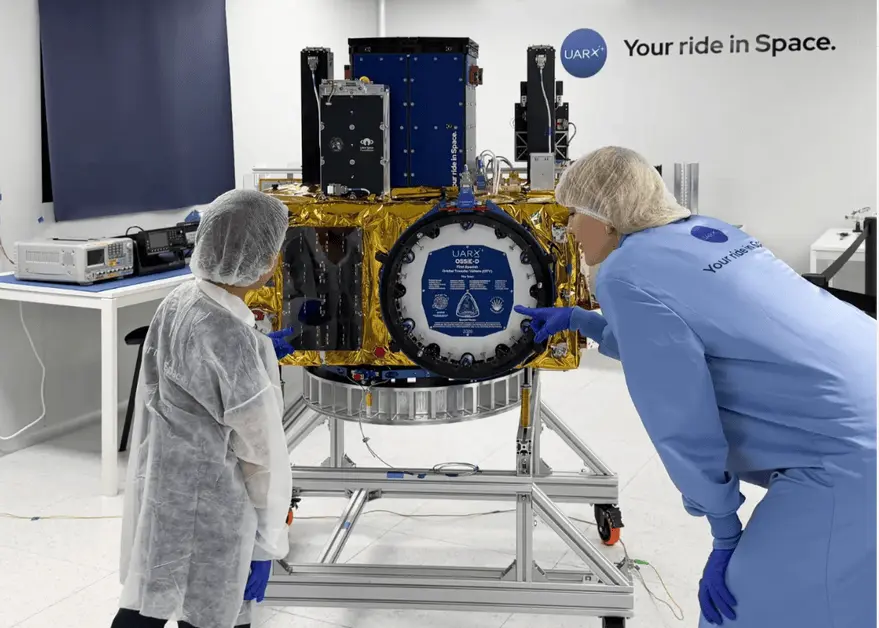
SAN FRANCISCO — Spanish aerospace startup UARX Space has successfully resolved critical anomalies encountered during the inaugural flight of its OSSIE-D orbital transfer vehicle (OTV), which lifted off on October 1 aboard SpaceX’s Transporter-18 mission. Despite initial challenges that included an unexpected communications blackout, the mission has successfully deployed at least 10 PocketQubes, marking a significant milestone for the 200-kilogram class OTV.
The complications began moments after the vehicle reached orbit. "Immediately after launch, we experienced a communications blackout with our spacecraft," Andrés Villa Granata, UARX co-founder and chief technology officer, told SpaceNews by email.
To mitigate the unfolding situation and protect the onboard cargo, UARX engineers made a decisive intervention. The team opted to transmit a backup command to the OTV designed to activate onboard fault detection, isolation, and recovery automation. This software-driven fail-safe was engineered to execute the deployment of the payloads autonomously, entirely bypassing the need for intervention from ground stations.

UARX transmitted this deployment command just two days into the flight. However, because robust, two-way communications had not yet been re-established, the engineering team operated in a state of uncertainty. "We didn’t know if the command was properly received," Villa Granata explained.
The decision to proceed blindly was driven by necessity and caution. UARX prioritized the safety of its customers’ missions in the event that OSSIE was grappling with more severe, underlying hardware issues. Furthermore, the company was acutely aware of the finite operational lifespan of the spacecraft while it operated strictly on battery power.
Tracing and Fixing the Root Cause
Subsequent troubleshooting revealed the precise nature of the anomaly. UARX determined that the communications blackout was not caused by a hardware failure aboard the spacecraft itself, but rather by a configuration error on the interface of the ground station service the company was utilizing.
Once identified, the configuration error was promptly corrected. From that critical juncture onward, communications with the OSSIE vehicle normalized completely. With the telemetry link restored, comprehensive spacecraft systems check-outs were successfully executed, revealing that all internal subsystems were functioning nominally.
The restoration of the data link allowed UARX to re-engage the spacecraft’s sequencer, which had drifted into an ultra-low-power mode during the blackout, and finally download the long-awaited deployment telemetry. The incoming data confirmed that the manual commands transmitted two days post-launch had indeed been received correctly by the OTV. Additional telemetry verified that all commanded deployments executed precisely as planned, resulting in the successful release of the payloads.
OSSIE, whose acronym stands for Orbit Solutions to Simplify Injection and Exploration, carries more than just its initial batch of small satellites. Additional payloads remain onboard the 200-kilogram class OTV, including hosted hardware such as Dawn Aerospace’s Docking and Fluidic Transfer Port.
While certain secondary satellites and payloads remain slated for release later in the mission timeline, UARX co-founders noted that they are currently unable to provide specific operational details regarding those particular customers.
OSSIE Customers and Surprises in Orbit
Prior to liftoff, the operational profile for OSSIE-D outlined a deployment schedule targeting windows between seven and 30 days following the launch. However, the autonomous fault-recovery commands triggered by UARX accelerated this timeline significantly, catching several payload operators completely by surprise.
Among those affected was the German nonprofit organization AMSAT-Deutschland, which had three PocketQube satellites integrated into the OSSIE-D mission.
"While the successful launch was still being celebrated in Bochum and preparations for the next planned activities were underway, a surprise announcement came in on Saturday evening, October 3," AMSAT-DL posted on October 4, detailing the unexpected shift. The organization noted that the sequence for the deployable payloads had unexpectedly initiated on October 2 at 1:48 p.m. Central European Summer Time.
Because AMSAT-Deutschland anticipated a much longer commissioning delay before deployment, continuous monitoring of the expected transmission frequencies had not yet begun. Consequently, the initial signals emitted by the ERMINAZ satellites initially went unnoticed by the ground team.
"Our three ERMINAZ-2 PocketQubes have been successfully deployed from the Picobus Deployer from Libre Space Foundation on OSSIE-D," AMSAT-DL President Peter Gulzow told SpaceNews. Providing an update on their condition, Gulzow added, "Two of our Satellites, ERMINAZ-2U and ERMINAZ-2V, are operating and under commissioning. The third one, ERMINAZ-2X status is unknown, as we have not yet been able to acquire a signal from it."
Beyond the AMSAT payloads, OSSIE-D also transported PocketQube units developed by the Libre Space Foundation, Orion Space of Nepal, and Argentina’s National Technological University – Haedo Regional Faculty. Additional cubesats aboard the OTV were contributed by Argentina’s National University of La Plata and Ethereal Space.
Argentine firm DIYSatellite provided the specialized PocketQube dispensers utilized on the mission and managed flight arrangements for multiple participants.
"From our side, the mission continues according to the planned timeline, and we expect our satellites to be deployed in the next weeks," Gustavo Carpignano, CEO of DIYSatellite, stated by email. He added that the company looks forward to assessing and confirming the performance of its deployment hardware once those subsequent releases take place.
By October 15, Villa Granata confirmed that a total of 10 OSSIE-D PocketQubes had been successfully deployed and had established initial contact with their respective mission operators on the ground. UARX leadership declined to comment further on the status of remaining unacknowledged satellites housed within the vehicle.
In the lead-up to the flight, UARX highlighted on social media that two three-unit cubesats supplied by Ethereal Space were integrated directly within RAMI, the company’s proprietary CubeSat deployment system, designed to release them accurately into orbit to commence their intended scientific and commercial operations.
Reflecting on the unpredictable nature of orbital operations, Ethereal CEO Shawn Cochran shared his perspective with SpaceNews. "Spaceflight is inherently challenging, and not every mission milestone unfolds as originally anticipated," Cochran said by email. "What remains unchanged is Ethereal Space’s commitment to building a reliable, operational space-weather observing capability. We remain confident in our technology, our team, and the long-term importance of providing high-quality space-weather observations to government and commercial customers."
In addition to serving as a functional testbed for its primary services, OSSIE’s maiden flight also achieved a technical milestone for UARX by serving as the inaugural space-based demonstration of the company’s SAU&RON 24-inch and SAU&RON 15-inch deployment rings.