





By Jeff Baumgartner
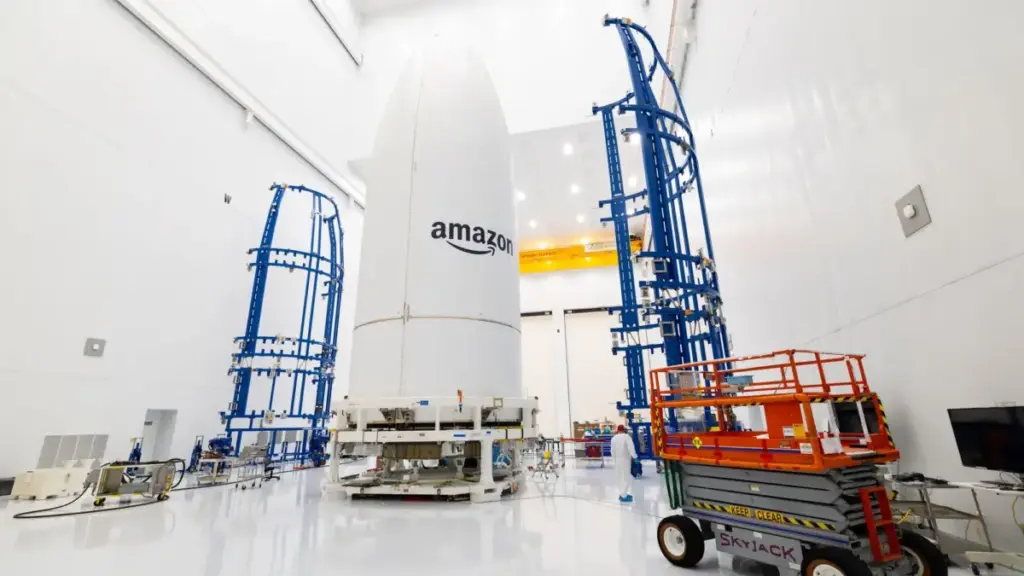
Federal regulators have cleared the path for Amazon Leo to significantly expand its footprint in the rapidly evolving satellite communications market. The Federal Communications Commission (FCC) has officially approved Amazon Leo’s acquisition of Globalstar’s existing satellite operations, infrastructure, and core assets, a sweeping transaction that includes critical mobile satellite services (MSS) spectrum licenses.
The high-stakes corporate pairing brings together Amazon’s vast technological and financial resources with Globalstar’s established space-based architecture. Globalstar currently operates roughly two dozen low-Earth orbit (LEO) satellites, maintaining a prominent role in the telecommunications ecosystem through its high-profile direct-to-device (D2D) partnership with Apple, while serving more than 780,000 end-user devices spread across more than 120 countries worldwide.

This regulatory milestone follows a massive corporate maneuver in which Amazon reportedly targeted Globalstar in an $11.5 billion transaction, simultaneously locking in a renewed and expanded pact with Apple. The strategic move dramatically alters the competitive landscape of the global space economy, injecting intense new pressure into a market already racing to connect everyday mobile devices directly to orbiting constellations.
Strategic Infrastructure and the "C-3" System
Heading into the completion of the Amazon Leo deal, Globalstar was already hard at work planning and developing its next-generation architecture, known as the "C-3" LEO platform. This ambitious system was designed to be comprised of 48 operational satellites alongside six on-orbit spares, dramatically increasing capacity and geographic reliability.
In its official order approving the transaction, the FCC noted that its Space Bureau recently granted Globalstar’s pending request for United States market access for the C-3 system. Furthermore, the regulatory green light clears the satellite operator to utilize specific frequency bands for vital communications links. Specifically, the operator is authorized to use the 1610MHz to 1618.725MHz range for Earth-to-space MSS links, and the 2483.5MHz to 2500MHz spectrum for space-to-Earth service links.
"Following the close of its transaction with Globalstar, Amazon Leo may use the C-3 System grant to build and launch this newly authorized system," the FCC stated in its decision, signaling that the regulatory framework is fully aligned for Amazon to inherit and expand upon Globalstar’s heavily vetted space infrastructure.
The acquisition has not been entirely without turbulence, however. During the regulatory review process, legal and commercial challenges emerged. Yippy attempted to block the transaction entirely, leading Amazon and Globalstar to push back aggressively against those opposition efforts.

Conversely, a robust coalition of public interest and technology policy groups lined up in strong support of the deal. Organizations including Public Knowledge, New America’s Open Technology Institute, and the Information Technology & Innovation Foundation filed comments arguing that absorbing Globalstar’s established assets would empower Amazon Leo to emerge as a far more effective and viable competitor in the burgeoning D2D market.
Reshaping the Direct-to-Device Competitive Arena
The combination of Globalstar’s assets with Amazon Leo’s broader LEO ambitions arrives at a transformative moment for telecommunications, fundamentally reshaping a D2D arena that is fiercely competitive. The sector is currently anchored by its undisputed leader, SpaceX and its Starlink constellation, which has captured significant global attention and regulatory momentum through early deployment of direct-to-cellular capabilities.
Beyond SpaceX and the newly fortified Amazon-Globalstar alliance, the space is crowded with aggressive challengers. AST SpaceMobile continues to develop its heavy-satellite approach for standard cellular connectivity, while Elveo—a new market contender created through the strategic combination of Lynk and Omnispace—is carving out its own operational niche.
At the same time, terrestrial telecom giants are scrambling to secure their own positions in the sky. Major U.S. carriers AT&T, T-Mobile, and Verizon are collectively pushing ahead on an ambitious satellite D2D rural coverage joint venture. Industry analysts widely view this carrier collaboration as a crucial strategic hedge against the growing dominance of SpaceX and other vertically integrated satellite operators, ensuring that traditional mobile network operators are not cut out of the space-based future of mobile connectivity.
Regulatory Outlook and Market Impact
The FCC itself has expressed clear optimism that the transaction will ultimately benefit consumers by spurring intense competition across both mobile and fixed broadband sectors.
In its formal assessment, the Commission emphasized that the buyout will serve the public interest. "In particular, the transaction would facilitate Amazon’s entry into D2D services and create a vigorous satellite-based operator capable of offering fixed and mobile services to both residential and business customers," the Commission noted.
By marrying Globalstar’s proven operational track record and spectrum rights with Amazon’s deep pockets, cloud infrastructure, and consumer hardware ecosystem, the newly expanded Amazon Leo division is positioned to mount a formidable challenge to existing space monopolies. As the transition moves toward its final closure, the telecommunications industry will be closely watching how Amazon integrates Globalstar’s assets and accelerates the deployment of the C-3 system to meet the surging global demand for seamless, ubiquitous connectivity.