










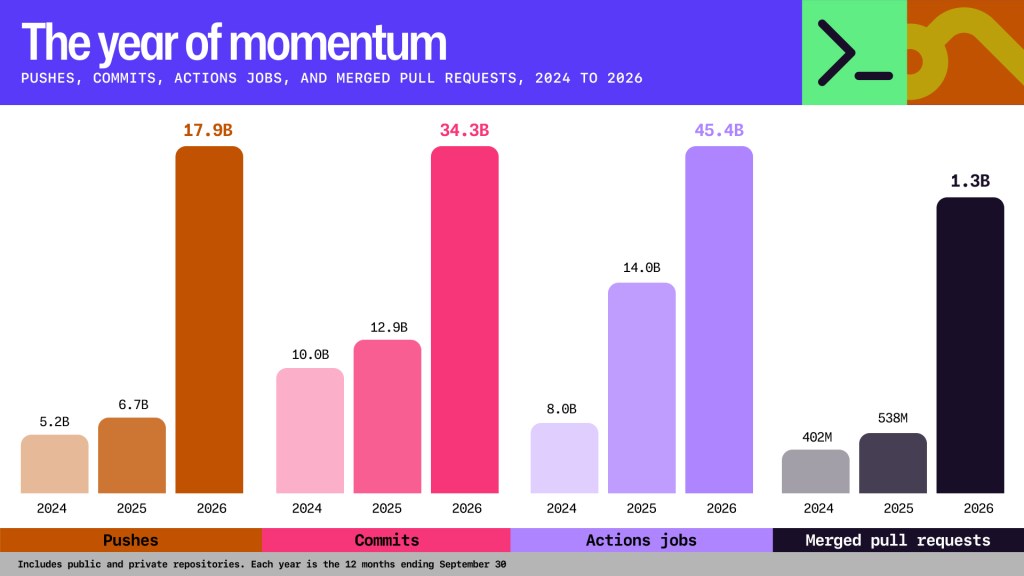
In a year defined by unprecedented velocity, the global developer community has fundamentally altered its relationship with technology. According to the 2026 Octoverse report, developers pushed code to GitHub a staggering 17.9 billion times over the past 12 months. This figure is not merely a record; it represents a volume of activity that surpasses the combined output of 2024 and 2025, signaling an era of rapid, AI-augmented acceleration.
Behind these massive datasets lies a story of human ingenuity. From a lone developer in Nepal creating a life-saving flood alert system on GitHub Pages to NASA engineers at the Jet Propulsion Laboratory developing software for spacecraft, the scale of curiosity is unprecedented. The shift in activity became particularly pronounced mid-year, as developers moved from experimenting with AI agents to integrating them as core collaborators in their daily workflows.
The Year Developers Set a New Pace
The data reveals a period of intense momentum. Beyond the 17.9 billion pushes, total commits across all public and private repositories climbed to 34.3 billion—more than triple the levels observed just two years ago. Perhaps most telling is the rise in merged pull requests, which reached 1.3 billion for the year. This averages to approximately 3.5 million pull requests per day, highlighting the relentless pace at which modern software is being built and refined.

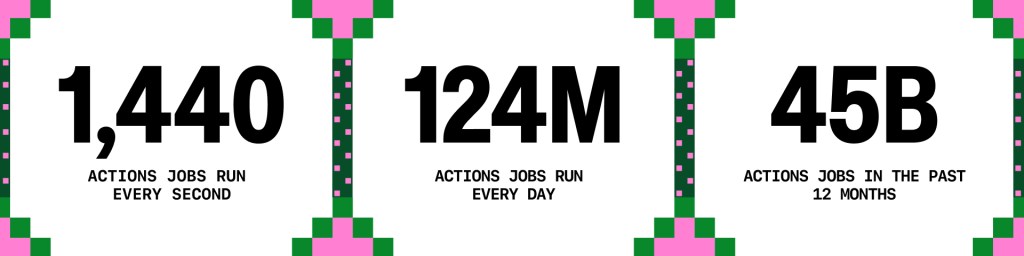
Central to this transformation is the rise of the AI agent. GitHub’s telemetry indicates that repositories configured with agent files logged significantly higher commit volumes than those without, suggesting that teams leveraging automation from the outset are operating at a fundamentally different speed. This is further evidenced by the infrastructure supporting these projects: GitHub Actions ran a job 1,440 times every single second this year, totaling 45 billion jobs. This is more than triple the volume of the previous year, underscoring how heavily developers have come to rely on automated pipelines to sustain their output.
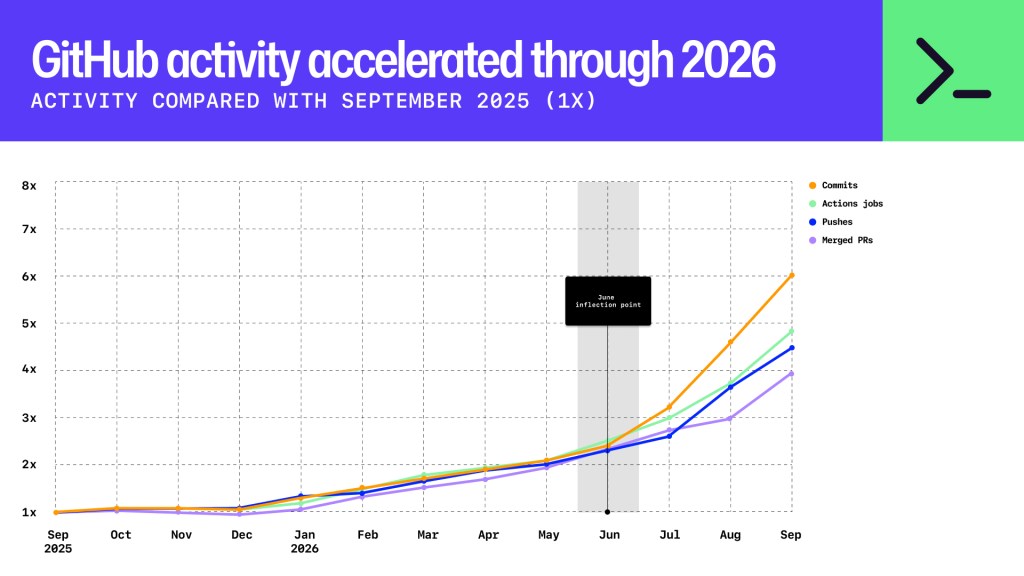
The surge in activity experienced a distinct inflection point around June. This coincided with a convergence of industry-wide advancements: the deployment of more capable underlying models, the maturation of tools built around those models, and the emergence of persistent agents. These agents have evolved from simple, single-session tools into sophisticated entities capable of tracking progress across multiple days and orchestrating specialized sub-agents. Furthermore, the ability of these agents to leverage cloud computing to execute tasks remotely—rather than relying solely on local machine power—has dramatically expanded the scope of what developers can accomplish.
This growth is not limited to new entrants. More than half of all commits since June originated from new repositories, but seasoned developers remain equally active. The average developer on the platform has been contributing for roughly 36 months, and they are increasingly branching out, working across 10% more repositories than they did a year ago. Open source, in particular, has seen a massive resurgence, with public contributions hitting 2.5 billion—more than double the total from the previous year.
Developers Are Building from More Places
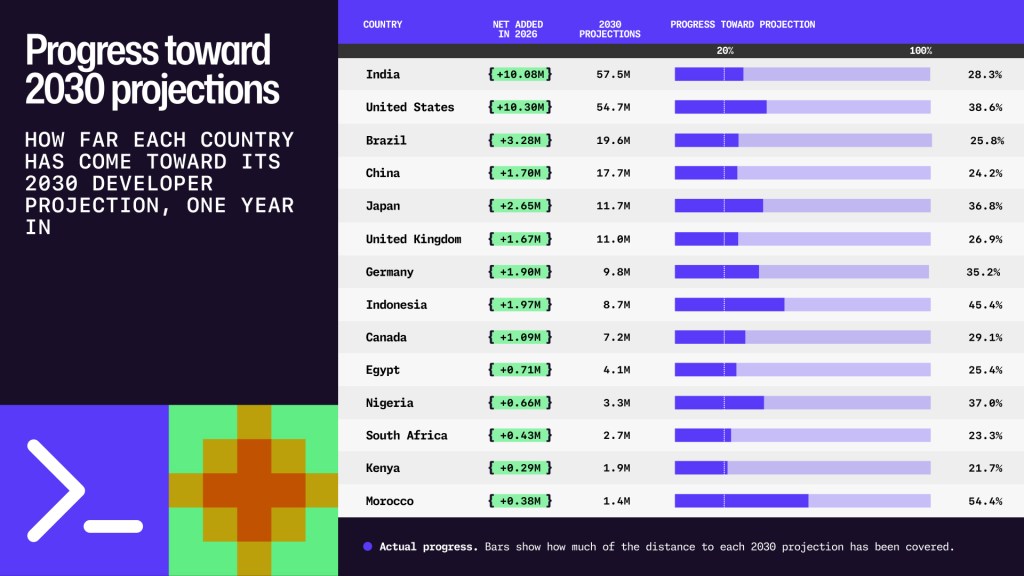
The developer ecosystem now spans more than 225 million users worldwide, with the United States and India leading as the largest communities, each adding more than 10 million developers in 2026. Brazil, too, has seen a surge, adding over 3 million developers. This geographical expansion is tracking ahead of previous projections. Last year, forecasts suggested that India and the U.S. would reach massive population milestones by 2030; one year into that window, every country studied has already closed at least 20% of the distance toward its 2030 goal.
Regional drivers vary significantly. In the Americas, growth is largely fueled by the maturity of the fintech sector and digital payment infrastructure. In the EMEA region, AI adoption is driving innovation across manufacturing and startup hubs in Germany, France, and Morocco, while Kenya, Nigeria, and South Africa are seeing massive growth in agritech and coding education. In the APAC region, heavy government investment in AI infrastructure and talent programs—most notably in Japan and South Korea—has solidified the area as a critical engine of global development.
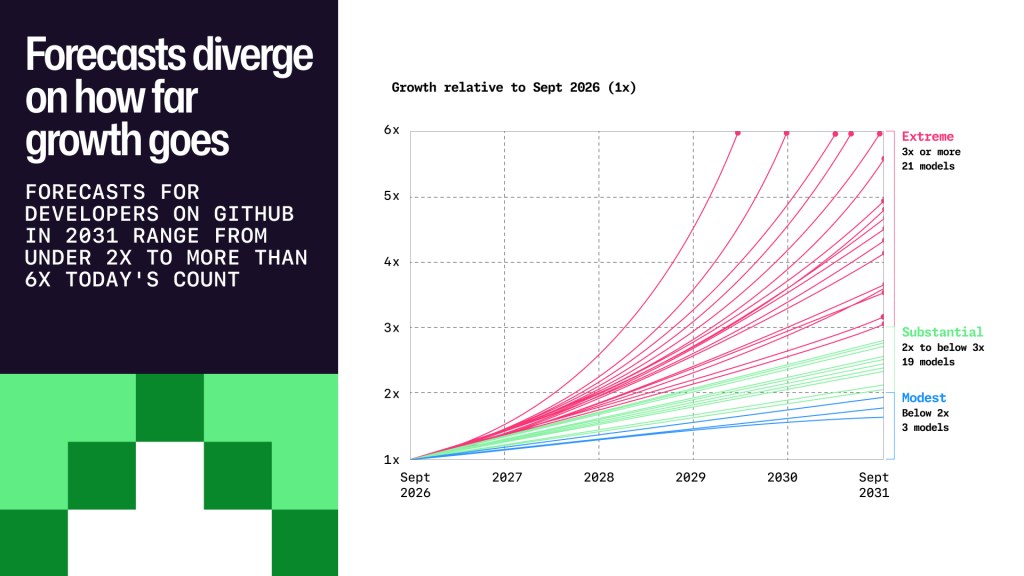
This rapid expansion has made long-term forecasting increasingly difficult. GitHub’s internal models now suggest that the most plausible outcomes for 2031 involve massive growth, with roughly half of the 40 predictive models anticipating that the global developer count will triple. Even the most conservative estimates suggest a near doubling of the community within five years.
The Future Is Being Built Everywhere
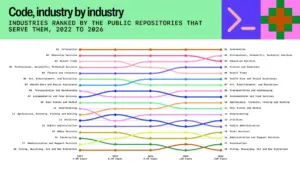
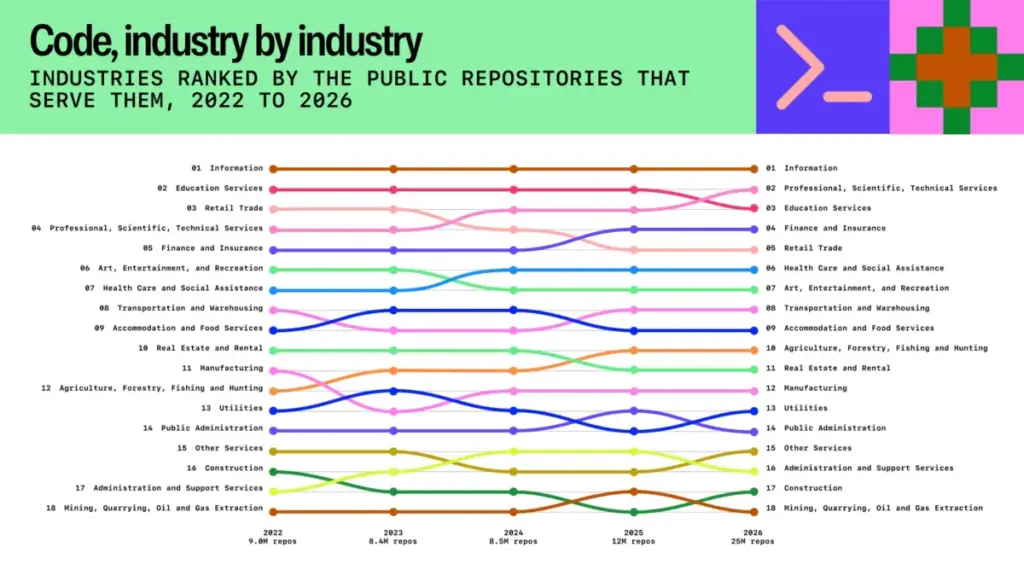
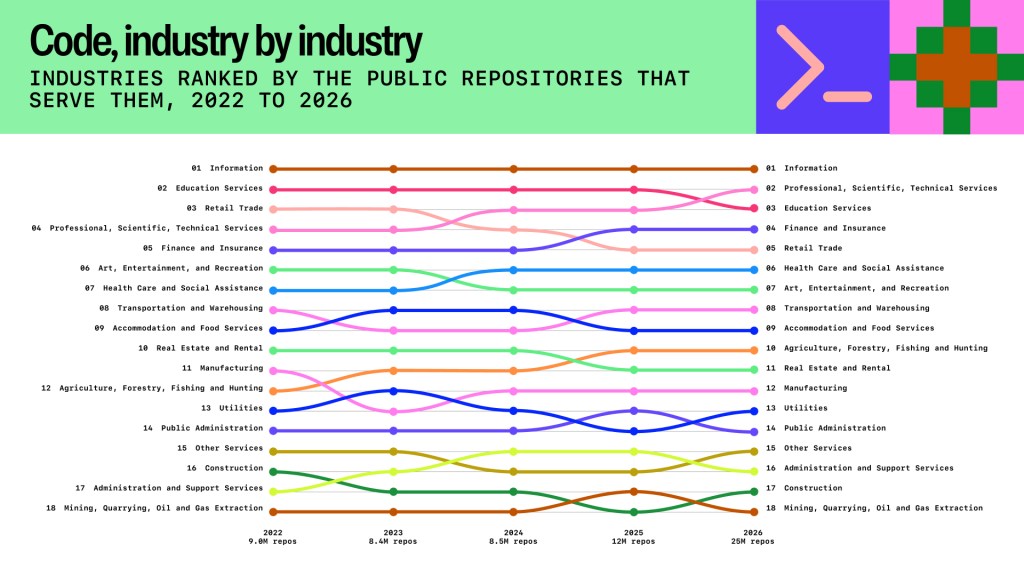
The concept of "building everywhere" now extends beyond geography to include industries that have historically been on the periphery of software development. Utilizing the North American Industry Classification System (NAICS), GitHub found that professional, scientific, and technical services, agriculture, and healthcare are all seeing massive increases in repository creation.
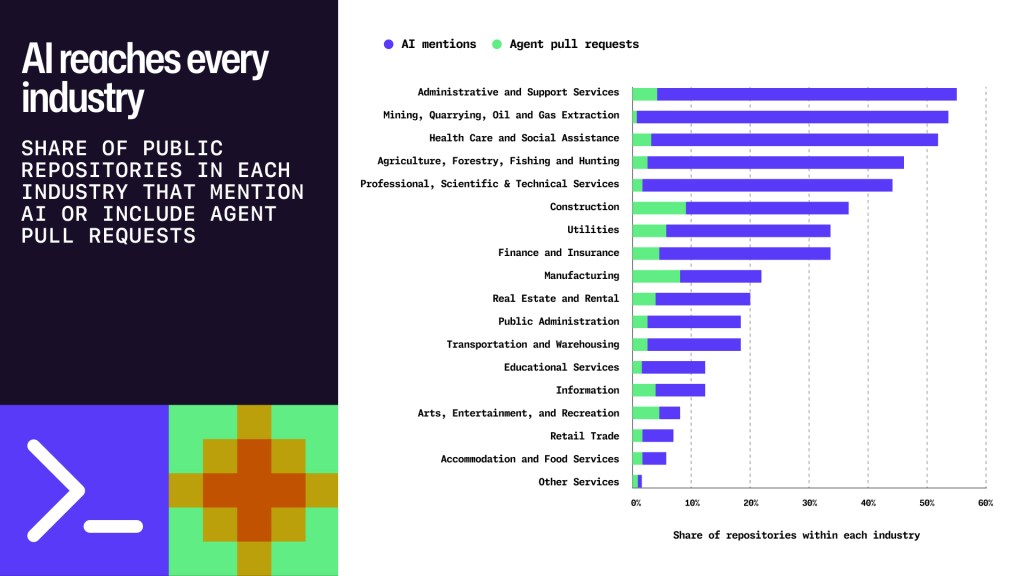
In sectors such as mining and administrative services, over 40% of public repositories now reference AI. Construction has emerged as a leader in agent utilization, with 9% of its repositories featuring agent-opened pull requests, the highest of any sector. This trend is visible in real-world applications: from manufacturing teams using AI to create 3D-printable drawer organizers to university labs using computer vision to classify animal behavior, the people closest to a problem are increasingly using AI agents to build the solutions themselves.
This professional shift is also impacting scientific research. The "paper trail" of modern science is now increasingly hosted on platforms like GitHub, where code repositories serve as the backbone for Nobel Prize-winning work in biochemistry, groundbreaking AI architecture papers, and complex astrophysical imaging.
Developers Are Reshaping Their Workflow
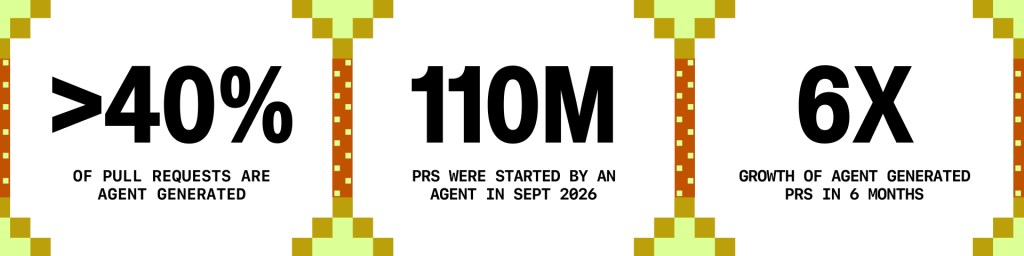
Workflow patterns are shifting as developers increasingly delegate tasks to AI. By September 2026, more than 40% of all pull requests on GitHub were started by an agent’s initial draft, a significant increase from just 17% in March. These agent-authored pull requests are not only more likely to involve changes to multiple files but are also being merged at a faster rate than human-only contributions, indicating a high level of trust and efficiency.
The use of GitHub Copilot has similarly evolved. Among monthly active users, 55% now utilize agentic features, with the most significant growth occurring in "hands-off" modes, where developers assign a high-level task to a cloud agent and allow it to work independently. This delegation has prompted a 300% year-over-year increase in repositories mentioning interoperability or reverse engineering, as developers focus on connecting disparate systems.
Model Choice Moves at Developer Speed
The sophistication of the developer community is also reflected in how they select AI models. By September 2026, 61% of GitHub Copilot users who manually selected their models were using more than one in their sessions. There is no single "winner" in the model wars; paying users experimented with 47 distinct models in a single month, with no single model accounting for more than 25% of requests.
Developers are becoming adept at choosing the right tool for the job, often rotating between deep reasoning models for complex planning, general-purpose models for standard coding, and fast, lightweight models for rapid iteration. To simplify this, GitHub has introduced orchestration tools like Copilot Fusion, which dynamically match the best model to each step of a project’s lifecycle.
Language Choice Has New Influence
TypeScript remains the most-used language on GitHub, followed by Python and JavaScript. However, a new trend is emerging: the influence of AI on language adoption. Rust has seen the fastest percentage growth among top languages, doubling in the past year. Interestingly, the languages with the highest share of AI-involved pull requests—TypeScript, Python, and Rust—are also the languages experiencing the fastest community growth.
Data suggests that developers are gravitating toward languages where AI output is easier to verify. When developers leave the choice of language to an agent, there is a clear preference for TypeScript. This suggests that while human developers still provide the vision and the final sign-off, the tools they use are subtly shaping the technical landscape of the future.
What Doesn’t Change
Amidst this year of record-breaking growth and technological evolution, the most frequently used emoji in repositories remains the rocket. It is a fitting symbol for a period defined by momentum, yet it belies the human reality at the center of the platform. While agents have made it exponentially easier to move from a weekend idea to a functional application, the fundamental decisions remain with the developer. Whether it is assessing earthquake risks, managing energy systems, or creating new software, the human capacity for initiative remains the primary driver. The tools will continue to change, and the scope of what is possible will continue to expand, but the choice of what to build, and for whom, remains firmly in the hands of the developers.