












August proved to be a demanding period for GitHub’s engineering teams, as the platform navigated a series of five distinct incidents that resulted in degraded performance across various services. While the company continues to see substantial growth in user activity and demand, these outages have served as a critical catalyst for accelerating architectural refinements and the ongoing transition of the platform’s core infrastructure to Microsoft Azure.
In a recent assessment of its system performance, GitHub acknowledged that while significant progress has been made in scaling, the incidents of August highlighted the inherent risks of managing one of the world’s most active software development platforms. The company maintains that its core priority remains a disciplined hierarchy of needs: “availability, then capacity, then features.” This strategic focus aims to ensure that as the platform grows, the foundational stability of the service is not compromised.
Strengthening Core Architecture and Capacity
The path forward for GitHub is heavily tied to its migration toward Azure, which is expected to provide the necessary headroom to handle future spikes in traffic. As of August 11, the platform successfully operated a production MySQL primary from Azure for the first time. This transition was executed with minimal impact on customers, providing a successful proof-of-concept that was replicated with two additional primaries on August 27. The engineering team plans to continue this migration in the coming weeks, intentionally increasing the complexity of each subsequent failover to ensure robust system integrity.


Alongside the migration, GitHub has seen record-breaking traffic, particularly in read operations. Migrated services saw read volume peak at 60.4%, while the platform’s legacy monolith reached 64.3% in Azure. Git reads, a core component of the platform’s daily utility, reached 54% utilization within the new environment.
Beyond the regional shifts, engineers have been aggressively optimizing database performance. A notable achievement included moving the 24-table authentication-core cohort off the aging mysql1 shared database. This transition relieved the system of approximately one million queries per second. Additional query-hygiene efforts removed another 120,000 queries per second, effectively eliminating 59,000 hours of wasted database compute time every hour, thereby freeing up significant capacity.
GitHub Actions also received targeted interventions to manage the platform’s explosive growth. By routing 33% of jobs away from a constrained production cluster toward spare capacity, the team successfully reduced peak cache CPU utilization from 98% to 80%, buying an estimated three months of headroom. However, the company is quick to note that these are short-term containment measures; the long-term goal remains the implementation of more durable isolation and capacity strategies.
Analyzing the August Outages
The five incidents throughout the month varied in their complexity and root causes, ranging from deployment-related capacity issues to external provider failures.
August 6: The Deployment Bottleneck
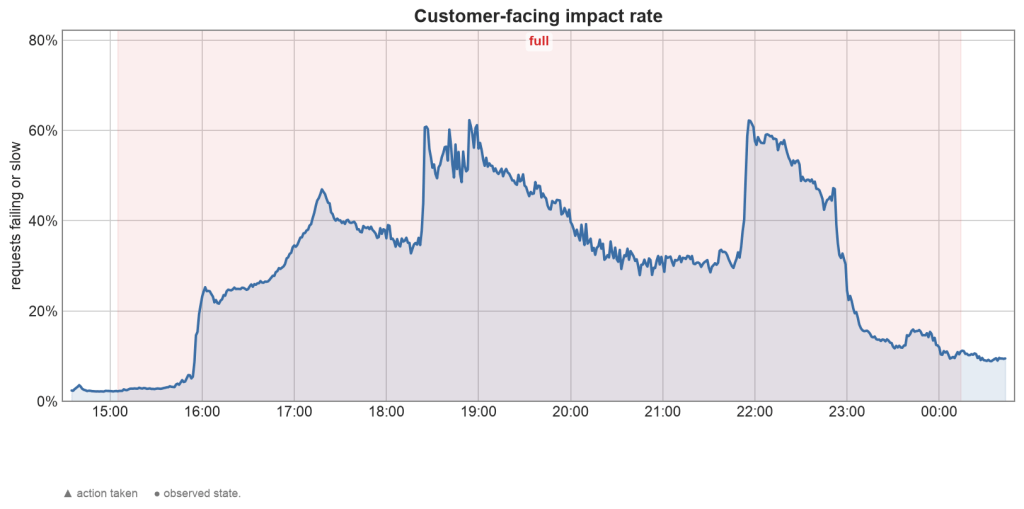
On August 6, a routine deployment to an internal GitHub Actions service triggered a 10-hour and 42-minute degradation. While the deployment content itself was stable, the process of replacing pods during the rollout reduced capacity in one site, pushing remaining sites past their operational limits. This led to CPU throttling and out-of-memory restarts within the service mesh, cascading into broader API and DNS errors. Recovery was further hampered by a latent bug that caused runners to repeatedly attempt to process revoked jobs, creating an artificial backlog.
August 17: Load Balancer Exhaustion
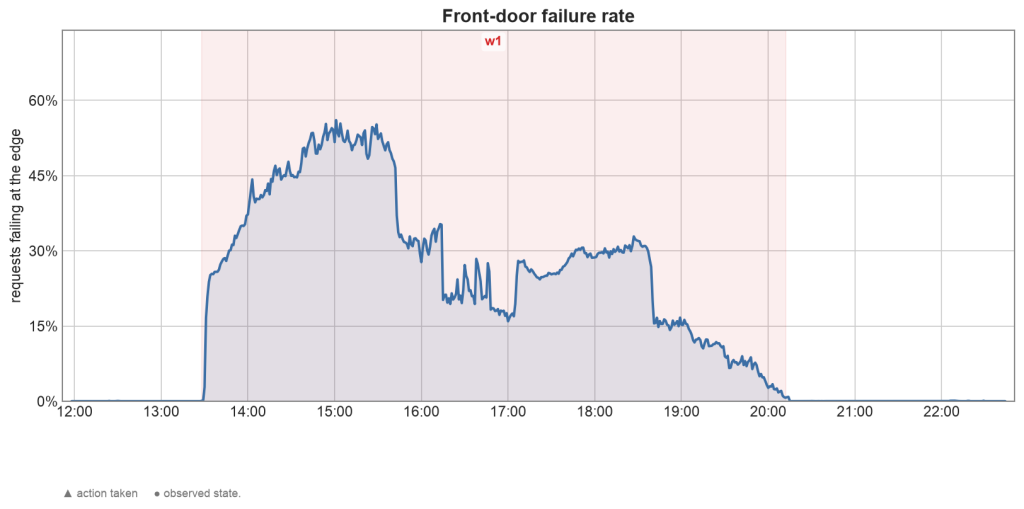
A traffic spike on August 17 pushed load balancers in a specific datacenter beyond their limits. The failure of a service-mesh sidecar to scale, coupled with exhausted network flow limits on load balancer nodes, led to authentication latency across the platform. The situation was exacerbated by a client-side retry bug that amplified traffic to authentication endpoints, further slowing the recovery of the Copilot Token Service.
August 20: Cloud Database Latency
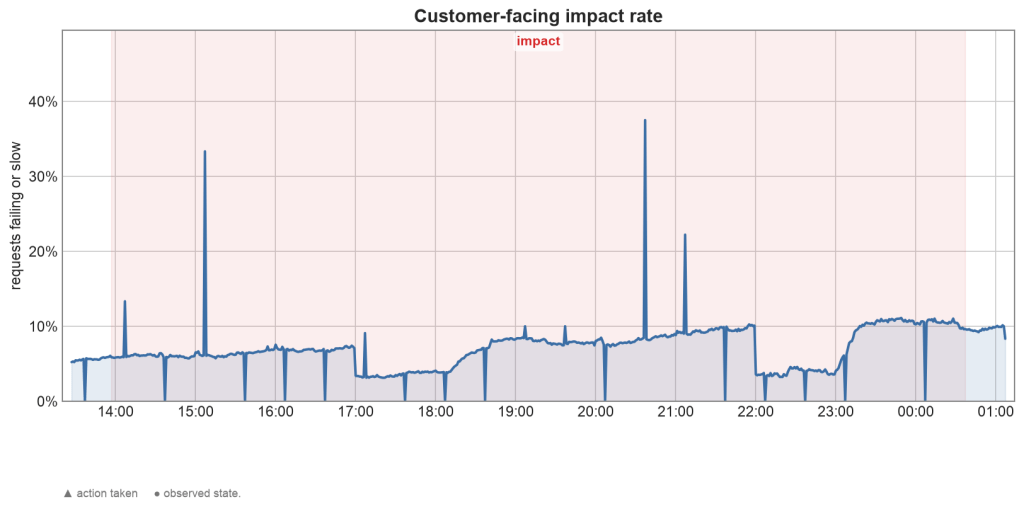
The incident on August 20 specifically impacted the Copilot cloud agent. While the tasks themselves were not lost, users experienced significant lag in status updates and results. The issue stemmed from a provider-side outage in one region of the managed database used by the agent. Because the latency exceeded the headroom of the processing partitions, a backlog of task-status updates accumulated. Difficulties in failing over the database further extended the duration of the incident.
August 26: Infrastructure Saturation
On August 26, the cumulative load on shared infrastructure services, which had not kept pace with the month-over-month growth of GitHub Actions, reached a breaking point. A surge of incoming events overwhelmed the database, causing query times to spike. The internal service responsible for job assignment could not maintain throughput, leading to queued actions runs. The lack of an automated circuit breaker meant that protective throttling had to be applied manually, a limitation the engineering team is now working to address.
August 27: Upstream AI Model Provider Failure
The final major incident of the month on August 27 affected users of the Kimi K3 AI model within GitHub Copilot. The issue was localized to an upstream provider, which experienced a serving degradation. Users who utilized other models or the “Auto” routing setting remained unaffected, illustrating the success of the platform’s model-agnostic architecture.
Enhancing Monitoring and Future Resilience
Learning from these challenges, GitHub has implemented several structural improvements to its monitoring and telemetry systems. Pull request monitoring now evaluates merge, review, and comment failures independently to ensure that high read volumes do not mask critical write-path failures. Furthermore, on August 21, the company launched an automated incident detection system that correlates customer-support signals with internal service telemetry. This, combined with a recalibrated API monitoring stack, has significantly improved the signal-to-noise ratio during high-stress periods.
Moving forward, the engineering team’s roadmap is focused on the continued migration of database primaries, ongoing service migration to Azure, and a relentless focus on database health. The team is also prioritizing the automation of capacity management and auto-scaling, alongside the extension of dependency-failure handling to cover more of the pull request experience.
As the company looks toward the next quarter, it remains committed to the principle of addressing foundational stability before introducing new features. By refining its retry policies, strengthening load-shedding protections, and aggressively migrating to a more modern infrastructure, GitHub aims to build a platform capable of sustaining the high-velocity demands of its global developer community. For those seeking real-time transparency, the company continues to maintain its status page, where it provides detailed post-incident recaps and updates on ongoing engineering efforts.