













A data science notebook dies the exact moment its creator or a colleague clicks "Restart Kernel and Run All" and the workflow grinds to a halt. Often, nobody notices this silent failure for days or even weeks. An analysis is finished, a chart makes its way into an executive slide deck, and the file is successfully pushed to a repository. Then, months later, someone asks where a specific metric originated. The analyst opens the legacy notebook, executes it from the top, and watches in frustration as a cell deep in the pipeline throws a KeyError because a column was renamed in an earlier cell and entirely deleted later in the script. Yet, because the output cells still display legacy numbers from the previous run, the notebook appears deceptively functional while remaining entirely unrunnable.
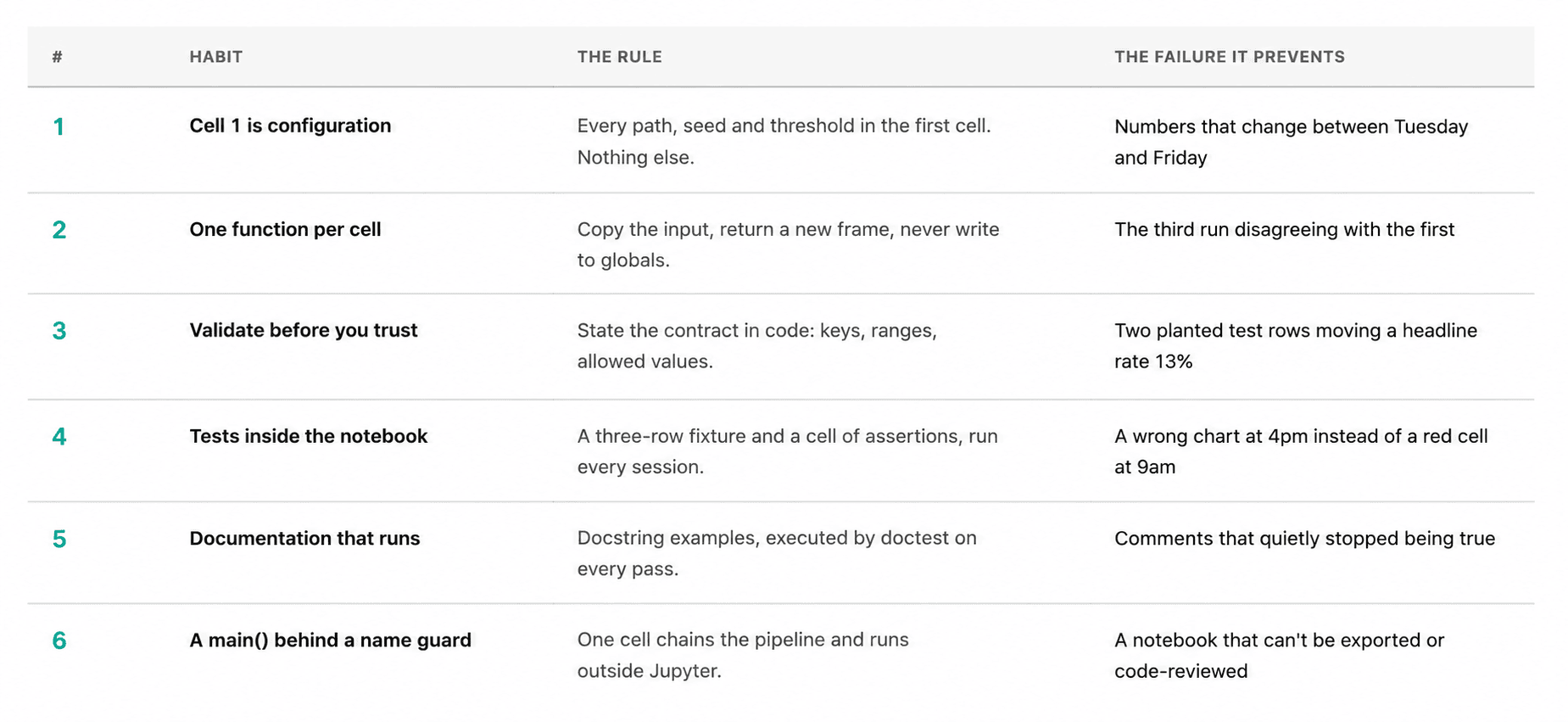
The habits required to prevent this common professional pitfall are remarkably inexpensive in terms of time and effort. Industry professionals are increasingly adopting structured scripting paradigms to ensure reproducibility, keeping entire analytical pipelines concise and maintainable. By examining a real-world dataset utilizing standard Python libraries like Pandas, developers and data practitioners can implement rigorous practices that guarantee long-term stability and trustworthiness in exploratory computing environments.
The Data
To understand how fragile notebooks break and how robust ones survive, consider an analytical workflow using a standard Olympic dataset, specifically the table designated as olympics_athletes_events. This historical dataset tracks individual athlete performance records across multiple Olympic Games. In a typical extract containing hundreds of rows, the data provides a granular, row-level perspective mapping individual athletes to specific events.


A standard extract might span multiple decades, covering a wide range of international competitors, distinct sporting categories, and specific Games. Within such tables, columns typically capture unique identifiers, athlete names, biological sex, age, physical dimensions, national teams, National Olympic Committee codes, event years, sporting disciplines, and awarded medals. In many historical sports datasets, blank entries in the medal column do not represent missing data or system errors; rather, they signify that a particular athlete competed in an event but did not secure a podium finish. Recognizing this distinction is critical for maintaining data integrity during downstream transformations.
Adding Configurations to the First Cell
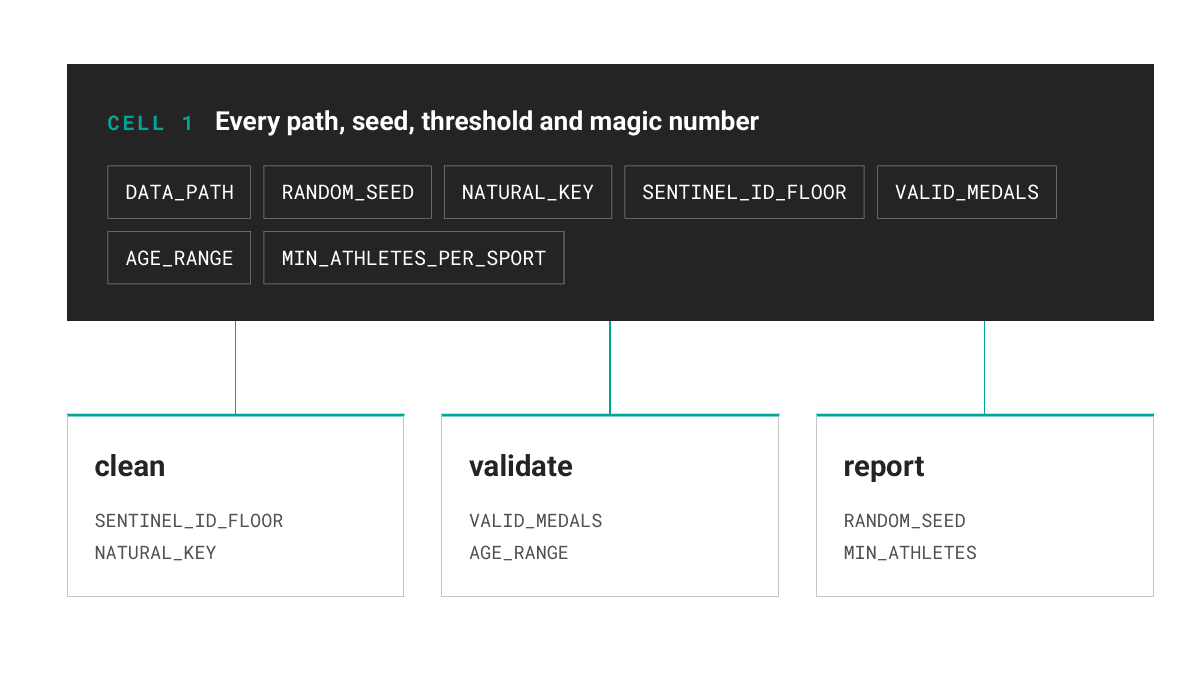
The first line of defense against fragile notebooks is strict discipline regarding global configurations. Every file path, random seed, operational threshold, and hardcoded magic number must reside exclusively within the very first executable cell of the notebook. Nothing else belongs there.
By centralizing parameters such as file directories, random seeds for reproducibility, validation limits, and acceptable categorical values at the top, anyone reviewing the notebook months later can inspect every core assumption within seconds without scrolling through thousands of lines of code. Furthermore, when file locations change or business rules shift, developers only need to update a single, dedicated location.

The inclusion of a global random seed is particularly vital, even in analyses where direct sampling is not immediately obvious. Standard operations such as data frame sampling, train-test splits, and cluster initializations all draw from the global random state. A notebook that yields fluctuating figures on different days of the week quickly erodes stakeholder trust.
Writing One Function per Cell
Another foundational rule for resilient notebooks is maintaining a strict separation of concerns: a single cell should either define a function or call one, but never both. Furthermore, individual functions must never mutate variables created by preceding cells.
The simple inclusion of a data frame copy operation at the outset of custom functions transforms how data flows through a notebook. Once individual functions stop writing directly to their input arguments, the execution order of cells becomes irrelevant. Re-executing a feature-engineering function multiple times consistently yields the exact same output frame, eliminating the classic notebook failure mode where repeated executions produce conflicting results.
This approach also forces analysts to handle missing or ambiguous values correctly. For instance, rather than treating blank medal fields as random null values, explicit categorical encoding ensures that non-podium finishes are treated as meaningful analytical data points rather than ignored omissions.
Validating the Data Before You Trust It
Robust notebooks do not blindly trust incoming data sources. Instead, they explicitly outline assumptions about the schema and allow the computational environment to verify them automatically before proceeding with the analysis.
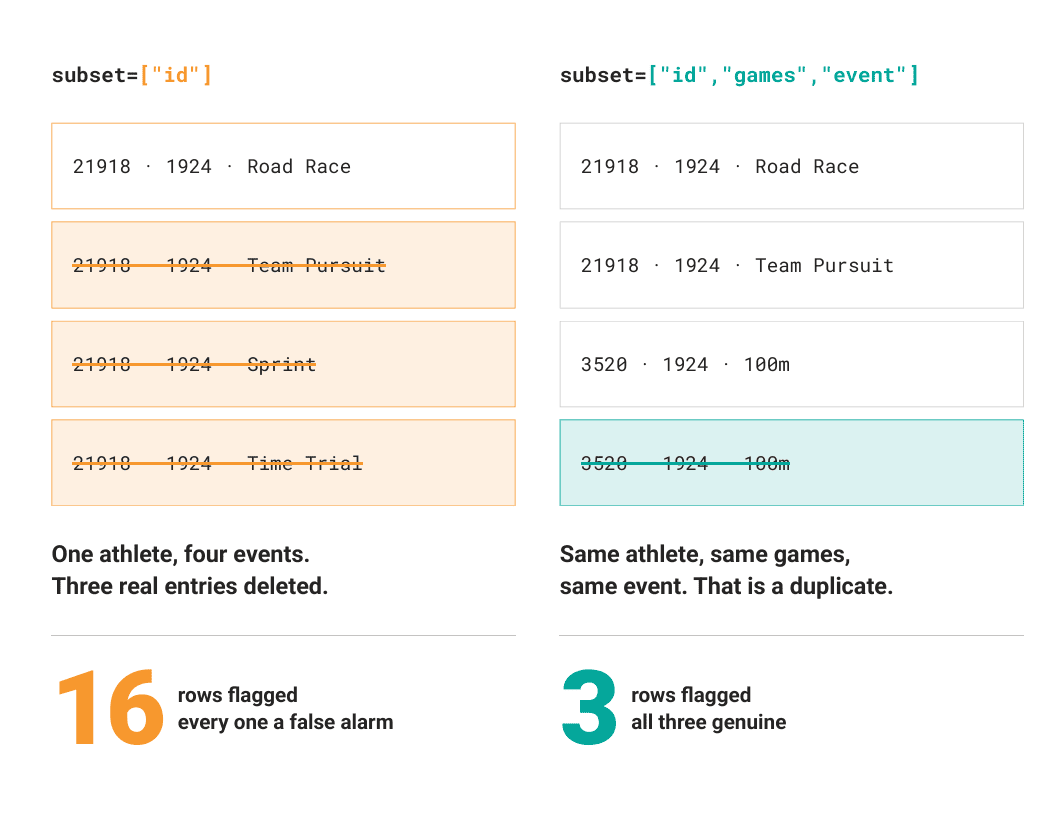
Validation functions can programmatically check for expected columns, identify duplicate records based on natural keys rather than arbitrary identifiers, and flag anomalous values or planted test records. For example, checking for duplicate entries using an athlete’s unique ID alone can easily trigger false alarms, because elite athletes frequently compete in multiple events during the same Olympic Games. Selecting the correct natural key is essential to prevent the accidental deletion of legitimate entries.
Comprehensive validation routines also catch anomalies that bypass standard visual checks. In many datasets, automated test fixtures or placeholder rows accidentally slip into production extracts. These rogue records often constitute a tiny fraction of the total file, remaining entirely invisible to standard summary statistics or null counts, yet they can significantly distort headline figures. Automated validation checks catch these errors instantly, ensuring analytical accuracy.
Writing Tests That Live in the Notebook
Ensuring notebook longevity does not require complex external testing suites. Analysts can easily embed lightweight unit tests directly into the notebook environment by utilizing small, controlled fixtures and standard assertion statements.
By designing miniature data frames that mimic production schemas, developers can verify that cleaning functions drop duplicates correctly, missing values are encoded properly, and features are computed without mutating input frames. Running these validation checks at the start of every interactive session ensures that code modifications do not introduce silent regressions. A failed assertion in the morning is infinitely preferable to an inaccurate executive chart in the afternoon.
Writing Documentation That Runs
Traditional comments and static documentation tend to degrade over time because nothing actively verifies their accuracy. In contrast, executable documentation leverages built-in testing utilities to ensure that code explanations and actual behaviors never drift apart.
By incorporating structured docstring examples within custom functions, developers can automatically test analytical formulas against expected outputs. If a core mathematical formula is updated or modified in future iterations, the embedded docstring tests will immediately fail upon execution, alerting the developer to discrepancies between documentation and implementation.
Making the Notebook Run as a Script
The ultimate test of a resilient notebook is its ability to execute cleanly as a standard standalone script. The final cell of a well-structured notebook typically chains the modular functions together, providing a clear execution path from raw data ingestion to final report generation.
By encapsulating the primary execution logic within standard conditional checks, the notebook can be easily converted into a standard Python script using command-line utilities. This allows the analytical code to integrate seamlessly into traditional software review pipelines and version control systems without triggering unintended side effects upon import.
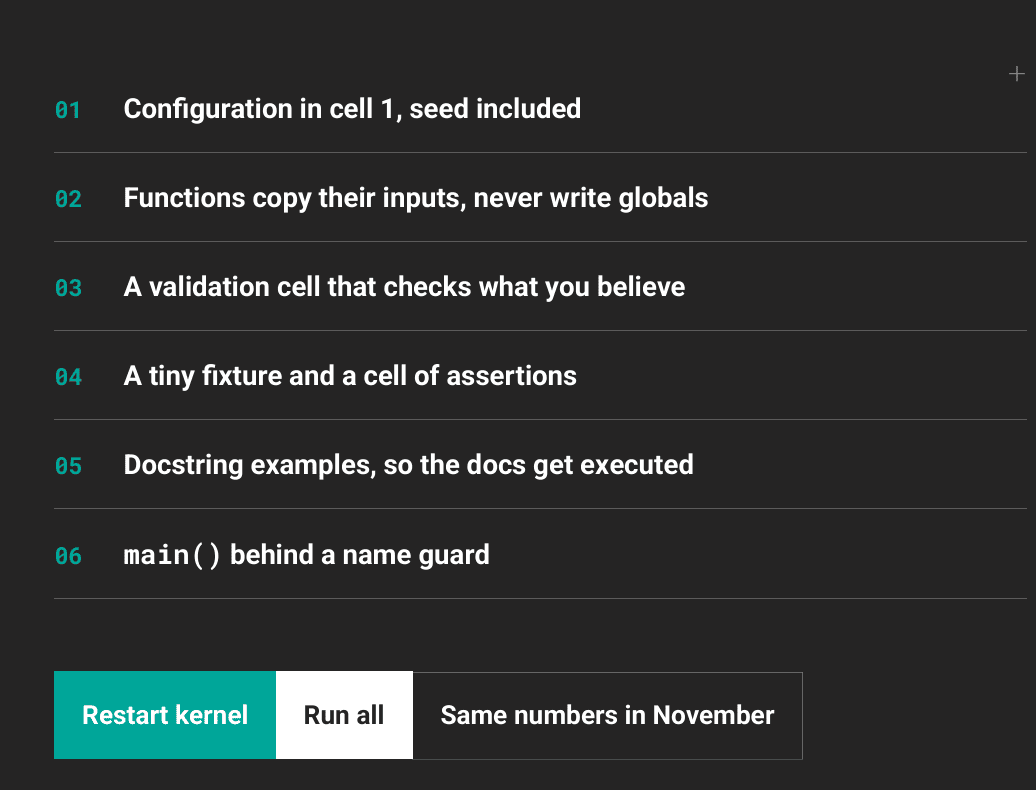
Ultimately, investing a small amount of initial time into structured configurations, modular functions, automated validation, and embedded testing ensures that analytical notebooks remain reliable, transparent, and reproducible over the long term. When a colleague or stakeholder eventually restarts the kernel and runs all cells from scratch, a well-built notebook will execute flawlessly every single time.