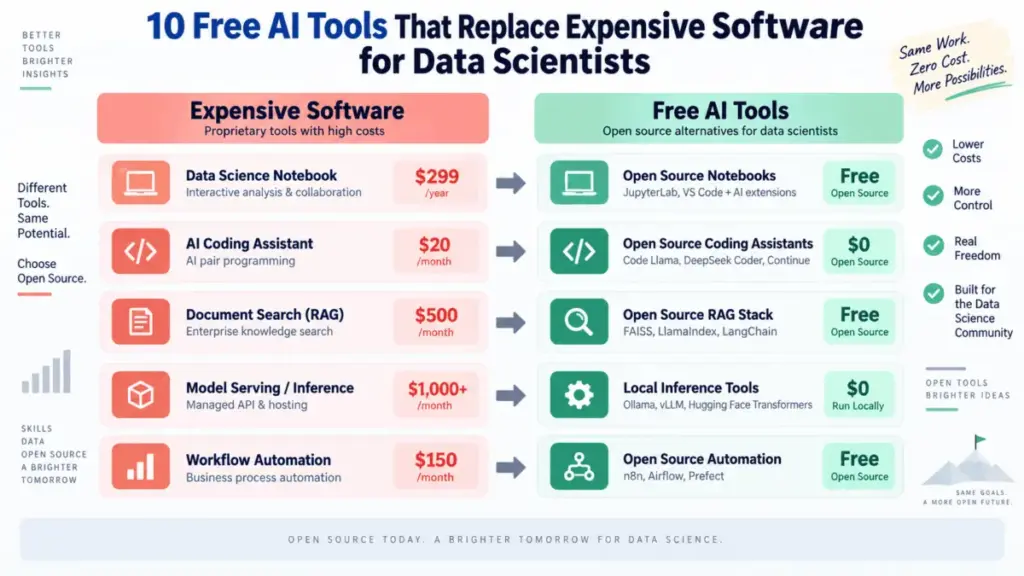
Enterprise data science infrastructure has long been characterized by prohibitive licensing fees, with organizations routinely absorbing massive recurring overhead just to keep their foundational toolkits operational. A single enterprise seat for advanced machine learning platforms like DataRobot can easily exceed fifty thousand dollars annually, while business intelligence solutions such as Tableau Creator demand hundreds of dollars per user each year. Furthermore, modern teams relying on commercial large language model application programming interfaces face continuous per-token fee structures that scale without a ceiling, racking up thousands of dollars in monthly inference costs for data-heavy text extraction, summarization, and pipeline operations.
However, a fundamental shift is reshaping the industry due to the rapid maturation and rising quality of open-source software alternatives. The historical gap between paid enterprise proprietary tools and their free, community-driven counterparts has narrowed dramatically, with the functional divide effectively closed for the vast majority of professional workflows. Capabilities that once necessitated complex cloud infrastructure, proprietary connectors, and expensive commercial licenses can now execute locally at state-of-the-art performance levels, occasionally even surpassing their paid commercial equivalents in flexibility and data control.
This evolution spans the entire lifecycle of data science operations, offering viable, zero-cost replacements across local model inference, AI-assisted coding, automated machine learning, natural language analytics, and advanced observability.
For organizations struggling with unbounded API expenses, local deployment stacks centered around Ollama and Open WebUI have emerged as prominent replacements for proprietary services provided by OpenAI and Anthropic. Ollama allows data science teams to download and execute powerful open-weight language models, including advanced architectures like DeepSeek-R1, Llama 3.3, Mistral, and Phi-4, directly on their own local hardware infrastructure. This eliminates API keys, rate limits, and external data routing, allowing teams engaged in document extraction, text classification, and synthetic data generation to run continuous pipelines without budget anxiety. When paired with Open WebUI, users receive a browser-based chat environment that mirrors mainstream commercial interfaces, complete with multi-turn conversations and file uploads, enabling non-technical stakeholders to leverage local models securely behind corporate firewalls.
The push toward local infrastructure extends to software engineering workflows, where tools like Tabby are challenging paid subscription models such as GitHub Copilot Business and Tabnine. Tabby provides self-hosted, context-aware code completion within popular integrated development environments while operating entirely on private servers. For engineering and data science departments handling proprietary algorithms or operating under strict regulatory compliance mandates, routing code context to external cloud servers presents significant security hurdles. Tabby resolves this tension by keeping the entire code completion pipeline internal while offering repository-level context indexing that adapts specifically to an organization’s internal libraries and coding patterns.
Automated machine learning has similarly shifted toward open-source frameworks, with Amazon Web Services’ AutoGluon challenging enterprise platforms like DataRobot and H2O Driverless AI. AutoGluon automates the end-to-end machine learning lifecycle across tabular, text, image, and multimodal data sets, handling preprocessing, feature engineering, model selection, hyperparameter tuning, and ensemble stacking natively in Python. By avoiding cloud-based platform fees and per-row pricing structures, data teams can execute aggressive iteration cycles without monitoring a corporate billing dashboard.
Natural language data exploration is also experiencing decentralization through projects like PandasAI, which serves as a zero-cost alternative to expensive business intelligence and data transformation platforms such as ThoughtSpot and Alteryx. By integrating a natural language query layer directly over standard Pandas DataFrames, PandasAI allows data scientists and business analysts to execute complex filtering, aggregation, and plotting operations through plain English descriptions. This capability accelerates exploratory data analysis and democratizes data access for non-technical domain experts who prefer conversational interaction over writing custom code, all while maintaining local data privacy when paired with offline foundation models.
For unstructured data and institutional knowledge management, AnythingLLM provides a full-stack retrieval-augmented generation application that rivals expensive enterprise knowledge bases. By pointing the application at local document repositories, PDFs, and codebases, teams can instantly establish a queryable AI knowledge base complete with source citations, replicating the functionality of commercial document search platforms entirely on local hardware.
Similarly, computer vision pipelines are benefiting from tools like Autodistill, which bypasses the expensive per-item pricing models of commercial annotation platforms such as Scale AI and Labelbox. By leveraging foundation models like Grounding DINO and the Segment Anything Model, Autodistill automatically generates high-quality training labels for computer vision datasets using natural language prompts, allowing teams to bootstrap custom object detection models without manual human annotation overhead.
Visual analytics and experiment tracking have also integrated deeply into the open-source ecosystem. PyGWalker transforms standard Python data frames into interactive, drag-and-drop visual exploration interfaces directly inside Jupyter notebooks, offering a streamlined alternative to standalone visualization tools like Tableau and Power BI. For experiment tracking and model registry management, MLflow provides a robust standard that logs parameters, metrics, and artifacts across training runs while expanding its capabilities to track prompt versions, latency, and token consumption for modern language model applications.
At the data storage and querying layer, DuckDB offers an in-process analytical database capable of executing high-performance SQL queries directly against local file formats like Parquet and CSV without requiring the provisioned compute infrastructure associated with managed cloud data warehouses like Snowflake or BigQuery. Finally, for production monitoring of generative AI systems, Langfuse delivers an open-source observability platform that captures traces, token counts, and cost estimates for every model call, providing a self-hosted alternative to managed observability tools like LangSmith.
Industry educators and technical mentors note that while adopting these open-source tools introduces an initial configuration overhead compared to managed commercial platforms, the long-term cost savings and data sovereignty advantages heavily outweigh the setup investment. By tackling high-cost line items incrementally, data science organizations can systematically transition to a robust, entirely open-source infrastructure without sacrificing capability or compromising data privacy.