The United Kingdom has launched a significant crackdown on the shadow infrastructure of the global cryptocurrency economy, imposing rigorous economic sanctions on Cryptomus, a platform widely identified by security experts as a primary conduit for high-stakes cybercrime. The move represents a major escalation in the effort to disrupt digital payment networks that have allegedly facilitated ransomware operations, narcotics trafficking, darknet market activity, and a range of fraudulent services that enable the Russian government to bypass international financial restrictions.
On October 8, the U.K. government officially designated Cryptomus for sanctions, citing its role in processing payments that directly benefit Russian state interests and its financial institutions. The sanctions carry immediate and severe consequences: any assets held by Cryptomus in U.K. banks are now frozen, and British companies are strictly prohibited from engaging in any business dealings with the platform, whether through virtual asset services or traditional financial transactions. The regulatory net cast by the U.K. also ensnared several other virtual payment entities, specifically VexPay, TokenSpot, and the Tsunami Payments service, all of which are believed to play a role in the same ecosystem of illicit finance.
A History of Evasion and Rebranding
Cryptomus, which has operated under various aliases including Certa Payments and Xeltox Enterprises, has proven notoriously difficult for regulators to pin down. Since its inception in 2022, the platform has cultivated a reputation for agility, frequently shifting its corporate identity and operational structure to avoid detection and enforcement. Its most recent incarnation, "Heleket," surfaced following a historic legal blow from Canadian authorities. In October 2025, Canada imposed a record-breaking CAD $176 million fine against the platform for flagrant violations of anti-money laundering (AML) laws.
Despite the heavy financial penalties, Cryptomus has demonstrated a remarkable ability to pivot. Investigations—including a deep-dive analysis by Krebs on Security in December 2024—revealed that the platform acted as a critical payment processor for dozens of Russian cryptocurrency exchanges and websites dedicated to hawking cybercrime-as-a-service. When the heat from international regulators increased, the platform simply launched Heleket as a parallel service. While the original Cryptomus interface eventually implemented stricter "Know Your Customer" (KYC) requirements, which led to a cratering of transaction volume, Heleket continued to operate without such hurdles, effectively providing a "no-questions-asked" gateway for illicit actors.
The Role of Blockchain Analytics in Disrupting Illicit Hubs
The U.K. sanctions are being hailed by industry observers as a strategic move to dismantle the broader infrastructure supporting Russia’s wartime economy. Blockchain data-crunching firm Chainalysis, which has been tracking the movement of funds through these channels, noted that the designation of Cryptomus and Heleket hits the very heart of these illicit payment hubs. According to a blog post published by Chainalysis on October 8, these services became a preferred destination for cybercriminals, noting that the number of illicit counterparties using these platforms surged to more than 900 in a single month during late 2025.

The sheer scale of the activity passing through these channels is staggering. In April 2026, TRM Labs, another leader in blockchain intelligence, released findings indicating that Cryptomus had processed more than $7 billion in transactions since its 2022 launch. The transactions were not merely limited to run-of-the-mill financial fraud; they included direct links to vendors of child sexual abuse material, major terrorist financing networks, and international human trafficking operations.
Enforceability and the "Five Eyes" Precedent
The decision by the United Kingdom to sanction Cryptomus is being viewed as a vital step forward in addressing the limitations of previous enforcement actions. Richard Sanders, a prominent blockchain analyst who has spent months mapping the intricate payment infrastructure of Cryptomus, emphasized the necessity of the U.K.’s move. According to Sanders, while the Canadian fine was a significant symbolic gesture, it ultimately proved unenforceable and uncollectible.
"A fine doesn’t stop a cryptocurrency payment processor from processing payments," Sanders wrote in a LinkedIn analysis following the U.K. announcement. "Sanctions kill the operation. The distinction matters."
Sanders also highlighted the geopolitical significance of this action. This marks the first known instance of a "Five Eyes" nation—the intelligence alliance comprising Australia, Canada, New Zealand, the U.K., and the U.S.—sanctioning a cryptocurrency operation that was incorporated within the jurisdiction of another Five Eyes member. By taking this step, the U.K. has effectively bypassed the jurisdictional loopholes that allowed Cryptomus to weather the Canadian regulatory storm. The platform’s ability to hide behind multiple corporate shells, such as the Vancouver address it shared with dozens of other phantom money transfer businesses, had previously allowed it to ignore administrative orders while continuing to process large volumes of illicit funds.
The Mystery of "Phony" Regulatory Bodies
A central question remains: how do entities like Cryptomus and Heleket derive the apparent authority to conduct international financial services? The investigation into the platform’s roots points toward a web of fabricated financial institutions and a dubious regulatory body operating out of a region with contested sovereignty.

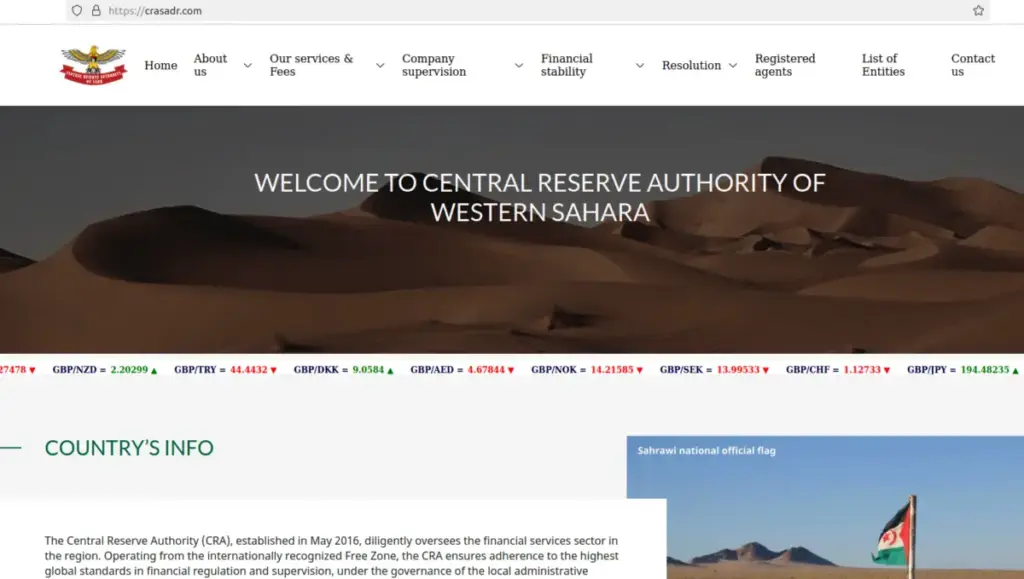
The 2024 investigation into Cryptomus’s parent company, Certa Payments, uncovered that its sole shareholder was a 25-year-old Ukrainian woman. She was also linked to several other firms, most notably the "WS Management and Advisory Corporation." This entity presented itself as the sole regulatory body responsible for overseeing licenses for cryptocurrency, foreign exchange, and online gaming businesses incorporated in the Western Sahara, a disputed region in northwest Africa.
The website for this self-styled regulator, crasadr.com, paints a professional facade, offering services such as bank setup, business formation, and the issuance of licenses for foreign exchange brokers. Further technical analysis revealed that the Certa Payments website once shared a server with over a dozen other domains, including one titled "rasd-state.ws," which purported to be the official site for the Central Reserve Authority of the Western Sahara. This elaborate system of "regulatory" legitimacy appears to have been designed to provide a veneer of legality to high-risk, high-volume cryptocurrency operations, allowing them to solicit customers while operating in the shadows of the global financial system.
As of October 8, the impact of the U.K. sanctions was immediate. Support bots for the platforms on Telegram reported an inability to process transactions, suggesting that the freeze on assets and the prohibition of British business involvement has successfully disrupted the operational capabilities of these services. Whether these entities can once again rebrand and migrate their infrastructure remains to be seen, but the U.K. action has significantly raised the cost of business for those who seek to profit from the digital underbelly of the global economy.