By Staff Reporters
Visitors to Opensource.com may have noticed a distinct quietness settling over the platform lately. For a publication known for its steady stream of articles, essays, and stories about creating, adopting, and sharing open source solutions, the recent lull has not gone unnoticed by its dedicated readership. The reason behind the stillness, however, points to an exciting new horizon: the community is hard at work on something entirely new.
While specific details regarding the upcoming project remain under wraps for the moment, the anticipation surrounding the development has given the community plenty to talk about. In looking forward to what comes next, organizers and contributors are taking a step back to reflect on the very nature of the internet, the foundational structures of digital communication, and the human networks that have fueled the open source movement for more than a decade. And what better way to frame a new beginning for a global collaborative project than by looking at the entire internet itself?

The Internet, and Top-Level Domains
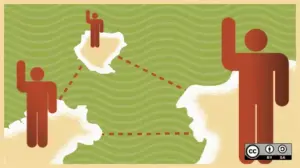
To understand where Opensource.com and its community are heading, it helps to examine where the digital world began. Most people know that the internet is a vast global network. By definition, a network is simply a group of connections. In fact, the very word "internet" is a portmanteau derived from "interconnected" and "network."
In its earliest conceptualization, the internet was a network of interconnected networks consisting primarily of two distinct entities: a military network and an academic network. As long as the digital realm remained confined to these specialized sectors, navigating and categorizing network traffic was a relatively straightforward affair. However, once the internet began to catch on and grow popular outside those two foundational groups, it quickly became apparent that different designations were urgently needed.

Administrators and network architects needed a way to instantly differentiate a commercial entity from a charitable organization, a university from a governmental department, or a personal project from a public institution. These crucial designations eventually became known as top-level domains, commonly abbreviated as TLDs.
Today, internet users have access to a vast array of available TLDs, ranging from specialized geographic extensions to industry-specific labels. But for a long time, there were only a handful of original TLDs that managed the traffic of the entire nascent web. These original TLDs remain deeply familiar and remarkably popular today. Most internet users intuitively recognize that when they navigate to a web address ending in .com, they are visiting a commercial site. Conversely, when they visit an address ending in .org, they understand they are navigating to a non-profit website, an organization dedicated to a public mission rather than a commercial bottom line.
These suffixes do more than just route data packets across the global infrastructure; they tell a story about the intent, governance, and identity behind the digital space being visited. They represent the institutional structures that have long defined how organizations present themselves to the digital public.
Open Source Is a Network
This foundational concept of networks and institutional identities brings the conversation directly back to open source. Open source can be many things, encompassing a staggering variety of forms, goals, and implementations. It can be commercial, driving enterprise software solutions and powering global financial markets. It can be non-profit, supporting public infrastructure and digital rights. It can be academic, fostering foundational research and technological innovation. Or it can be cultural, preserving human knowledge, creative works, and shared digital heritage.
No matter what form it ultimately takes, however, open source is always a network. Sometimes, that network consists of computers, servers, and repositories exchanging code across continents. But most importantly, and at its very core, open source is a network of people.

Whether people are gathering physically at an international conference, informally at a local pub, or digitally in an online chat room, the true heartbeat of open source is its community. It is a collective of human beings working together, solving complex technical problems, sharing documentation, and building tools designed to empower users rather than restrict them.
For the past 12 years, the website Opensource.com has been supported by a commercial entity. Throughout that extensive run, the platform has served as a vital hub for publishing stories about creating, adopting, and sharing open source solutions, connecting contributors and readers from all walks of digital life. Yet, the people—referring directly to the readers, writers, advocates, and maintainers who make up the vibrant Opensource.com community—are not commercial entities. They are people.
That distinction matters. As the digital landscape evolves and the needs of the community shift, the structures supporting collaborative spaces must adapt to better reflect the human networks that power them. For a community built on the principles of openness, participation, and shared ownership, aligning the platform’s organizational reality with its community-driven ethos is a vital step forward.
In just one month, Opensource.com is going to resolve that long-standing structural mismatch. The upcoming project promises to realign the platform with the people who have sustained it through more than a decade of storytelling and collaboration. As preparations continue behind the scenes, community members and followers are encouraged to stay tuned for the official rollout of the new initiative.