








For platform engineering teams, managing containerized applications at scale on Amazon Elastic Container Service (Amazon ECS) has long been a complex, resource-heavy endeavor. While ECS provides a robust foundation for running high-performance applications, the "day-two" operations—specifically the management of ingress networking—often create a significant bottleneck. Each new service typically requires a manual or scripted orchestration of Application Load Balancers (ALBs), AWS Certificate Manager (ACM) certificates, AWS WAF web ACLs, and intricate security group configurations. As organizations scale from a handful of services to hundreds or thousands, keeping these resources synchronized becomes increasingly difficult, often leading to configuration drift, increased deployment times, and heightened security risks.
To address these operational hurdles, Amazon Web Services has officially announced the launch of Amazon ECS Gateway, a new account-level resource designed to fundamentally simplify ingress networking for containerized workloads. By shifting the burden of infrastructure provisioning and management to the ECS control plane, the new feature allows teams to focus on application logic rather than the underlying network plumbing.
Streamlining the Infrastructure Lifecycle
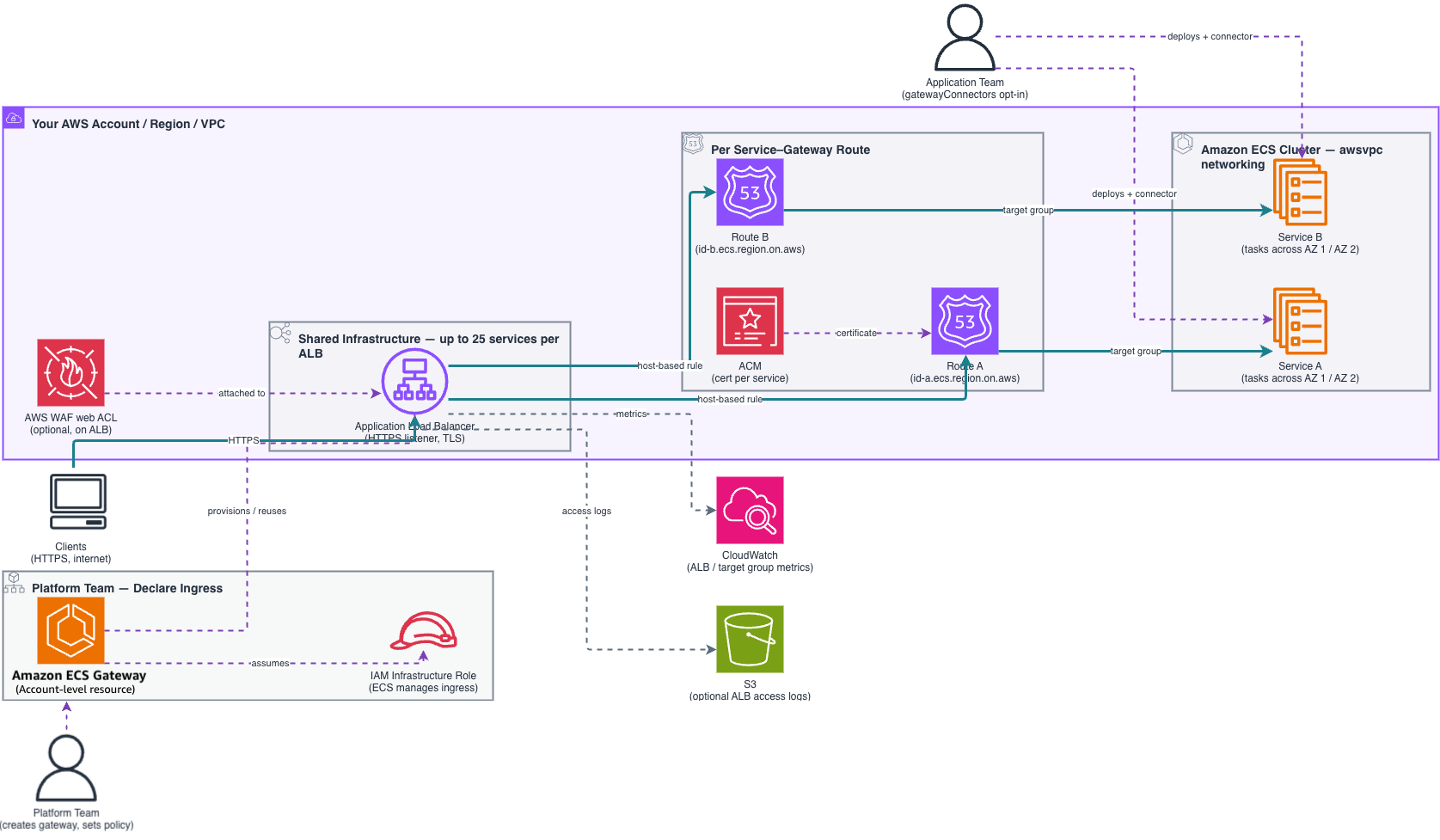
The core philosophy behind ECS Gateway is the automation of infrastructure lifecycle management. Instead of requiring developers to provision individual load balancers and certificates for every single microservice, ECS Gateway acts as an intelligent orchestrator. When a platform team creates a gateway within their account, it serves as a central hub for ingress traffic. From that point on, ECS manages the heavy lifting: it dynamically provisions and configures the necessary load balancers, security groups, and certificates on behalf of the user, ensuring all resources remain in sync with the state of the services they support.

This approach introduces a much-needed separation of concerns between platform teams and application developers. Platform teams retain control over the gateway’s global configuration—such as security policies, load balancer schemes, and infrastructure roles—while application teams simply "connect" their services to the existing gateway. This model significantly reduces the risk of misconfiguration, as the service-level network resources are created automatically based on verified, secure templates managed by the platform team.
Optimizing Performance and Cost
A standout feature of ECS Gateway is its ability to optimize infrastructure utilization through host-based routing. By allowing up to 25 different services to share a single Application Load Balancer, the gateway helps organizations significantly reduce their infrastructure footprint. This is a departure from traditional models where services might be deployed with dedicated load balancers, often leading to underutilized resources and unnecessary costs.
The lifecycle management provided by ECS is proactive and intelligent. The service monitors the capacity of the gateways; it will automatically provision the first ALB when the initial service connects and will continue to add capacity as needed. Conversely, if a service is removed or traffic patterns change, ECS manages the cleanup, removing resources that are no longer required. Each service is provided with a unique, ready-to-use DNS hostname the moment provisioning is complete, eliminating the wait time previously associated with DNS propagation and manual load balancer registration.

Integration and Configuration
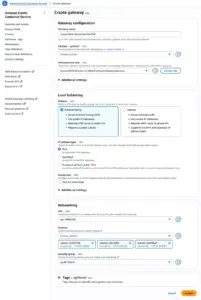
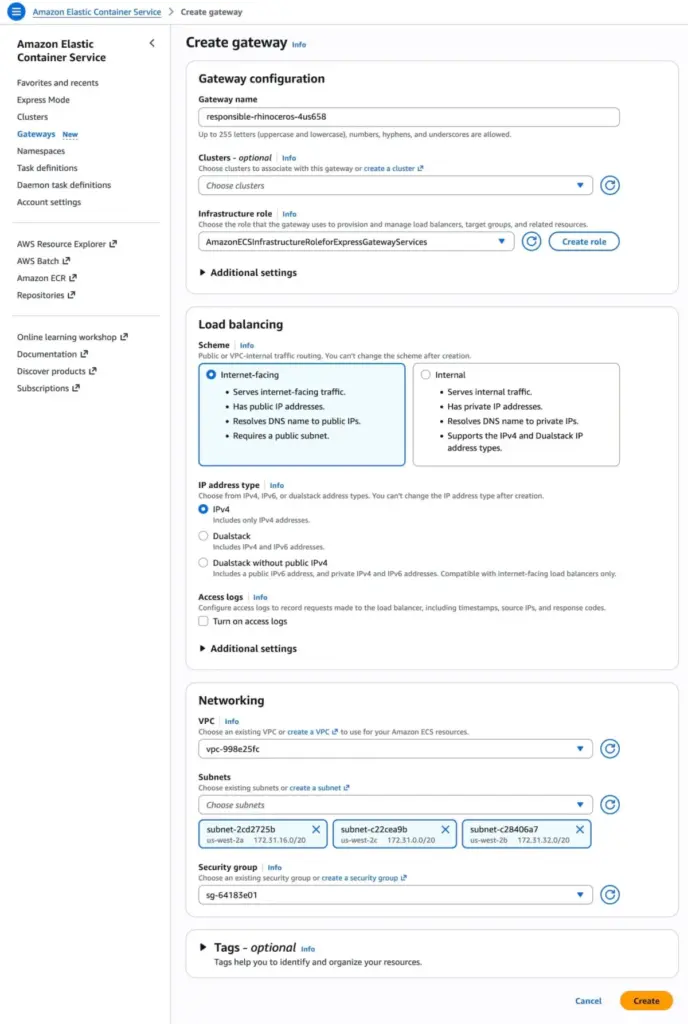
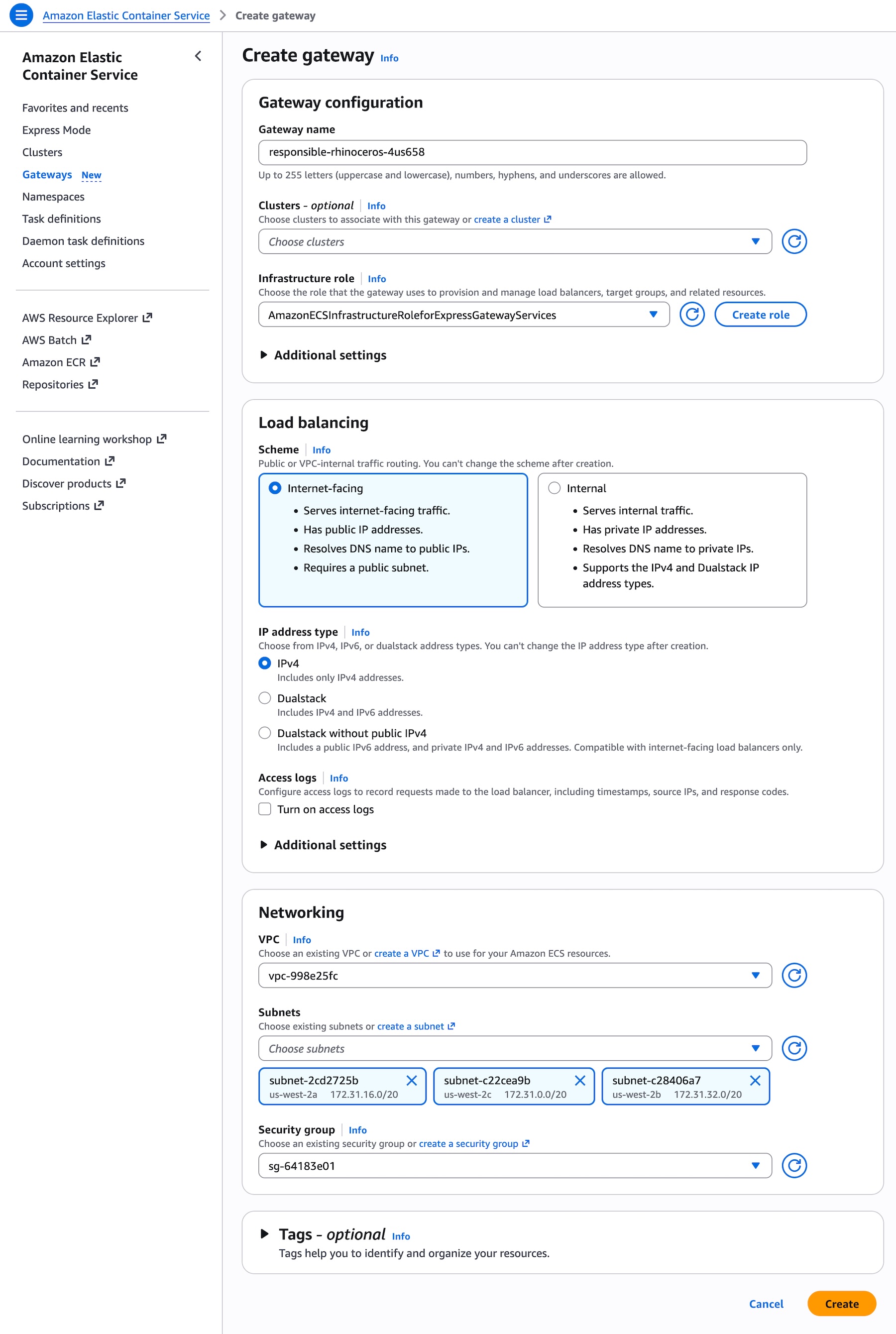
Getting started with ECS Gateway is designed to be intuitive for those already familiar with the AWS ecosystem. Through the ECS console, platform teams can define a gateway by providing a name and selecting an infrastructure IAM role—the permissions set that allows ECS to manage networking resources such as ALBs and WAF web ACLs on the user’s behalf. During the setup process, teams can choose between public or VPC-internal routing schemes, and configure essential parameters such as listener protocols and security requirements.
Once created, the gateway functions as a flexible resource that can be associated with multiple ECS clusters, and conversely, a cluster can be associated with multiple gateways. This many-to-many relationship provides platform teams with the agility to create distinct gateways for different environments—such as public-facing traffic vs. internal-only APIs—and assign them to specific clusters based on the needs of the application teams.
For teams that prefer infrastructure-as-code or automated workflows, the AWS Command Line Interface (CLI) offers full support for these operations. Using the CreateGateway command, users can define their network configuration, subnets, and security parameters in a structured object. The system is built to remain dormant until a service explicitly requests a connection, at which point the automated provisioning sequence is triggered. This "just-in-time" provisioning ensures that costs are only incurred when actual workloads are deployed.
A Measured Approach to Adoption
Recognizing that many organizations have existing, complex networking setups, AWS has ensured that ECS Gateway supports incremental adoption. If a team is currently running an ECS service with a legacy load balancer configuration, they can adopt the gateway by adding a connector to their service definition via UpdateService. This allows for a parallel deployment where both the old and new ingress paths exist simultaneously. Teams can validate the new connection, verify that their service is reachable through the gateway, and confirm that all security and traffic routing rules are functioning as expected before decommissioning the legacy infrastructure.
When a service is deployed, Amazon ECS performs a compatibility check to ensure that the gateway matches the service’s requirements, including VPC alignment and Availability Zone coverage. If all conditions are met, ECS handles the provisioning of the ACM certificate, the listener rule, and the necessary security group updates. Once the gateway route reaches an ACTIVE status, the service is immediately ready to handle production traffic.
Behind the Scenes of the Gateway
The architecture of ECS Gateway is designed to handle high-scale environments. A single gateway can be associated with up to 10,000 clusters, providing a robust solution for large enterprises with expansive microservices architectures. By using IAM policies to control which teams can associate which gateways with which clusters, organizations can enforce strong security boundaries. This governance capability ensures that application teams can only deploy to the environments that are appropriate for their specific services, maintaining a "least-privilege" access model across the entire organization.
The operational benefits extend to maintenance and security. When it comes to managing SSL/TLS certificates, ECS Gateway handles the renewal and association of ACM certificates automatically, removing one of the most common sources of production downtime—expired certificates. Furthermore, by centralizing the WAF configuration at the gateway level, security teams can ensure that consistent web application firewall policies are applied across all services connected to that gateway, providing a uniform security posture that is far easier to audit and update than individual per-service ACLs.
Availability and Pricing
Amazon ECS Gateway is currently available in all commercial AWS Regions where Amazon ECS is offered. AWS has positioned the feature to be cost-effective, with no additional service fees for using the gateway itself. Customers pay only for the underlying AWS infrastructure that is provisioned within their accounts, such as the Application Load Balancers, CloudWatch logs and metrics, ACM certificates, and data transfer costs. This transparent pricing model ensures that as teams migrate to this more efficient networking model, their costs remain directly tied to the resources actually in use.
As the industry continues to shift toward more automated and "platform-centric" approaches to cloud infrastructure, tools like ECS Gateway represent a significant step forward in reducing the cognitive load on engineering teams. By abstracting the complexities of ingress networking, AWS is enabling developers to focus on building features rather than managing the infrastructure that delivers them. For those looking to dive deeper into the technical specifications or to begin integrating ECS Gateway into their workflows, comprehensive documentation is available through the official Amazon ECS developer resources, and the team behind the service continues to welcome feedback through AWS re:Post and traditional support channels.