










As artificial intelligence continues to fundamentally reshape how digital products are conceptualized, constructed, shipped, and evaluated, organizations across industries are confronting a stark reality. The primary challenge in the current technological landscape is rarely a lack of promising AI prototypes or cutting-edge research. Instead, the persistent hurdle lies in bridging the critical gap between an impressive experimental model and a finished product that real users can genuinely trust and rely upon in daily operations.
Industry observers note that this crucial operational space is precisely where the modern AI product manager lives. Unlike traditional product managers who have historically overseen deterministic systems with predictable behaviors, contemporary AI product managers must navigate outputs that frequently shift, occasionally hallucinate, and behave with significant variance across diverse user populations. Succeeding in this demanding environment requires a rare fluency in machine learning trade-offs, rigorous evaluation systems, complex compute economics, and evolving regulatory frameworks—all while maintaining clear, effective communication channels with software engineers, legal counsel, and executive leadership.
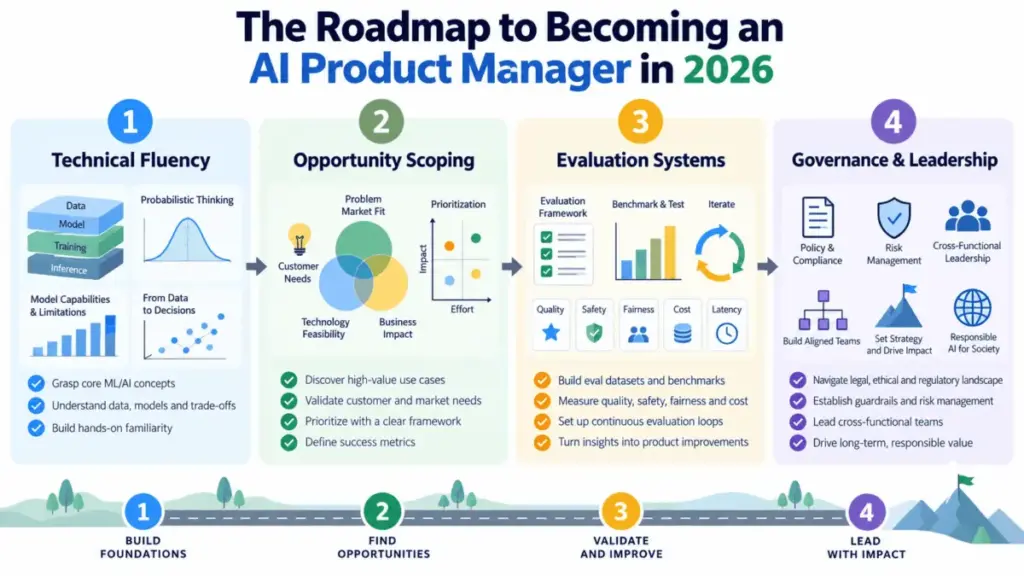
To help professionals navigate this rapidly shifting terrain, industry experts have outlined a comprehensive developmental roadmap that breaks the career path into four distinct phases. Moving progressively from foundational technical fluency through to high-level organizational leadership, each phase builds directly upon the last, allowing professional skills to compound rapidly once the necessary mindset shift takes hold.

The foundational stage of this journey requires aspiring AI product managers to make a definitive mental pivot away from traditional deterministic thinking and toward a probabilistic mindset. Conventional software engineering has long operated on predictable rules: given a specific input A, the system reliably produces a specific output B. By contrast, modern AI systems produce outputs that are inherently likely, approximate, and heavily context-dependent. Rather than viewing this probabilistic behavior as a flaw to be engineered away, successful AI product managers learn to embrace it as the operational terrain they are managing.
Aspiring leaders in this space begin by building deep intuition around major architectural choices they will inevitably encounter during product development. While they do not necessarily need to implement these architectures from scratch, they must understand the underlying technical trade-offs well enough to ask incisive questions during scoping discussions and push back constructively against engineering assumptions during project planning.
Alongside architectural awareness, professionals at this stage must learn to expertly manage a perpetual three-way tension that will define their careers: balancing latency, cost, and accuracy. Considerations such as token consumption, time-to-first-token metrics, and context-window sizing naturally emerge in nearly every strategic product discussion. Experts recommend immersing oneself in foundational resources on large language models and practical deep learning to build architecture intuition without requiring heavy, advanced mathematics prerequisites.
Once an aspiring product manager has mastered this essential technical vocabulary, the next critical competency involves identifying which specific AI opportunities are genuinely worth pursuing and understanding why the vast majority of proposed use cases ultimately fail to make economic sense. Navigating this phase requires structured frameworks for mapping tasks along multiple axes, evaluating both the potential value if the system performs successfully and the potential risk if it encounters failure. High-leverage, low-risk tasks such as basic classification, text summarization, and routine document extraction consistently serve as solid early candidates for development. Conversely, high-risk tasks involving safety, critical compliance, or irreversible actions demand substantial evaluation infrastructure long before they are cleared for deployment.
A defining skill at this juncture is mastering the complex build, buy, or assemble decision. This choice is rarely purely technical; it is deeply financial. Product managers must learn to accurately model the unit economics of compute, analyzing how gross profit margins hold up as token consumption scales over time. Understanding how GPU hosting costs compare to per-call API fees at significant volume multipliers, and calculating the precise costs associated with vector database queries and retrieval depths, separates professionals who build sustainable AI products from those whose impressive demos collapse under real-world load.
As products move from conception to user experience design, the role diverges sharply from conventional product management practices. When a software product’s outputs are inherently probabilistic, teams can no longer rely on binary pass-and-fail testing paradigms. Instead, they must establish robust evaluation infrastructure and adopt eval-driven development practices.
User experience design for non-deterministic interfaces introduces complex challenges entirely foreign to traditional software environments. Product managers must determine how to effectively communicate system uncertainty to users without eroding their trust, how to design graceful degradation states for moments when the model produces incorrect results, and where to strategically insert human-in-the-loop checkpoints. Furthermore, they must engineer continuous feedback loops—collecting both explicit user ratings and implicit behavioral signals—that allow the system to improve organically over time.
Before launching any user-facing artificial intelligence feature, rigorous adversarial testing and red-teaming are treated as absolute necessities rather than optional afterthoughts. Structured probing for prompt injection vulnerabilities, behavioral boundaries, and worst-case scenario simulations must be embedded directly into pre-launch checklists from the very beginning of the product lifecycle.
The final phase of the roadmap transitions from initial building to large-scale operations, shifting the professional focus from individual contribution to broad organizational influence. Artificial intelligence products operating at significant scale invariably encounter complex regulatory, legal, and cultural challenges that require the product manager to act as a versatile translator between technical researchers, legal experts, and business executives.
Regulatory literacy has rapidly transformed from a niche advantage into a fundamental baseline requirement. Emerging legislative measures, such as the European Union artificial intelligence act alongside various domestic executive orders and sector-specific rules governing healthcare and finance, directly dictate what companies are permitted to build, where those models can be deployed, and what documentation must be meticulously maintained. While product managers do not need formal legal degrees, they must possess enough working knowledge to flag regulatory exposure early in the development cycle and collaborate productively with legal counsel.
Concurrently, data lineage and privacy remain ongoing operational priorities. Teams must constantly evaluate which customer data is being transmitted to external model providers, what sanitization pipelines exist before information interacts with a model, and how enterprise opt-out policies are enforced. In enterprise environments, rigorous compliance frameworks such as SOC 2 and HIPAA significantly shape underlying architectural decisions.
Ultimately, cross-functional orchestration remains one of the most vital yet underappreciated skills at this advanced level. The ability to successfully align research engineers who think strictly in benchmarks, legal teams focused primarily on liability, and non-executive stakeholders driven by revenue and risk management is paramount. According to industry educator Vinod Chugani, the defining characteristic of a strong AI product manager is intellectual honesty regarding uncertainty—never overselling model capabilities, diligently constructing reliable fallback systems, and treating evaluation as essential infrastructure rather than an afterthought.