








For pet owners who have ever navigated a cat’s sudden health scare, the transition to a specialized diet is a familiar and often stressful ordeal. A couple of years ago, following a minor health scare, a reviewer’s cat spent a significant stretch on a wet-food diet before eventually returning to dry kibble managed by a smart pet feeder. That period offered a firsthand education in the logistical challenges of serving wet cat food: it demands freshness, spoils quickly when left out too long, and forces owners to carefully plan their daily schedules around precise meal times. Beyond the scheduling inconvenience, wet food typically carries a higher price tag than dry kibble and requires maintaining a steady stockpile of cans and pouches.
While wet food was undeniably inconvenient, it was considered a necessary sacrifice to keep the feline companion healthy and happy at the time. Exploring automatic wet food dispensers yielded few practical solutions, as most legacy models relied on bulky freezer packs to keep meals chilled, while the rare refrigerated alternatives offered a capacity limited to just a single day or so of feeding.

Enter the Neakasa Riko, an innovative smart cat feeder designed to tackle these exact pain points by rehydrating food meal by meal. Rather than storing pre-moistened food, the device keeps freeze-dried ingredients and water separated in dedicated compartments, offering partial compatibility with select dry foods as well. When a scheduled feeding time arrives, the unit grinds and soaks the food with integrated water jets before serving it into a retractable bowl. Following a thorough month-long evaluation by tech reviewers, the Neakasa Riko has emerged as a fascinating glimpse into the future of automated pet care, though it comes with specific trade-offs regarding cost and dietary suitability.

How the Neakasa Riko Makes Wet Food Easier
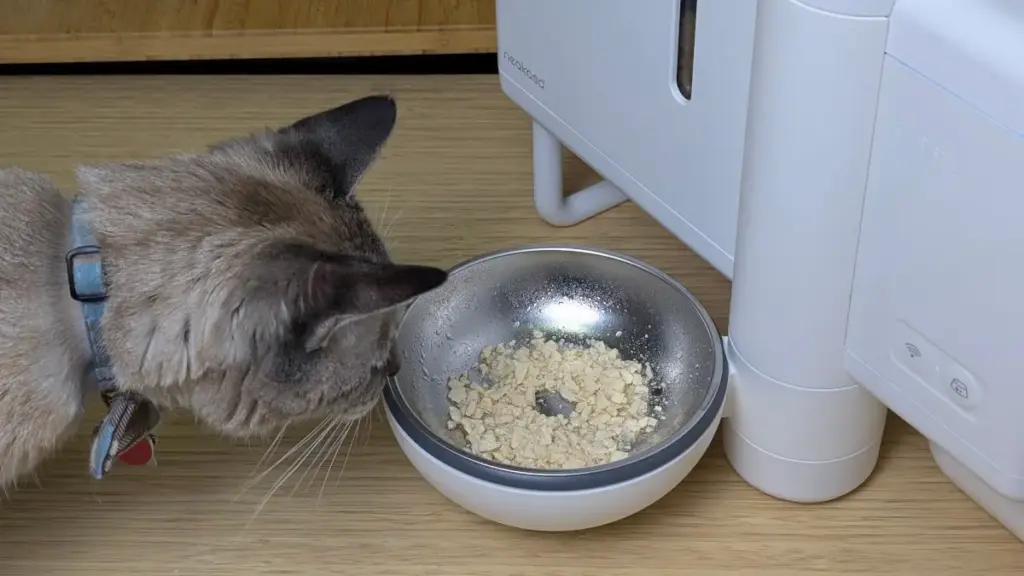
At first glance, the Neakasa Riko immediately distinguishes itself from traditional smart cat feeders. The most prominent physical indicators of its unique functionality are the substantial 80-ounce water tank positioned on the right-hand side and the retractable feeding bowl situated directly beneath the food hopper. Positioned below a built-in grinder and water jets integrated into the underside of the dry food storage chamber, the retractable bowl allows the freshly soaked meal to sit for a designated period to fully rehydrate before a pet approaches to eat.

While the Riko is explicitly engineered to handle freeze-dried food, manufacturer specifications indicate it can also accommodate air-dried and baked cat food formulations. However, Neakasa explicitly advises against using standard extruded kibble in the device. Testers experimented with standard commercial dry food brands that support softening with water, noting that while the Riko did not grind the kibble pieces, the initial results were surprisingly promising. Because cats can be indifferent to subtle textural shifts, early trials showed acceptance, though experts remain cautious about relying on the machine for a total dietary overhaul using unapproved food types.
Combining freeze-dried food with kibble in the Neakasa Riko represents a potentially ideal middle ground for many cats, echoing commercial mixes already available from specialized pet food brands. Owners must determine the optimal water-to-food ratio for their specific pets, but the flexibility is notable. Although the hardware is capable of dispensing water independently from food, reviewers suggest that utilizing this feature purely for independent hydration is an inefficient use of the unit, aside from perhaps maintaining a secondary drinking source adjacent to meal times.

Design-wise, the storage containers are conveniently removable for straightforward refilling and routine cleaning. As an essential safety measure, the appliance refuses to operate unless the food hopper lid is securely locked in place, preventing clever pets from attempting to access the storage compartment directly from the top. The unit also emits an audible chime if the lid remains detached. Similar to other high-end smart feeders, the Riko incorporates a specialized compartment designed to house desiccant packs, ensuring the stored dry ingredients remain fresh and moisture-free.
Maintenance is further simplified by the inclusion of two dishwasher-safe stainless steel bowl inserts, marking a notable upgrade in ease of cleaning compared to older generation smart pet appliances. An ingenious engineering choice involves calibrating the food dispenser’s internal scale with the bowl completely removed, allowing owners to swap out bowls instantly without needing to recalibrate or zero out the weight measurements. The starter package reviewed by CNET also included specialized wet wipes for interior maintenance, replacement desiccant packs, and a limescale cleaning solution to combat mineral buildup within the water reservoir. An optional rechargeable battery pack, capable of providing up to seven days of backup power during local utility outages, is available with the expanded everyday set.

The Neakasa App Is Good
Operating the companion Neakasa app proves to be an intuitive experience. The main software dashboard presents essential metrics clearly, including daily feeding history logs, immediate controls for manual and scheduled feedings, and real-time status indicators for estimated food and water levels. The settings menu accommodates a robust array of features—spanning customized feeding schedules, maintenance reminders, scale calibration, a child lock toggle, and deep-cleaning protocols—organized logically by frequency of use.
Smart device notifications and audible chimes can be polarizing for pet owners, but the Riko’s mealtime chime serves a practical purpose by alerting pets that their food has finished rehydrating and is ready for consumption. Additionally, a small status display on the front of the device shows basic operational information. When idle, owners can configure the screen to display a clock, a minimalist icon, or custom text. Because short custom text strings scroll continuously across the small panel even when they fit entirely within the frame, many users find the motion distracting, often opting for a static heart icon instead. The display and audio settings can also be toggled off completely or scheduled through a do-not-disturb mode for overnight hours.

Notably, the Neakasa Riko omits native integration with broader smart home automation platforms. This design choice aligns with the device’s core purpose of managing dietary intake and feeding schedules reliably. While smart home enthusiasts managing platforms like Home Assistant might appreciate data aggregation, standard home automation triggers—such as adjusting smart lights, controlling door locks, or tracking energy consumption—offer little functional value for a pet feeder, save for perhaps shifting a nearby lamp color to indicate a low food warning.
Putting the Neakasa Riko to the Test
Transitioning a cat to a new diet is notoriously gradual, requiring days or weeks of careful mixing to avoid digestive upset. Because the test cat already maintained a stable diet and freeze-dried chicken represents a significant financial investment, real-world testing focused primarily on replacing daily treats with rehydrated protein. This approach allowed evaluators to assess the machine’s mechanical performance while safely enriching the animal’s nutritional routine.

Discovering the ideal water-to-food ratio required a brief trial-and-error period. Initial tests utilizing equal parts water and freeze-dried chicken failed to entice the cat, who ignored the bowl for nearly an entire day. Because leaving hydrated food sitting out for extended periods risks bacterial spoilage, finding a faster acceptance rate was critical. Adjusting the ratio to one part food to four parts water proved to be the optimal formula, resulting in the cat consuming the entire meal within minutes.
While the Neakasa Riko features an automatic safety retraction mechanism designed to pull the bowl away when uneaten food remains, the threshold is limited to settings between 10 and 60 grams, meaning it cannot accommodate tiny leftover portions. Owners are strongly cautioned against leaving pets unattended with the feeder for multi-day trips until they have thoroughly verified that the machine’s proportions and rehydration times consistently satisfy their pet without leaving spoiled food behind.

A minor software quirk observed during testing involved scheduling execution: scheduled meals consistently dispensed an hour later than programmed, despite correct time zone configurations and the absence of a manual daylight saving toggle. Resolving the issue simply required shifting the schedule forward by an hour. Furthermore, unlike manual feedings where rehydration duration can be customized, scheduled meals automatically allot approximately 20 minutes for soaking, ensuring adequate liquid absorption. Once finished, the bowl remains extended rather than retracting, a design choice that permits pets to clean up remaining morsels and provides immediate physical access for owners looking to swap in a clean bowl.
Is the Neakasa Riko Worth It?
Priced at $240, the Neakasa Riko occupies a unique market position, offering genuine convenience and dietary diversification for pet owners willing to invest in freeze-dried nutrition or moistened kibble. However, economic analysis reveals that relying on freeze-dried food as a primary diet creates a steep financial hurdle. Calculations based on a standard 10-pound adult cat indicate that an exclusive freeze-dried diet sourced from premium brands like Weruva, Instinct, or Stella & Chewy averages around $5.18 per daily serving. That figure is roughly five times higher than budget canned food alternatives like Friskies or Meow Mix, which cost around $1.05 per day, and significantly surpasses mid-tier canned brands like Fancy Feast and Sheba.

Even premium dry kibble remains far more economical, costing a fraction of a dollar per serving. When factoring in traditional canned wet food, competing automatic feeders that utilize refrigeration achieve much lower daily feeding costs. Alternatives like the $170 Petlibro PLAF109 employ refrigeration to keep three canned meals fresh for up to three days, while the $262 PetSafe FreshFeed extends that capacity to six days.
Should You Buy the Neakasa Riko?
Setting aside the high cost of exclusive freeze-dried ingredients, the Neakasa Riko stands out as the most technologically ambitious and convenient smart feeder designed for moist pet diets. It accommodates up to 10 days of food storage, consumes less electrical power than refrigeration-based competitors, and eliminates the need to load individual meal trays manually.

For owners seeking a versatile device capable of handling standard dry kibble, intermittent freeze-dried meals, or vacation-specific automated feeding without locking features behind an expensive software subscription, the Neakasa Riko delivers robust long-term value. While it may not completely replace the economy of traditional canned food for everyday multi-cat households, it represents a sophisticated leap forward in automated pet care technology.