







Developers utilizing AI coding assistants frequently encounter a frustrating bottleneck: generated code that relies on outdated or incompatible library versions. When a developer asks an AI agent like Claude Code to build an application, the assistant often draws from older tutorials or internal training data, implementing deprecated APIs that fail upon execution. This discrepancy leads to import errors, broken workflows, and wasted development time and computational tokens. To combat this widespread issue in "vibe coding," database and messaging infrastructure provider Upstash has introduced Context7, an open-source Model Context Protocol (MCP) server designed to supply AI agents with real-time, version-specific library documentation.
The core challenge facing modern AI-assisted software development is the rapid iteration cycle of programming frameworks and libraries. For instance, a developer with LangChain version 1.x installed might prompt Claude Code to generate an application, only for the assistant to reference legacy patterns like the discontinued LLMChain import. Consequently, the application crashes immediately upon execution. The AI must then diagnose the version mismatch, search for the correct updated API, and rewrite the code—a trial-and-error process that can span multiple failed runs. While AI coding tools excel at scaffolding entire applications, their built-in knowledge bases struggle to keep pace with constant upstream API updates.
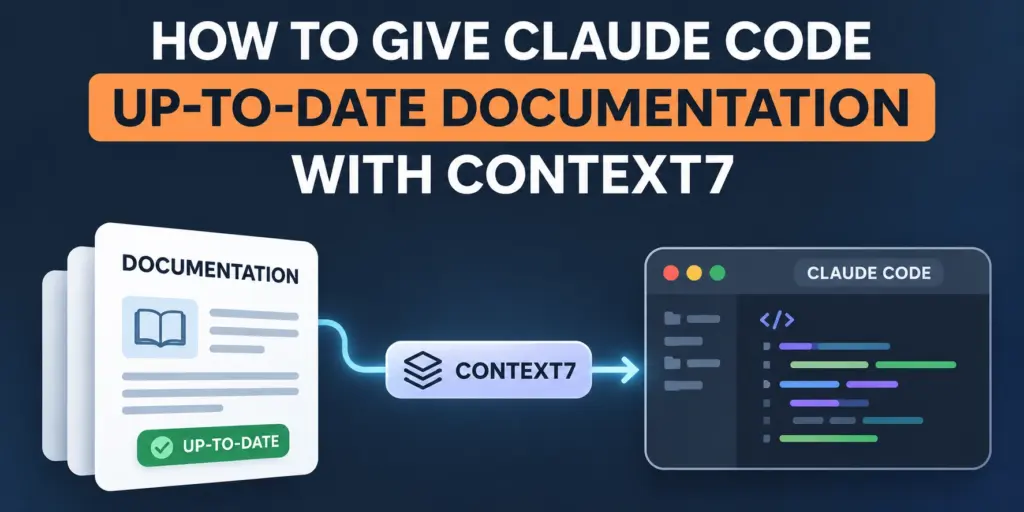
Context7 addresses this friction by acting as a dynamic documentation retrieval service that integrates seamlessly with AI coding assistants via the Model Context Protocol. Rather than forcing developers to manually search official documentation pages, copy code snippets, and paste them into their chat interfaces, Context7 allows the AI agent to autonomously query the exact documentation it needs while actively working on a project. The service operates through two primary MCP tools: resolve-library-id, which pinpoints the correct library in question, and query-docs, which retrieves targeted documentation addressing a specific technical query. The returned text serves as immediate contextual grounding before the AI writes any code.
Integrating Context7 into a development environment can be accomplished through several methods, including a Command Line Interface (CLI) setup, an official plugin, or a manual configuration using an API key. The recommended CLI installation requires Node.js version 22.13 or newer alongside Claude Code. Executing a single setup command launches an interactive configuration process that authenticates the user, generates an API key, and establishes the necessary MCP integration. This configuration also installs background rules and skills designed to help Claude Code recognize precisely when external documentation retrieval is required during a coding task.
Once connected, developers can verify the integration through Claude Code’s built-in MCP management interface using a simple inspection command to confirm that the server status is active and authenticated. When functioning correctly, the agent gains direct access to the documentation lookup tools. This integration transforms how the AI interacts with unfamiliar or rapidly changing codebases, ensuring that generated solutions align with the exact versions installed in the local project environment rather than defaulting to generic or obsolete examples.
The practical impact of this architecture becomes evident during complex coding tasks involving major framework updates. When tested with Next.js 16 to implement a proxy convention for securing a dashboard route, an AI agent equipped with Context7 successfully queried the relevant documentation multiple times before writing code. Instead of relying on legacy routing patterns, the agent retrieved specific guidance on the new proxy file convention, authentication procedures, and upgrade paths. It then mapped out the required server-side APIs, including the proxy(request) export, NextRequest and NextResponse utilities, and route matching configurations, producing accurate code tailored precisely to the installed framework version.
Beyond automated queries, developers can formalize this behavior across projects by incorporating explicit rules into project-level configuration files such as CLAUDE.md. By instructing the AI to always identify installed library versions, retrieve relevant documentation through Context7, and prioritize supported alternatives over deprecated APIs before generating code, development teams can enforce consistent code quality. This instruction-based approach enables the assistant to invoke documentation tools proactively, eliminating the need for developers to manually prompt the agent to use external context on every feature request.
Context7 also provides substantial utility when managing library upgrades and migrations, a scenario where breaking changes frequently disrupt development workflows. For example, migrating complex data models from Pydantic version 1 to version 2 involves numerous structural adjustments, such as replacing the inner class Config structure with model_config = ConfigDict(...) and updating legacy field validators. By instructing the agent to retrieve version-specific migration guides, developers can streamline the transition process. The AI can accurately translate deprecated validation methods, adjust optional field behaviors that alter default values, and apply updated serialization methods without introducing silent bugs.
For developers seeking alternative installation pathways, Context7 supports an official plugin managed directly inside the Claude Code interface, bypassing the need for local Node.js tooling or manual API key management through browser-based authentication. Alternatively, technical users preferring granular control can manually configure the hosted MCP server or run a local instance using an explicit API key generated from the Context7 dashboard. While these tools do not replace traditional testing, code reviews, or official reading material, they provide AI coding agents with a reliable foundation, minimizing version-related errors and bridging the gap between static training data and rapidly evolving software ecosystems.