











Not every artificial intelligence task requires a massive, resource-heavy language model to generate paragraphs of conversational text. Often, automated systems simply need to make a rapid, discrete choice—such as selecting the appropriate tool, categorizing an incoming customer complaint, or determining whether a digital transaction exhibits signs of suspicious activity.
This operational shift has catalyzed the development of Decision AI, a specialized branch of machine learning designed to bypass text generation entirely. With the recent debut of proprietary systems like Jev by TypeSafe AI alongside a rapidly growing ecosystem of open-source alternatives, developers now have access to models built explicitly to make structured decisions and return precise probabilities without the overhead of natural language generation.
The concept addresses a fundamental inefficiency in modern software architecture. Traditional large language models are engineered to predict the next token in a sequence, a process that is computationally expensive and slow when applied to binary or categorical choices. Decision AI refines this underlying mechanics, focusing instead on evaluating a defined set of criteria and outputting statistical confidence levels for predefined options.

What Is Decision AI?
Decision AI represents a targeted application of machine learning focused on structured choice. While broader predictive analytics encompasses many fields, this newer generation of decision models operates on a streamlined principle: instead of generating free-form text, the model selects from explicit, predefined answers and returns associated probabilities.
These specialized systems generally handle three distinct categories of analytical queries. They can process classification tasks by assigning data points to designated categories, evaluate binary conditions to answer true-or-false questions, and score multiple-choice options to determine the most relevant course of action from a set list.
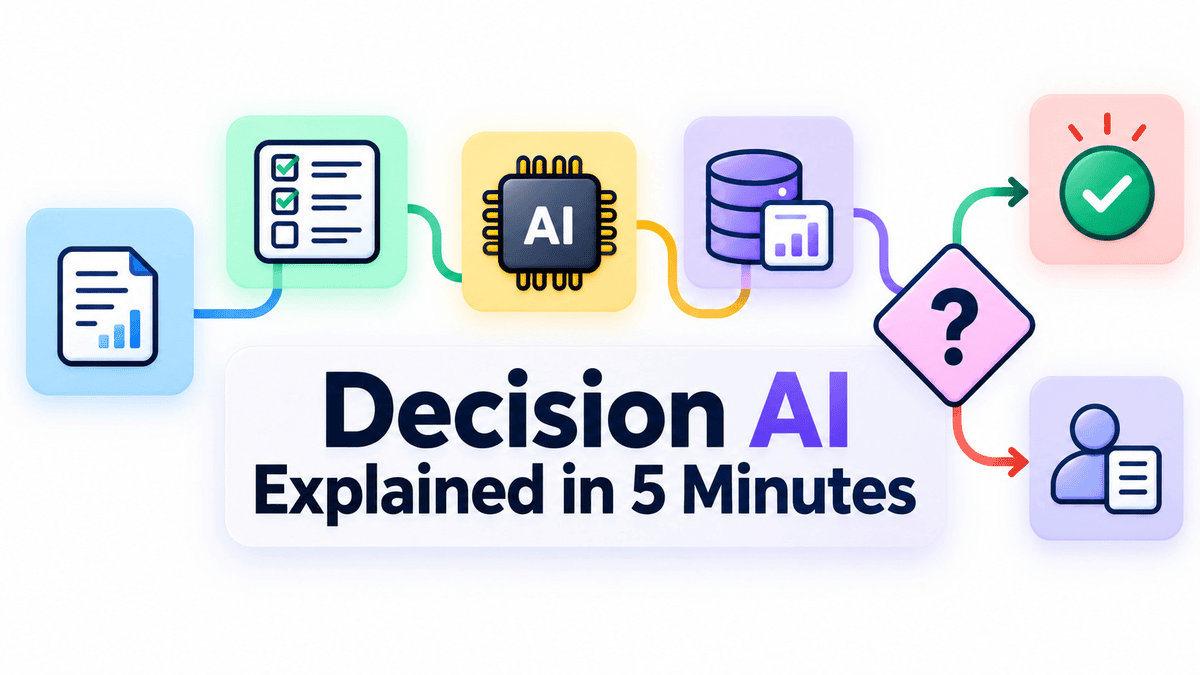
Consider a practical customer support scenario where an automated system receives an email stating that a client was charged twice for a recent order. Traditional workflows might route this through an expensive large language model instructed to draft a polite acknowledgment or extract metadata from a lengthy paragraph. In contrast, a decision model evaluates the incoming text and directly identifies the billing department as the most appropriate destination, attaching a high statistical probability to that conclusion while ignoring the need for prose.
By eliminating the token generation phase, these systems process thousands of similar requests with significantly lower latency and reduced computational expenditure.
How Does Decision AI Work?
The operational workflow for a decision model is structurally straightforward. The system receives a specific state or input, evaluates it against a defined question, and assesses a set of potential answers provided by the developer. The underlying neural network processes this information and returns a structured output consisting of the chosen category and its corresponding confidence score.
In the customer support example, the evaluation yields structured metrics rather than conversational text. The model might indicate that the correct department is billing with a ninety-two percent probability, assess whether the issue is urgent with an eighty-one percent probability, and determine whether human review is required with a seventy-six percent probability.
These numerical outputs allow downstream software applications to consume the data directly. Because the format is predictable and structured, engineers do not need to write fragile parsing scripts to extract information from generated paragraphs. While these probabilities must be tested rigorously against real-world data before deploying automated actions, the deterministic nature of the output streamlines application logic.
Turning Large Language Models Into Decision Models
The architectural foundation of Decision AI relies on repurposing the internal mechanisms of traditional language models. When a standard model processes an input sequence, it calculates raw numerical scores, known as logits, for every possible next token in its vocabulary.
Instead of sampling from these logits to generate text, decision models extract the specific scores associated with predefined answer tokens. A mathematical function called softmax is then applied to convert these raw scores into standardized probabilities. For instance, when evaluating a product review, the model calculates the internal weights for positive and negative sentiment tokens, translating them into relative percentages without producing a single sentence of explanation.
Researchers can take this optimization further by replacing the traditional text-generation layer with a specialized prediction head and fine-tuning the model entirely on decision-making objectives. This specialized training enables the system to score multiple distinct options and answer several complex queries in a single computational forward pass.
The primary advantage of this approach is the total elimination of token-by-token generation. By bypassing the autoregressive loop required for text creation, repeated operational decisions execute with substantially higher speed and resource efficiency.
Open-Source Decision AI Models and Frameworks
While early commercial implementations like TypeSafe’s Jev operate as proprietary services accessible via managed application programming interfaces, the broader open-source community has moved rapidly to democratize the technology. Because closed-source providers often withhold underlying architectures, weights, and training methodologies, open-source alternatives offer essential transparency for enterprises with strict data governance requirements.
Developers now have access to a growing ecosystem of open-source decision models that can be inspected, audited, and fine-tuned for specialized vertical tasks. Projects emerging within this space have demonstrated competitive performance benchmarks, reduced inference latency, and lower total cost of ownership compared to traditional API dependencies.
This shift allows organizations to build sophisticated decision-making pipelines without being locked into a single vendor’s ecosystem. Teams can select smaller, highly optimized models for rapid edge deployment, customize them for domain-specific classification tasks, or execute them entirely on-premises to maintain absolute control over sensitive operational data.
Running Decision AI Locally With Modern Tooling
The software tooling surrounding decision models has evolved rapidly to support local execution. Major local runtime environments, including Ollama and llama.cpp, now offer native support for decision models through standardized compatibility endpoints, allowing developers to integrate these systems into local development workflows effortlessly.
Ollama supports specialized architectures such as Nimble and Tev1, while llama.cpp provides robust execution support for models like Laya, Kev, Julia-1, and OpenJev. Running these systems locally requires minimal configuration. Using llama.cpp, an engineer can initialize a local server instance and load a model such as Laya using standard command-line utilities.
Once the local server is operational, applications can query the model using standard HTTP requests. For example, sending a customer support payload containing an inquiry about a duplicate charge to the local endpoint prompts the model to evaluate the text against predefined criteria. The system returns the designated department and statistical probabilities instantly, running entirely on local hardware without incurring external API fees or transmitting data to third-party servers.
The Future of Decision AI
The broader implications of Decision AI extend far beyond simple customer support routing. One of the most promising developments involves using these lightweight models alongside larger, more capable language models to orchestrate complex AI workflows more efficiently.
In advanced software development environments, an automated coding agent might employ a small, fast decision model to evaluate incoming tasks, select the appropriate software tool, determine whether to perform a web search, or decide when a complex problem warrants invoking an expensive reasoning model. By reserving resource-intensive models exclusively for tasks that demand deep cognitive processing, organizations can dramatically reduce the operational costs of running autonomous agent systems.
Real-time applications also stand to benefit significantly from this technology. Because decision models operate in milliseconds, they are well-suited for integration into high-frequency environments such as interactive video games, automated financial fraud detection systems, robotics control loops, and fast-paced edge computing scenarios.
Despite these advantages, technical challenges remain. As decision models are deployed into mission-critical environments, system reliability and calibration become paramount. Ensuring that a model’s stated confidence score accurately reflects its real-world accuracy requires ongoing empirical validation, careful threshold tuning, and appropriate human oversight. As training methodologies and evaluation frameworks mature, Decision AI is positioned to become a foundational component of modern software architecture, bridging the gap between raw data processing and intelligent automation.