






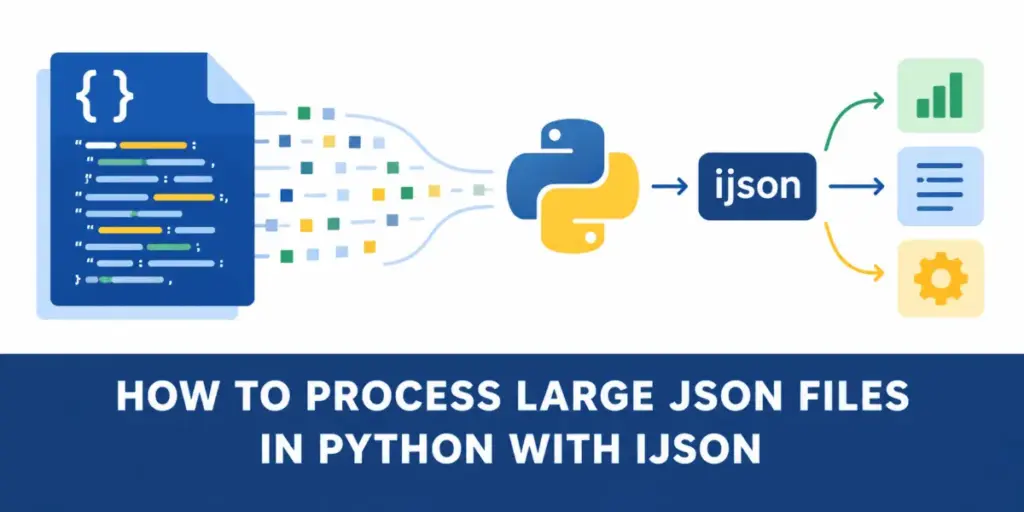
The JavaScript Object Notation format has long served as a bedrock for data storage and application communication in the Python ecosystem. For modest workloads, Python’s built-in json module provides a straightforward and reliable mechanism for parsing data into memory with simple commands. However, modern data engineering challenges often involve multi-gigabyte datasets, exposing significant performance and memory bottlenecks in traditional loading methods. Software engineers and data scientists are increasingly confronting the limits of standard parsing approaches when dealing with large files, prompting a closer look at streaming solutions that can drastically reduce memory overhead.
The core limitation stems from how traditional functions like json.load() handle incoming data. When a Python application calls this built-in function, the interpreter reads the entire document from disk, parses every object, and constructs the corresponding Python dictionaries, lists, strings, and numeric types in memory before any analytical operations can begin. Consequently, a file that occupies a few hundred megabytes on secondary storage can easily demand several times that amount in RAM once translated into native Python objects. This discrepancy frequently triggers severe performance degradation, swapping, or outright application crashes due to out-of-memory errors on constrained infrastructure.
To address this challenge, developers are turning to iterative parsing strategies that allow applications to process information incrementally. A prime example of this approach is ijson, an iterative JSON parser designed to stream data record by record. Rather than waiting for an entire document to load into memory, an iterative parser reads and analyzes the file on the fly, enabling developers to process massive datasets on hardware with limited resources.
To demonstrate the real-world implications of this memory bottleneck, technology practitioners frequently look to expansive public datasets, such as the San Francisco City Lots collection available through open-source repositories. This particular dataset, structured around standard GeoJSON FeatureCollection hierarchies, contains detailed land-parcel information spanning more than 200,000 individual records. While the raw file size sits at a manageable 181 megabytes, it serves as an ideal testbed for illustrating the stark contrast between loading an entire document at once versus streaming its contents.
When analyzing such files using the standard json.load() approach, an application must parse every single polygon, coordinate, and structural property before the developer can execute even a basic search query. In typical analytical scenarios, an engineer might only need a tiny fraction of the available fields, such as specific street names or parcel identification numbers. Nevertheless, the traditional parsing model forces the system to consume valuable RAM for every deeply nested coordinate array, regardless of whether that geographic data is relevant to the task at hand.
Memory profiling experiments reveal the true extent of this footprint. When executing a standard load operation on the San Francisco city lots dataset, peak memory consumption can spike dramatically beyond the original file size on disk. This inflation occurs because a simple string value paired with its key in a JSON document expands into multiple distinct memory allocations once converted into Python objects, nested dictionaries, and lists.
In contrast, adopting an iterative streaming parser fundamentally alters the memory dynamics of the application. By leveraging utility functions that target specific hierarchical paths within the document—such as extracting individual items from a primary feature array—the parser delivers records one at a time. The program processes each parcel, extracts the necessary attributes, and immediately discards the data from memory before moving on to the next entry.
Under this streaming model, the memory footprint remains remarkably stable and low, tied primarily to the active record and the parser’s internal buffer rather than the cumulative size of the entire collection. Benchmarks comparing the two approaches highlight this dramatic divergence in resource utilization. While both methods can complete the core analytical task in comparable amounts of time when sufficient RAM is available, the peak memory consumption drops by hundreds of megabytes when switching to an iterative parsing framework.
Industry specialists emphasize that iterative streaming is not necessarily chosen for raw execution speed, as traditional loading methods can sometimes parse small to medium documents very quickly if ample memory is present. Instead, the primary advantage lies in architectural stability and scalability. By ensuring that memory consumption does not scale linearly with the size of the input file, engineering teams can build robust data pipelines capable of handling growing volumes of information without requiring constant hardware upgrades.
As data volumes continue to expand across industries ranging from geographic information systems to healthcare and machine learning, the methods developers use to ingest common file formats require careful reevaluation. The experience with large-scale JSON processing underscores a broader lesson in software engineering: performance bottlenecks are frequently caused not by the underlying data formats themselves, but by the architectural assumptions made during the ingestion phase. By shifting from a load-everything model to a read-process-discard workflow, developers can maintain efficient, reliable applications even when faced with massive data workloads.