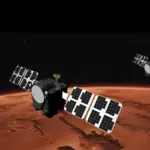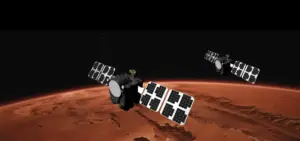









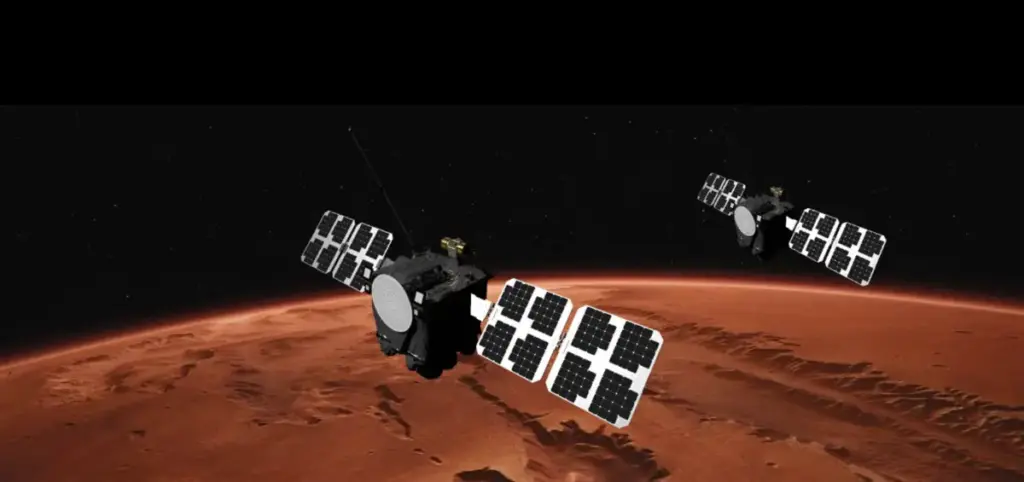
WASHINGTON — Two pioneering NASA smallsats are officially en route to the Red Planet after successfully completing precision flybys of Earth, marking the culmination of a nearly year-long journey since their initial launch and proving a novel trajectory concept that could reshape future interplanetary missions.
The twin spacecraft, known as the Escape and Plasma Acceleration and Dynamics Explorers (ESCAPADE) mission, executed their critical gravity-assist maneuvers over a span of 48 hours in early November. The second spacecraft, nicknamed Gold, swept past Earth at approximately 6 a.m. Eastern on November 9, coming within roughly 1,050 kilometers of the planet’s surface. This milestone followed just over 48 hours after the first spacecraft, Blue, executed a similar flyby at an altitude of approximately 1,600 kilometers.
During both high-speed encounters, the Rocket Lab-built spacecraft fired their onboard main engines at the exact point of closest approach. By executing these burns deep within Earth’s gravity well, the mission utilized a astrodynamics principle known as the Oberth effect, which maximizes the kinetic energy gained from a rocket burn. This historic sequence marks the very first time a NASA planetary mission has utilized a powered Earth flyby to propel a spacecraft toward Mars.

"This is the first time NASA has used a powered Earth flyby to propel a spacecraft toward Mars, and we’ve now executed this maneuver twice, flawlessly, in just two days," said Asal Naseri, acting associate flight director in NASA’s heliophysics division, in an official agency statement highlighting the achievement.
The ESCAPADE mission has broken traditional paradigms for Mars exploration from its inception. Historically, missions to the Red Planet are bound by rigid launch windows that open approximately every two years, dictated by the orbital alignment of Earth and Mars. Breaking this mold, ESCAPADE launched last November as a secondary payload on the second flight of Blue Origin’s heavy-lift New Glenn rocket.

Rather than heading directly to Mars, the twin smallsats spent nearly a year loitering near the Earth-Sun L-2 Lagrange point. This unique staging approach allowed them to bide their time before swinging back toward Earth for the final, critical gravity assist that set them on their interplanetary trajectory.
The sophisticated trajectory was designed by Advanced Space specifically to demonstrate new options for deep-space smallsat missions, circumventing the traditional biennial launch constraint. "This method provides the flexibility to launch almost anytime and then use Earth’s gravity to get a boost to Mars, rather than waiting every two years to launch there directly when the planets are aligned," explained Jeff Parker of Advanced Space.
While the trajectory offered unprecedented launch flexibility, it demanded extraordinary precision. The success of the entire interplanetary transfer hinged on flawless execution from the spacecraft propulsion systems during the brief windows of the Earth flybys.
"These burns were critical in the same way a Mars orbit insertion burn is," noted Rob Lillis, principal investigator for ESCAPADE, during a November 9 meeting of the Mars Exploration Program Analysis Group. "I’m happy to report that they went well. They were executed perfectly."
With the powered flybys successfully completed, the twin spacecraft are now coasting along their precise trajectories toward the Red Planet. They are scheduled to arrive just two days apart in September 2027. Upon arrival, each spacecraft will execute an demanding 11-minute burn of its main engine to capture into orbit around Mars, subsequently maneuvering into their planned operational science orbits.
Once science operations commence, the ESCAPADE mission will focus on unraveling the mysteries of space weather at Mars. The twin probes will examine how the solar wind interacts with the planet’s tenuous magnetosphere and atmosphere, shedding light on the historical evolution of the Martian climate. Initially, the spacecraft will gather observations from the same orbit, separated by up to 30 minutes, to measure short-term variations in space weather phenomena. Later in the mission, they will disperse into separate, complementary orbits—one stationed to monitor the incoming solar wind directly, and the other positioned to observe the resulting effects on the Martian environment.

The journey of ESCAPADE also holds profound significance within the broader landscape of NASA’s planetary exploration programs, representing the last surviving mission of the Small Innovative Missions for Planetary Exploration (SIMPLEx) portfolio. Established to foster low-cost, high-science-return planetary missions using small satellite architectures, NASA originally selected ESCAPADE for development in 2019 alongside two other ambitious SIMPLEx endeavors: the Janus asteroid flyby mission and the Lunar Trailblazer lunar orbiter.
However, the SIMPLEx program has faced severe headwinds in recent years. NASA canceled the Janus mission in 2023 after launch delays on the Psyche asteroid mission—its designated rideshare host—prevented it from meeting its target asteroid encounter windows. Meanwhile, the Lunar Trailblazer orbiter encountered a critical malfunction shortly after its launch in February 2025. Despite extensive recovery efforts, NASA formally terminated the Lunar Trailblazer mission five months later after determining the spacecraft could not be saved.
These setbacks follow earlier losses within the cubesat-class tier of the SIMPLEx initiative, notably the LunaH-Map and Q-PACE missions, both of which failed to achieve their science objectives following launch. Driven by tightening budget pressures across federal science programs, NASA has not issued solicitations for new SIMPLEx mission concepts and has indicated no plans to revive the program solicitation cycle in the foreseeable future.
As ESCAPADE continues its quiet, steady cruise through deep space toward its September 2027 rendezvous, it carries not only the hopes of unraveling the secrets of Martian atmospheric loss, but also the legacy and validation of low-cost planetary exploration strategies.