









Replacing complex JavaScript logic with sleek, modern CSS features often yields a satisfying pull request that looks pristine at first glance. Removing a verbose ResizeObserver in favor of a container query, for example, results in a code diff dominated by red deletions that easily wins peer approval before lunch. However, a growing body of developer discussion and engineering analysis suggests that this local simplicity can inadvertently introduce hidden complexity into the wider web application.
Frontend developer Gabriel Shoyombo has explored the nuanced friction that occurs when application logic is split between CSS and modern browser features, alongside existing scripts and stylesheets. The core issue centers on a deceptively simple premise: a native CSS feature can successfully streamline a specific piece of code while simultaneously making the broader system significantly harder to reason about if developers fail to account for how it interacts with legacy code.
This tension between local simplicity and systemic complexity has become a prominent topic across developer communities. Recent online discussions on platforms like Reddit have highlighted a deep division in how engineers view modern frontend development. While some developers emphasize that modern CSS capabilities have dramatically improved interactivity and reduced the reliance on heavy JavaScript frameworks, others caution that writing less code on paper does not automatically translate to a less complex system in practice. A native browser feature only truly reduces complexity when it completely replaces what came before it without disrupting the surrounding architecture.


To understand why these migrations frequently lead to unexpected bugs, developers must examine how new CSS features interact with existing systems. The complications typically manifest in several distinct ways, starting with dual ownership of component behavior. When teams migrate from JavaScript-driven classes to native features like container queries, legacy scripts or residual style rules are frequently left behind.
In many migration scenarios, a developer might successfully implement a container query to handle a component’s responsive layout while accidentally leaving an old ResizeObserver script intact in a separate file. Because both implementations happen to agree on initial breakpoints, the application appears stable. However, when design requirements change and a breakpoint is updated in only one location, the component enters an unwritten hybrid state. Resolving these issues requires developers to carefully audit both the stylesheet and the underlying JavaScript to ensure behavior has a single, unambiguous owner.
Beyond script conflicts, the introduction of modern CSS properties can fundamentally alter surrounding layout mechanics in unintended ways. Declaring a property like container-type: inline-size tells the browser to enable style and inline-size containment for a specific element. Yet, this single declaration also implicitly establishes a new block formatting context, which can trigger sweeping layout changes throughout the DOM. Margins that previously collapsed between elements may suddenly become trapped, floated elements can push components further across the screen, and content-sized cards lacking explicit dimensions can collapse entirely.

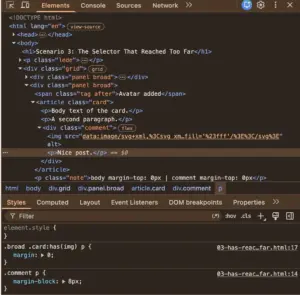
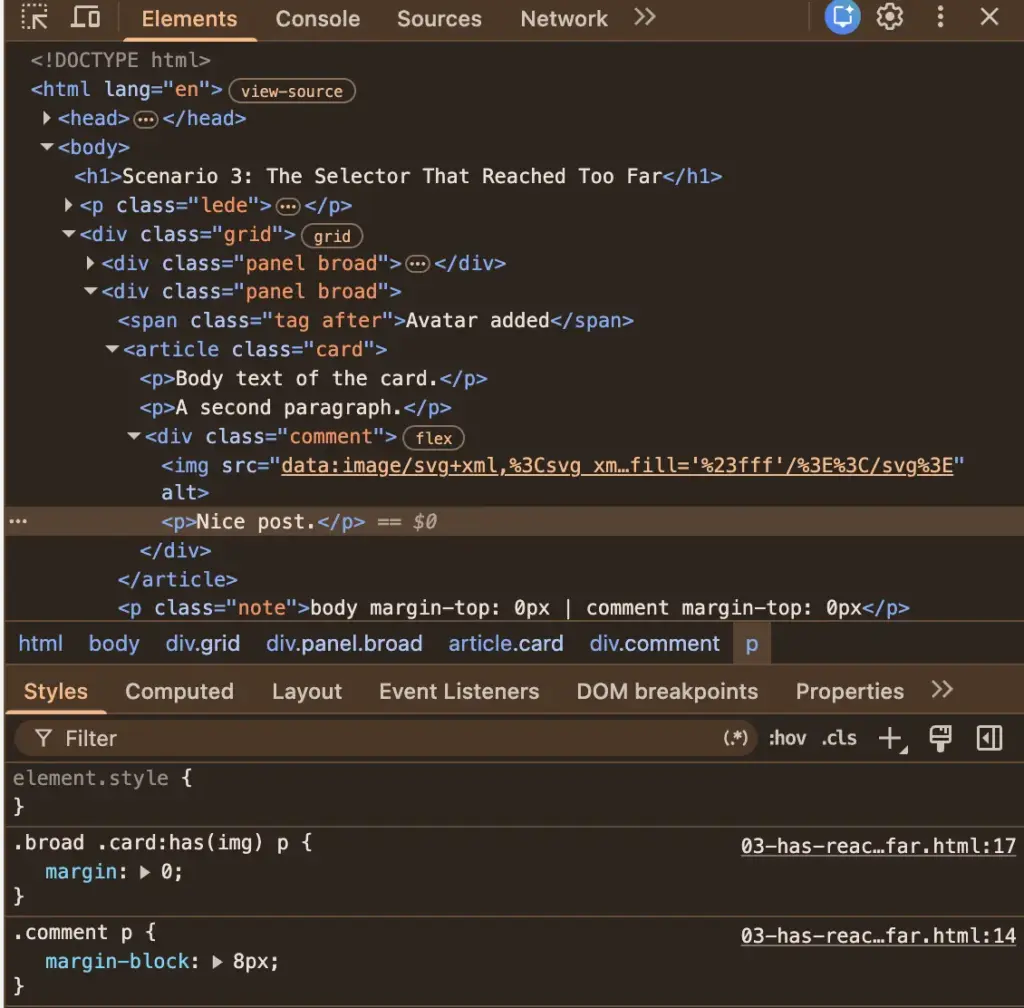
The cascade itself also presents significant challenges when deploying advanced selectors like :has() or native CSS nesting. Short, powerful selectors can easily reach further into a component tree than intended, inadvertently overriding spacing or typography rules in nested child components. Similarly, native nesting adopts the highest specificity of its associated selector list, frequently sparking unintended specificity wars with existing styles. Cascade layers do not automatically shield codebases either; unlayered legacy stylesheets will consistently override layered modern component styles unless both sides of a conflict are properly structured within the layer hierarchy.
Performance implications further complicate these migrations. While developers frequently assume that shifting logic from JavaScript to CSS guarantees speed improvements, the browser’s rendering engine still bears the computational cost. Complex queries and selectors can force the browser to restyle thousands of elements on every state change, sometimes introducing layout thrashing that rivals or exceeds the performance footprint of the original scripts.
Engineering teams navigating these transitions emphasize that most discussions surrounding new web standards are viewed through the lens of greenfield projects, whereas the vast majority of enterprise work involves legacy migrations. Successfully adopting modern CSS requires comprehensive auditing, careful scope management, and a thorough evaluation of how new styling rules integrate with the broader application ecosystem.