




Managing containerized applications at scale on Amazon Elastic Container Service (Amazon ECS) has long been a powerful way to run cloud-native workloads, but it has historically come with a significant operational tax for platform teams. As organizations expand their footprint, the process of configuring ingress networking for every individual service often transforms into a persistent bottleneck. For each new microservice, developers and platform engineers have been required to manually provision and orchestrate a complex web of supporting infrastructure: Application Load Balancers (ALBs), AWS Certificate Manager (ACM) certificates, AWS WAF web ACLs, and intricate security group rules.
Keeping these resources in perfect synchronization as services scale, undergo updates, or transition through lifecycle changes requires constant vigilance. This per-service overhead not only slows down deployment velocity—effectively creating a "configuration tax" on innovation—but also introduces the lingering risk of configuration drift. When manual or disparate automated processes are used to manage these components, it becomes increasingly difficult to ensure that security policies and load balancing configurations remain consistent across an entire organization.
To address these challenges, AWS has announced the launch of Amazon ECS Gateway, a new account-level resource designed to simplify the management of ingress networking for containerized workloads. By dynamically provisioning and managing the necessary infrastructure on behalf of the user, ECS Gateway removes the friction associated with manual setup. Crucially, while ECS handles the orchestration, all resulting resources—such as load balancers and certificates—are created directly within the user’s own AWS account, maintaining the visibility and control that enterprise teams require.


A New Model for Platform Responsibilities
The introduction of ECS Gateway signals a shift in the operational model for platform teams. Traditionally, the line between infrastructure management and application deployment has been blurred by the need to manage ingress components at the service level. ECS Gateway formalizes a clear separation of responsibilities. Platform teams can now define the high-level networking and security posture for their organization via the Gateway, while application teams remain focused on the business logic and container definitions of their services.
This new architecture offers host-based routing capabilities powered by ALBs. To optimize costs and reduce the proliferation of idle resources, ECS Gateway enables up to 25 different services to share a single Application Load Balancer. The system handles the entire lifecycle of this infrastructure automatically: it provisions the initial ALB the moment a service connects, dynamically adds further ALBs as capacity thresholds are reached, and scales down by removing them when they are no longer required. Every service connected to the gateway is automatically assigned a unique DNS hostname, providing developers with a production-ready endpoint the moment the provisioning process concludes.
Implementation and Configuration
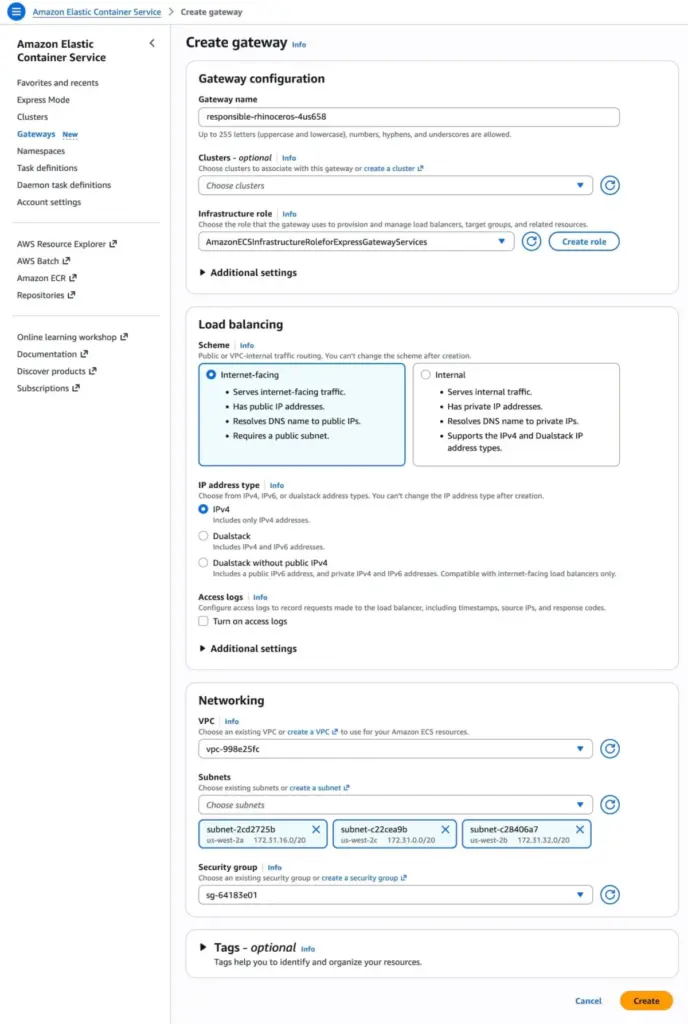
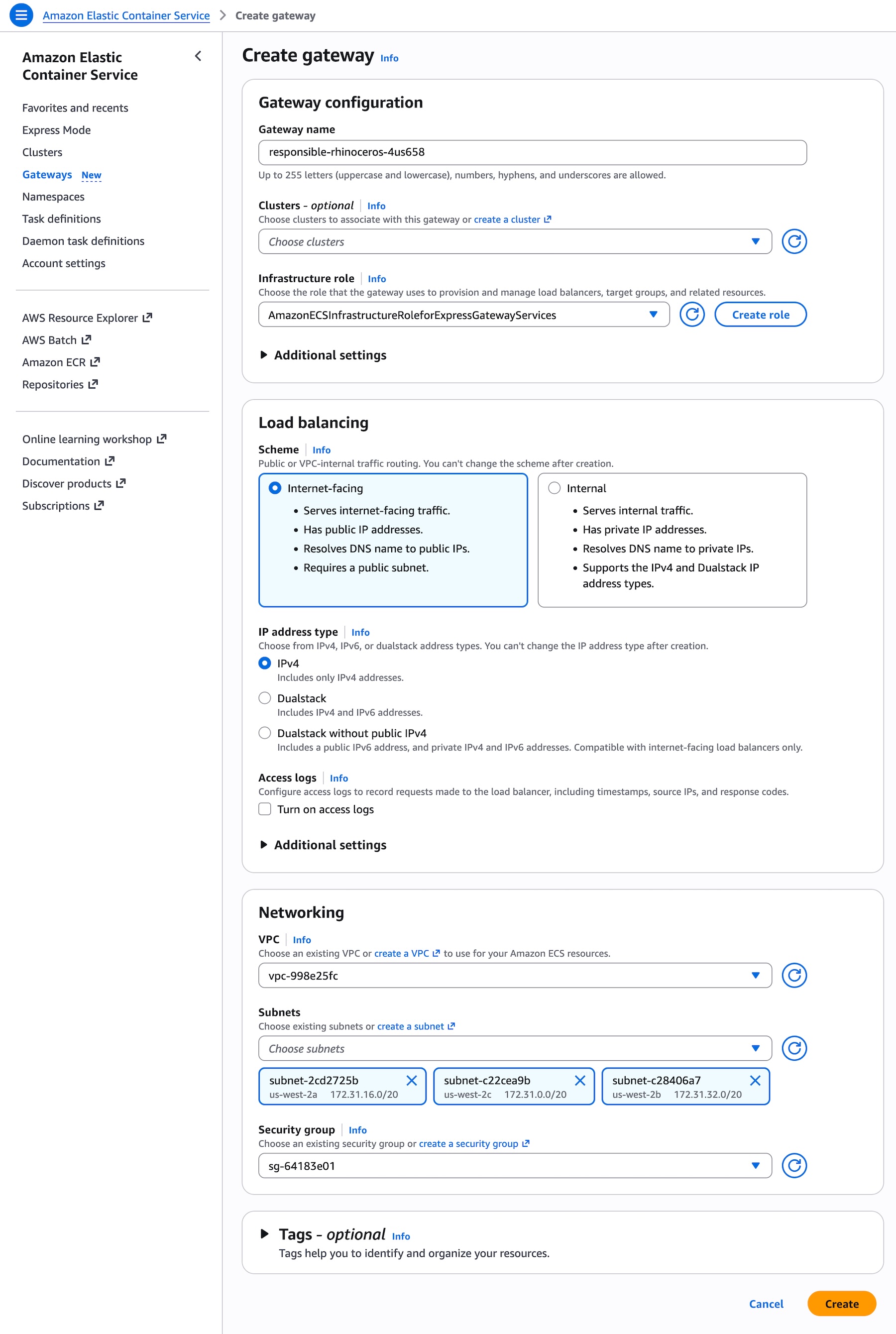
For platform teams looking to implement this new capability, the process begins within the Amazon ECS console. An administrator creates a gateway and associates it with an infrastructure IAM role. This role acts as the bridge, allowing the ECS control plane to assume the necessary permissions to provision and manage networking assets—such as ALBs, security groups, and SSL certificates—directly within the user’s account. When configuring the gateway, administrators define the load balancing scheme, choosing between public or VPC-internal traffic routing.

Beyond the basics, the configuration allows for the definition of listeners, specific ports, and maximum load balancer counts, providing a guardrail against uncontrolled infrastructure sprawl. Security is bolstered by the ability to associate AWS WAF web ACLs directly with the gateway, ensuring that web applications are protected by standardized security policies from the outset. While some parameters, such as the VPC, subnets, and protocol settings, are fixed upon creation to ensure stability, the overall workflow is designed to be highly flexible.
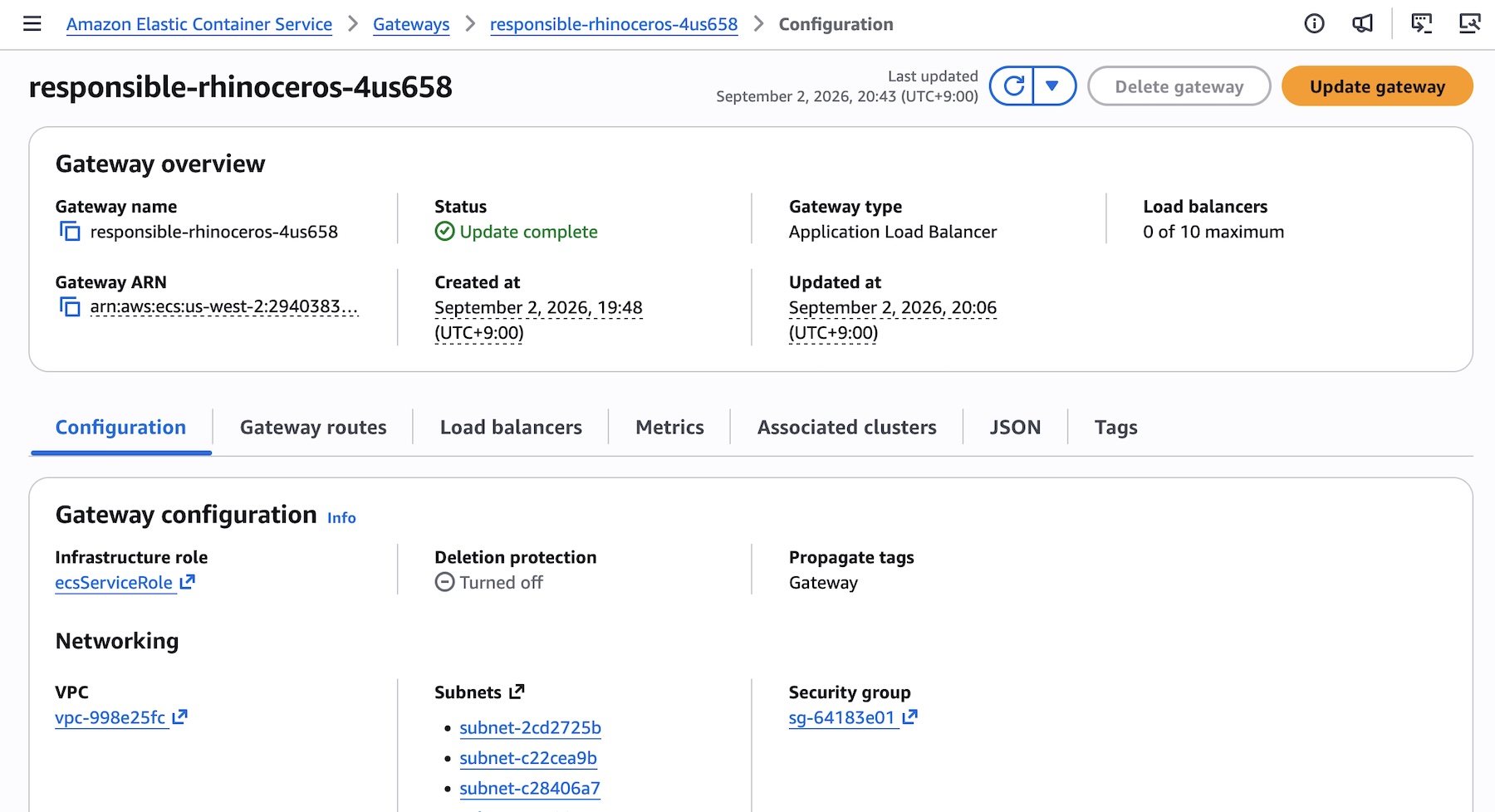
Using the AWS Command Line Interface (AWS CLI), users can initiate a gateway via the CreateGateway command, providing a unique name and the associated infrastructure role. It is important to note that the system follows a "just-in-time" provisioning philosophy; no physical infrastructure is created until a service actually connects via a gateway connector. Once the gateway is operational, administrators can query its state, inspect routing tables, and view the status of associated load balancers and clusters.
Scalability and Integration
The power of ECS Gateway lies in its ability to handle complex, large-scale environments through a many-to-many relationship model. A single gateway can be associated with up to 10,000 clusters, while an individual cluster can support up to five distinct gateway associations. This gives platform teams the versatility to share a single gateway across multiple development environments or to assign specialized gateways—such as one for public-facing traffic and another for strictly internal services—to a single cluster.
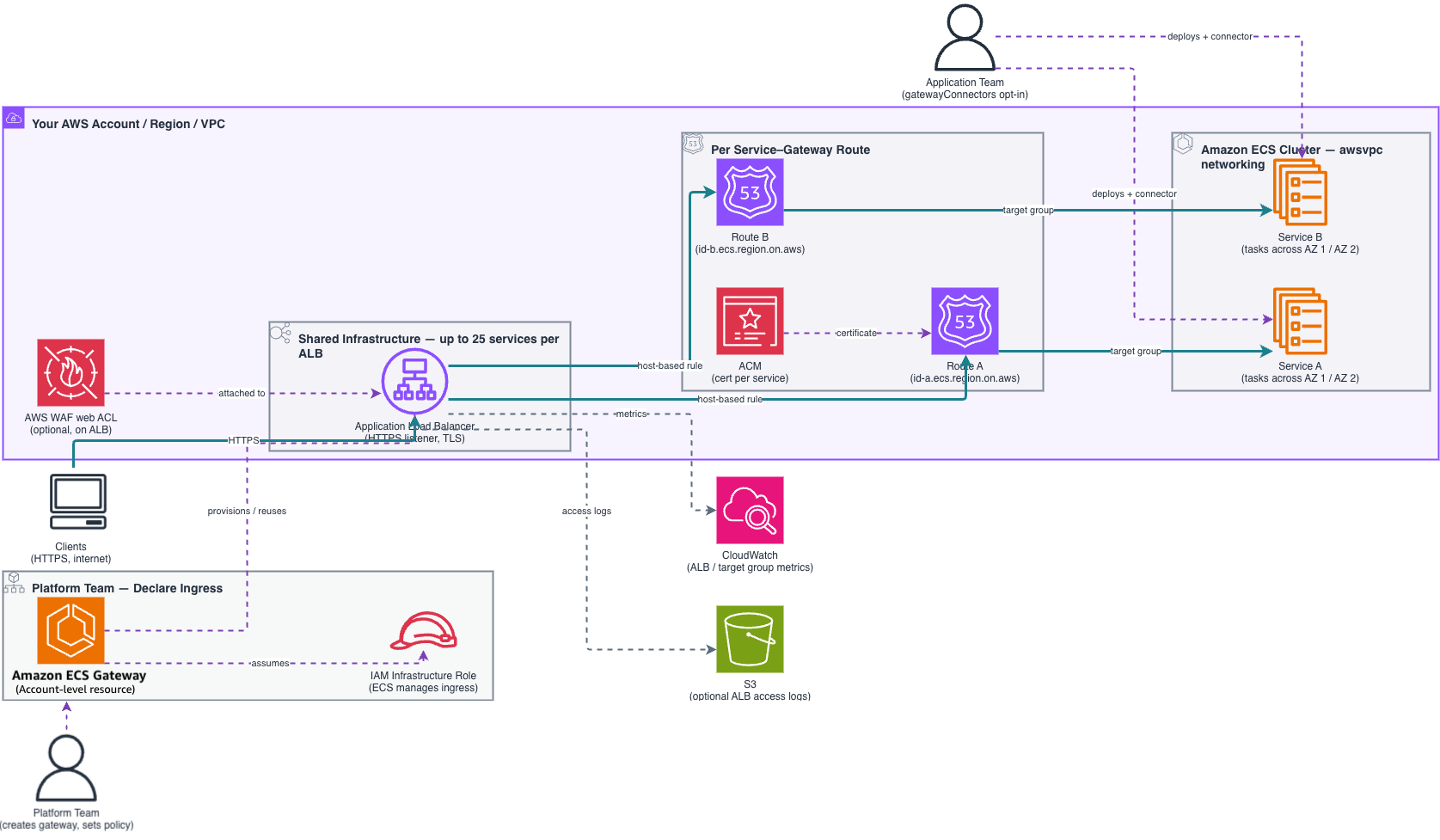
Access control is maintained through standard AWS mechanisms. Platform teams can exert granular control by selecting which gateways are associated with specific clusters. For organizations requiring further oversight, IAM policies can be utilized to restrict which users or service accounts have the authority to deploy services to specific clusters, ensuring that infrastructure remains aligned with organizational security standards.
For application teams, adopting the gateway is straightforward. When defining a service, teams include a gateway connector in the service definition. This allows for an incremental adoption strategy; if an existing ECS service is already using its own dedicated load balancer, it can be migrated to the ECS Gateway without a "big bang" transition. By using the UpdateService API, teams can add a gateway connector to an existing service, allowing both the old and new ingress paths to coexist. This allows for thorough validation of the gateway connection before the legacy load balancer configuration is decommissioned.
Behind the Scenes: Automated Lifecycle Management
When a deployment is initiated, Amazon ECS performs an evaluation of the gateways associated with the target cluster. The service is connected to every gateway that meets the necessary criteria: the access type must match, the gateway must exist within the same VPC, and it must provide coverage for all Availability Zones used by the service’s subnets.
Upon successful matching, ECS takes over the heavy lifting. It assigns the service to an ALB with available capacity and provisions the required stack of resources: an ACM certificate for secure communications, a unique DNS hostname, a listener rule that routes traffic for that hostname to the service’s target group, and a security group that limits inbound traffic exclusively to the ALB. If the system detects that no existing ALB has sufficient capacity, it automatically provisions a new one, provided the user-defined maximum limit has not been exceeded. Once this orchestration completes, the route becomes active, and the service is immediately reachable via its new URL.
The gateway also handles common operational hurdles autonomously. If a service is updated, the gateway ensures the ingress path remains intact. If a service is removed, the gateway manages the cleanup of the corresponding listener rules and target groups. For those integrating these workflows into automated pipelines or AI-assisted coding environments, the AWS MCP Server and associated plugins provide a streamlined way to manage these resources programmatically.
Availability and Pricing
Amazon ECS Gateway is currently available in all commercial AWS Regions where Amazon ECS is supported. There is no additional premium charged by AWS for using the Gateway service itself. Instead, customers continue to pay only for the underlying infrastructure resources that are provisioned in their accounts. This includes the standard costs associated with Application Load Balancers, CloudWatch logs and metrics, ACM certificates, and any applicable data transfer charges.
As organizations continue to shift toward container-centric architectures, the ability to automate the "plumbing" of cloud networking is becoming a critical requirement for maintaining velocity. By abstracting the complexity of load balancing and security orchestration, Amazon ECS Gateway allows teams to spend less time managing networking infrastructure and more time building and scaling the applications that drive their business. For those looking to get started, the latest documentation and console updates provide a path toward reducing operational overhead and standardizing ingress management across their ECS environments.