











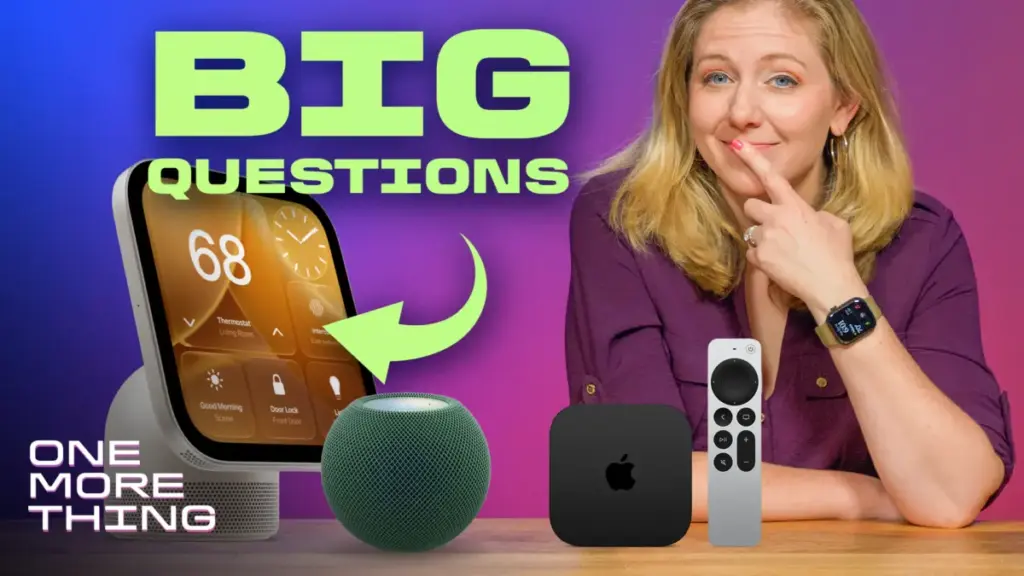
Apple’s latest hardware announcements have set the tech world abuzz, introducing a wave of innovations designed to reshape how consumers interact with their living spaces. At the center of this excitement is the newly unveiled Apple HomeView, a device that aims to eliminate the traditional friction points of smart home adoption. While the initial marketing and promotional videos for the HomeView successfully captured the attention of industry experts and consumers alike, the true test of its efficacy will ultimately lie in everyday living rooms, where families and children put its features through their paces.
Tech journalist and editor-at-large Bridget Carey recently broke down the massive wave of announcements from Apple’s latest event, offering a comprehensive look at what these new products mean for consumers. Beyond the HomeView, the spotlight also shone brightly on updates to the HomePod Mini 2 and the fourth-generation Apple TV 4K streaming box, signaling a comprehensive refresh of Apple’s ecosystem for the modern connected home.
The conversation surrounding the event naturally begins with reactions to the Apple HomeView commercial, a piece of media that struck a chord with reviewers by portraying an idealized, friction-free household. For years, the smart home market has struggled with fragmentation, complex setups, and interoperability issues between competing ecosystems. Apple’s pitch with HomeView is that it acts as a central hub designed to bridge these gaps, offering a seamless experience that even skeptics have found surprisingly compelling. Early hands-on reports indicate that Apple has invested heavily in trying to convince consumers that a centralized smart home interface can finally be intuitive.
Transitioning from home monitoring and control to the living room entertainment space, Apple also detailed the next evolution of its popular streaming hardware. The new Apple TV 4K box arrives with a series of hardware updates intended to solidify its position as a premium media player. Along with the updated streaming box comes a redesigned Apple TV Siri Remote, which promises tighter integration with Apple’s broader voice ecosystem. Pricing details for the new Apple TV 4K were a focal point of the discussion, as consumers continually weigh whether the performance gains justify the cost of upgrading from previous generations.
For audiophiles and home theater enthusiasts, one of the most intriguing hardware combinations discussed involves the ability to achieve a robust surround sound experience using the Apple TV 4K paired with four HomePods. This setup pushes the boundaries of spatial audio within a standard living room, offering an alternative to traditional, complex multi-speaker surround sound systems by leveraging Apple’s proprietary computational audio and ecosystem synergy.

Complementing the Apple TV updates is the introduction of the new HomePod Mini 2. While the original HomePod Mini found a dedicated audience due to its compact size and surprisingly rich sound profile, the second-generation iteration is poised to benefit from upcoming software advancements. Most notably, the integration of advanced Siri AI capabilities into the HomePods is expected to make these smart speakers vastly more conversational, responsive, and capable of understanding complex household commands. This artificial intelligence upgrade represents a crucial step forward for Apple, as voice assistants across the industry race to incorporate generative AI and more natural language processing to better serve users.
Returning to the flagship smart home reveal, the HomeView device itself is packed with features tailored for communal living spaces. One of the playful yet endearing touches highlighted during the event is the inclusion of Snoopy on the HomeView interface, adding a dose of classic character charm to the digital display. More functionally, the inclusion of a built-in FaceTime camera on the HomeView transforms the countertop or wall-mounted device into an effortless communication portal for families, making video calls as simple as walking up to the screen and starting a conversation.
Addressing the reality of modern households, the HomeView has been engineered with multiple user profiles in mind. Because homes are rarely inhabited by just one person, the device can recognize different family members, tailoring its interface, recommendations, and smart home controls to whoever is currently interacting with it. This multi-user capability is considered by many analysts to be one of the most critical elements of a successful shared home device, preventing the personalization confusion that often plagues single-profile smart displays.
Form factor and placement were also key points of analysis during the breakdown. Consumers will soon have to consider how a countertop HomeView device will physically fit into the layout of their houses, blending functionality with interior aesthetics. For those with limited counter space or specific architectural preferences, Apple also demonstrated a wall-mounted configuration for the HomeView, providing flexibility in how and where the hardware is deployed throughout the home.
Underpinning the hardware is a dedicated suite of HomeView apps and a specialized operating system designed specifically for the form factor. This software foundation dictates what living with the HomeView will actually feel like on a day-to-day basis, bridging the gap between passive digital photo frames, interactive control panels, and communication hubs. Of course, the ultimate success of the HomeView will depend heavily on how well it works with other smart home devices already residing in consumer households, ranging from smart lighting and locks to thermostats and security cameras.
As the autumn season progresses, Apple’s product pipeline shows no signs of slowing down. Industry watchers are already looking ahead to what else Apple has planned for October, a month that traditionally brings additional hardware refreshes and product availability updates. Among the most anticipated dates on the immediate calendar is October 23, when the newly announced iPhone Duo officially hits store shelves, completing another major chapter in Apple’s continuous hardware rollout for the year.