










The process of turning messy, unstructured text into organized, actionable data remains one of the most persistent hurdles in modern data analysis and machine learning. Traditionally, extracting structured information—such as company names, executive titles, hardware products, and geographical locations—required extensive natural language processing libraries. These legacy systems typically demanded massive training datasets and grueling fine-tuning cycles just to recognize custom categories. However, a shift is underway in the artificial intelligence community as developers adopt large language model frameworks that bypass the need for traditional model training.
Among the emerging tools bridging this gap is Scikit-LLM, a library designed to bring the sophisticated reasoning capabilities of large language models directly into standard machine learning workflows. By integrating seamlessly with familiar Python pipelines, the framework allows developers to execute complex natural language tasks with minimal configuration. One of the primary applications of this technology is named entity recognition, a process that identifies and categorizes specific elements within raw text. Through recent integrations with high-speed API providers like Groq, practitioners can now harness these advanced capabilities efficiently and without prohibitive costs.
Running Named Entity Recognition with Scikit-LLM
Implementing a modern named entity recognition workflow using these advanced models can be accomplished within standard interactive coding environments, such as Google Colab. By pairing the library with accessible infrastructure, developers can leverage free-tier large language models to parse unstructured data. This setup generally requires creating an account with an API provider, generating a secure authentication key, and integrating it safely into the notebook environment’s secret management system.

Once the environment is properly configured, the installation of the Scikit-LLM package requires only a simple command. The architectural design of the library mirrors standard OpenAI API conventions, but its flexibility allows engineers to override the default endpoints. This adaptability means the system can easily point to alternative, high-speed compatible providers, routing requests through customized URLs while utilizing securely stored credentials.
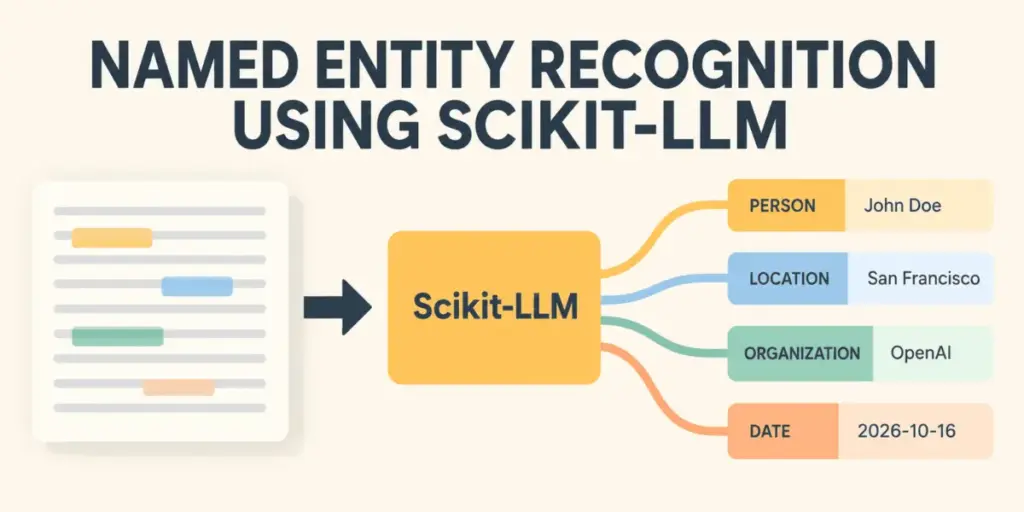
Unlike conventional text classification tasks—where models are trained on predefined class labels associated with text samples—large language model-driven named entity recognition relies heavily on a structured entity dictionary. This dictionary consists of key-value pairs where the keys represent the specific categories meant for extraction, and the values provide clear, descriptive instructions. These descriptions act as conceptual prompts, guiding the underlying language model through a logical reasoning process as it parses raw text.
To demonstrate the practical application of this method, developers often assemble a small corpus of domain-specific sentences, particularly within the technology business sector. For instance, statements detailing corporate announcements, executive actions, and product rollouts serve as ideal testing grounds. By defining target categories such as executives, corporations, products, and cities alongside descriptive guidelines, the model receives all the necessary context to evaluate unstructured sentences accurately.
Executing the Extraction Pipeline
The core mechanics of the extraction process rely on initializing a specialized estimator within the Scikit-LLM framework. For named entity recognition, the library provides a dedicated class known as GPTExplainableNER. This estimator wraps a compatible pre-trained model from the chosen provider, applying the user-defined entity dictionary to the incoming text.
When the execution method is triggered, the underlying large language model initiates its reasoning sequence, examining the raw sentences and evaluating them against the provided entity descriptions. Because these models output rich responses that include internal reasoning steps alongside the final classifications, the raw output often contains XML-like tags and explanatory text. While this transparency provides valuable insight into how the model reached its conclusion, it also requires secondary processing to isolate the clean data.
To refine the output into a usable format, developers typically employ regular expressions or parsing scripts to strip away the internal reasoning blocks and isolate the specific entity types and their corresponding values. When applied to domain-specific statements—such as announcements regarding corporate leaders unveiling new hardware architectures, software integrations, or geographical summits—the parsed results demonstrate a remarkably high degree of accuracy. The system successfully isolates corporate entities, executive names, technological products, and municipalities without requiring a single epoch of custom model training or fine-tuning.
This approach highlights a broader evolution in how data scientists approach natural language processing challenges. By utilizing pre-trained, open-source large language models through standardized wrappers, organizations can implement sophisticated information extraction pipelines rapidly. As AI development continues to prioritize efficiency and accessibility, frameworks like Scikit-LLM offer a practical blueprint for transforming unstructured information into structured intelligence with unprecedented ease.