










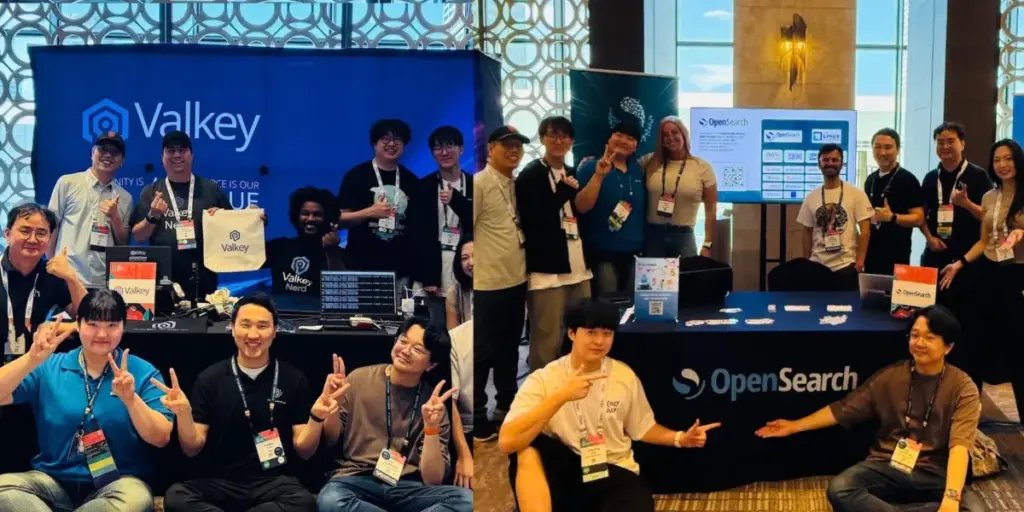
Last week, the vibrant world of open source development converged in Seoul as AWS contributors joined the global OpenSearch and Valkey communities for a four-day collaborative event. The gathering, which took place during the Open Source Summit Korea 2026 and the MCP DevSummit Seoul 2026, served as a vital touchpoint for engineers, developers, and project maintainers to exchange insights, refine technical solutions, and advance the roadmap for these critical Linux Foundation projects.
The event acted as a bridge between the high-level development of these open source technologies and the practical, real-world implementations managed by community users. Beyond the scheduled sessions and technical workshops, the atmosphere was defined by a spirit of cooperation. Leaders from the local Korean OpenSearch communities played an instrumental role, volunteering their time at the project booths and facilitating networking opportunities during the dedicated user group meetups. These interactions are essential for the health of open source ecosystems, as they allow contributors to gather feedback directly from those who rely on these tools for mission-critical infrastructure.
Advancements in OpenSearch: Powering Enterprise-Grade Observability
A significant portion of the discourse at the summit focused on the rapid evolution of OpenSearch, an enterprise-grade suite designed to manage, search, and visualize unstructured data at scale. With the release of OpenSearch 3.7 on June 9, 2026, the project has entered a new phase of maturity. The update introduced a suite of sophisticated tools aimed at streamlining operations by enabling users to query, alert, and monitor Service Level Objectives (SLOs) across logs, traces, and metrics from a unified interface.
The performance gains highlighted during the summit were of particular interest to attendees. OpenSearch 3.7 has achieved a milestone in search efficiency, offering the ability to retrieve vectors up to 5.5 times faster than previous iterations. This performance leap is a game-changer for organizations increasingly relying on vector databases to power machine learning applications and generative AI workflows. Since July 30, 2026, these advancements have been integrated into the Amazon OpenSearch Service, allowing enterprise users to leverage these improvements alongside refined search relevance and the comprehensive diagnostic capabilities of Query Insights. By bringing these enterprise features to a managed service, AWS continues to demonstrate its commitment to bridging the gap between raw open source innovation and scalable, production-ready infrastructure.
Elevating Performance with Valkey 9.1
The dialogue surrounding Valkey was equally robust. As an open source, high-performance key/value datastore, Valkey has become a staple for workloads requiring low latency, such as caching, message queuing, and primary data storage. The technical sessions at the summit highlighted the architectural refinements introduced in Valkey 9.1, which launched on May 19, 2026.
The centerpiece of this update is a redesigned I/O threading model. By optimizing how the datastore manages concurrent requests, the project has achieved a throughput increase of up to 17%. Furthermore, the release brings significant memory efficiency gains, specifically reducing memory usage for strings under 128 bytes by as much as 20%. These optimizations are critical for developers managing large-scale, memory-constrained environments. Since June 23, 2026, these capabilities have been available within Amazon ElastiCache for node-based clusters, providing users with a robust environment that supports not only higher throughput but also more granular access control—a necessity for modern, multi-tenant cloud applications. The engagement at the summit underscored that as Valkey matures, its utility in diverse, high-demand scenarios continues to expand.
A Culture of Continuous Collaboration
The presence of AWS contributors at these summits reflects a broader strategy of deep integration within the open source community. By actively participating in events like the Open Source Summit Korea and the MCP DevSummit, AWS facilitates a two-way street of information. Developers gain direct access to the engineers who help shape the services they use daily, while AWS contributors gain a clearer understanding of the challenges faced by the global developer community.
This collaborative ethos extends beyond individual summits. Both the OpenSearch and Valkey communities maintain active event calendars, providing ongoing opportunities for developers to connect, contribute, and stay informed about the latest project milestones. For those looking to get involved, these community-led events serve as the primary venue for technical deep dives and peer-to-peer networking.

For developers seeking to stay abreast of the broader landscape of AWS innovation, the "What’s New with AWS" page remains the authoritative source for product launches, feature updates, and service availability. Similarly, the AWS Blogs portal offers a deeper look into the technical rationale and practical applications of these updates, often providing the context necessary to implement new features effectively.
The engagement in Seoul is part of a larger, global effort by AWS to support the developers and architects who build on its platform. Beyond the specific projects discussed, AWS continues to foster a wide array of educational and community-focused initiatives. These include in-person and virtual summits, dedicated events for the startup ecosystem, and specialized sessions for developers. The AWS Builder Center, in particular, has become a key resource for those looking to connect with a wider network of builders, share best practices, and access content tailored to various stages of the development lifecycle.
As the industry moves further into a landscape dominated by complex, data-intensive applications, the importance of open source projects like OpenSearch and Valkey cannot be overstated. They provide the foundational building blocks that allow for rapid experimentation and scalable deployment. The discussions held in Seoul last week were a testament to the fact that the future of these technologies is not dictated in isolation, but through the active, daily collaboration of a diverse community of users and contributors.
Looking ahead, the momentum generated by these summits is expected to carry into the coming months as new features and optimizations continue to flow from the open source repositories into the managed service offerings provided by AWS. For the engineering community, this translates into a more powerful, efficient, and reliable toolkit for solving the most pressing data and infrastructure challenges of the modern digital era. As always, the landscape of technology remains fluid, and staying engaged with the community is the most effective way to navigate the evolving requirements of the cloud-native world. Check back next week for further updates on the latest developments in the AWS ecosystem.