





Computer vision has evolved dramatically, moving far beyond traditional tasks like object detection and image classification into a sophisticated discipline. In 2026, computer vision engineers operate at the critical intersection of foundation models, spatial computing, and embedded hardware. They are tasked with building complex systems that can perceive, reason over, and act upon the visual world in real time, transforming how machines interact with their environments.
The market demand for engineering talent capable of operating across this full technology stack is growing at a steady pace. Across multiple industries, autonomous vehicles, robotic warehouses, medical imaging platforms, and spatial computing devices share a fundamental requirement: they need professionals who understand not just individual model architectures, but the entire pipeline stretching from raw sensor data to production inference.
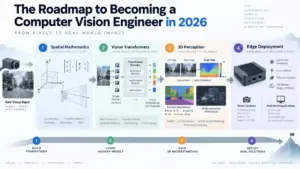
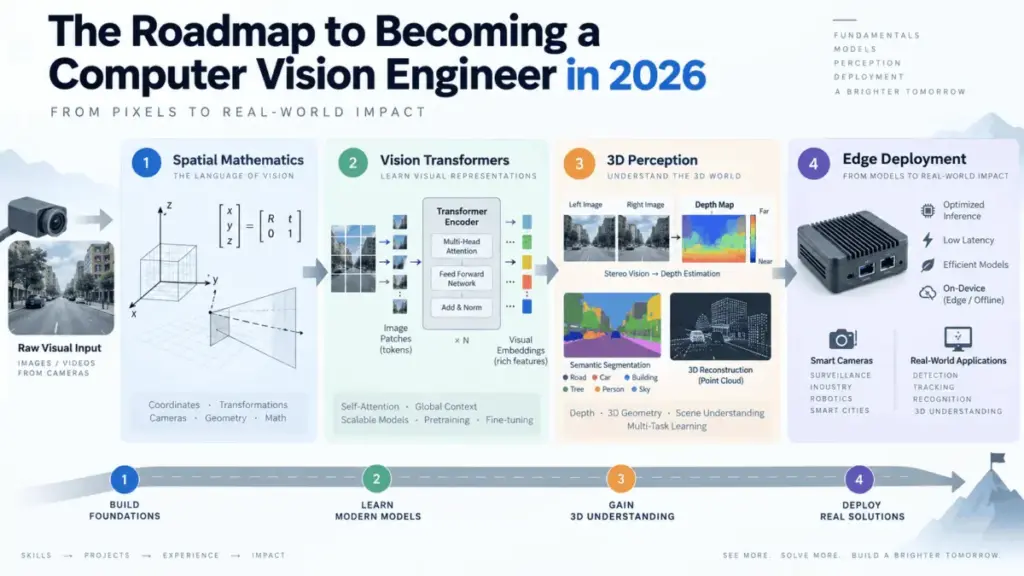
To help practitioners navigate this expanding landscape, AI and data science educator Vinod Chugani has outlined a comprehensive developmental roadmap. The framework is structured across four progressive stages, moving from spatial mathematics and foundational vision primitives up to edge deployment and hardware-aware optimization, with each phase building directly upon the preceding one.

The journey begins with spatial mathematics and foundation vision primitives. Because every computer vision system is ultimately a mechanism for reasoning about geometry, engineers must first master the mathematics that make visual reasoning possible. This foundational stage covers matrix transformations, coordinate frames, projective geometry, and multi-view geometry. These concepts are far from abstract; they dictate how a camera maps a three-dimensional world onto a two-dimensional sensor, how multiple camera views can accurately reconstruct depth, and how coordinate systems relate across sensors within a complex multi-camera rig.
On the implementation front, practitioners build fluency with PyTorch for tensor manipulation, cementing its status as the standard framework for both vision research and production environments. This is paired with synthetic data augmentation pipelines using libraries like Albumentations, which offers fast, composable transforms to simulate lighting variations, geometric distortions, and occlusions without the need for exhaustive data collection. Feature representation forms the third pillar of this initial stage, requiring engineers to understand the operational differences between convolutional backbones like ResNet and EfficientNet versus modern attention-based architectures. Contrastive representation learning, where models learn by comparing similar and dissimilar examples, has firmly established itself as a standard technique for developing useful embeddings before downstream fine-tuning.
As engineers progress to the second stage, they encounter the paradigm shift driven by Vision Transformers and multimodal foundation models. The broader transition from convolutional neural networks to transformer-based architectures has fundamentally redefined the core knowledge base for computer vision professionals. Vision Transformers process images as sequences of fixed-size patches, applying self-attention across those segments rather than relying on local convolutional filters, while Swin Transformers have extended this capability using hierarchical, windowed attention to handle high-resolution inputs.
Even more significant is the rapid rise of vision-language models. Systems like CLIP and SigLIP learn joint embeddings across both image and text modalities via contrastive training on massive web-scraped datasets. The practical outcome is open-vocabulary understanding, allowing users to query a visual scene using natural language descriptions rather than being restricted to fixed class labels. This unlocks advanced techniques such as open-vocabulary detection, exemplified by models like OWL-ViT and Grounding DINO, which facilitate object localization and detection based entirely on descriptive text without requiring task-specific retraining.
Concurrently, tools like Meta’s Segment Anything Model 2 introduce promptable, zero-shot segmentation for both static images and dynamic video streams. By providing a simple point, bounding box, or text prompt, users can generate high-quality segmentation masks instantly. Mastering how these foundation models operate, recognizing their limitations regarding domain shifts and rare objects, and knowing how to compose them into cohesive pipelines defines the central competency of this intermediate stage.
The third stage of the roadmap ventures into three-dimensional vision, neural rendering, and spatial perception, reflecting the broader industry push toward spatial reasoning. Here, the skill set expands to encompass the representations and algorithms that allow systems to interpret and reconstruct a three-dimensional world from two-dimensional inputs. Engineers work extensively with point clouds, voxel grids, and signed distance fields, each presenting distinct memory characteristics, computational costs, and application fits. Point clouds serve as the natural output of LiDAR sensors and structure-from-motion pipelines, while voxel grids offer regular spatial structure at a higher memory cost, and signed distance fields represent geometry as continuous functions to enable differentiable rendering.
Depth estimation acts as the entry point for most three-dimensional workflows, with models like Depth Anything leading the way in producing relative or metric depth maps from a single RGB image without auxiliary sensors. Meanwhile, neural rendering has evolved at a blistering pace. While Neural Radiance Fields initially allowed systems to synthesize novel views from posed images, 3D Gaussian Splatting has largely displaced them for real-time applications by offering a faster, more memory-efficient alternative that facilitates interactive novel view synthesis on consumer-grade hardware. For robotics and autonomous systems, spatial perception also demands a firm grasp of Visual Odometry and Simultaneous Localization and Mapping, enabling machines to estimate their position and incrementally map their environment using camera inputs alone.
The final stage of the roadmap bridges systems engineering and applied vision through inference optimization and edge deployment. A model that runs smoothly on a high-end GPU workstation is not automatically ready for production. Ensuring that computer vision systems operate reliably on constrained hardware with low latency and minimal accuracy loss represents a distinct and highly valued discipline. This phase involves model compression techniques, hardware execution frameworks like TensorRT, ONNX Runtime, and OpenVINO, and specialized embedded deployment targets such as NVIDIA Jetson modules and Apple Silicon’s Neural Engine. Furthermore, handling high-throughput multi-camera streaming introduces complex pipeline engineering challenges, requiring robust frameworks like NVIDIA DeepStream to manage frame synchronization, stream ingestion, and real-time processing under heavy loads.
Reflecting on the evolving landscape, Chugani notes that computer vision engineering remains a deeply layered discipline where foundational mathematics, rapidly advancing architectures, and stringent deployment constraints all must be balanced. The professionals who excel are those capable of moving fluidly between varying levels of abstraction—from the optical geometry of a camera model to the attention mechanisms of a transformer and the instruction sets of an edge accelerator. Developing this multifaceted versatility requires a deliberate, stage-by-stage approach rooted in practical, hands-on project work.