









In the world of cloud architecture, the ability to test code effectively is often the difference between a seamless deployment and a complex troubleshooting cycle. While "happy-path" demos are essential for showcasing functionality, they rarely reveal the true robustness of an application. Developers know that it is in the edge cases—the failed requests, the throttled API calls, and the unexpected latency—where the real character of a system is defined. This week, AWS has taken a significant step toward making these investigations easier and more accessible, prioritizing tools that allow developers to refine their applications while changes are still small and manageable.
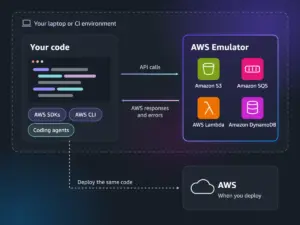
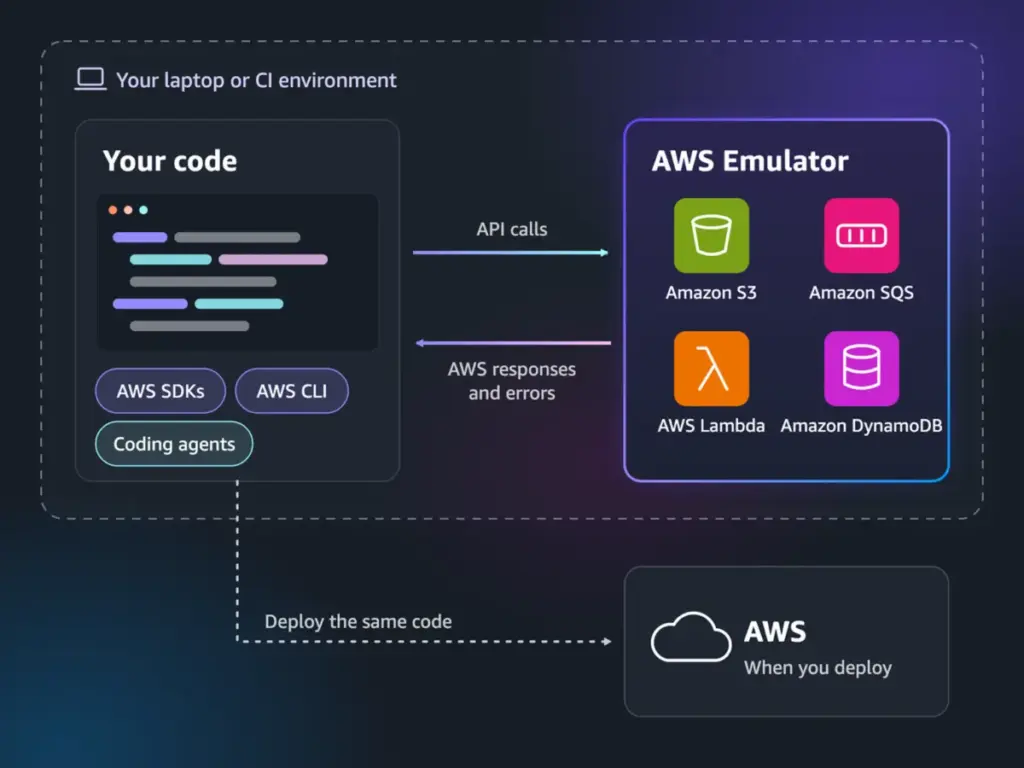
The standout announcement of the week is the general availability of the AWS Emulator, a tool designed to bring a substantial portion of the cloud development lifecycle onto the local machine. By allowing developers and autonomous coding agents to interact with AWS API endpoints locally, the emulator eliminates the need to provision actual cloud resources for every iterative test. This capability is a game-changer for those looking to speed up their development loops. Whether you are using the AWS CLI or one of the various AWS SDKs, pointing your requests to the emulator’s local HTTPS endpoint allows your application code to function as it would in production, providing immediate feedback on API interactions without incurring costs or requiring an active AWS account for those specific operations.
From a developer experience perspective, this is a major win for AI-assisted coding. When a coding agent is tasked with building infrastructure—such as creating an Amazon DynamoDB table, populating it with items, and verifying the data—the emulator acts as a sandbox that provides concrete, instantaneous results. This allows the agent to inspect the output, diagnose potential issues, and revise its code in real-time. As noted in recent industry discussions on agent feedback loops, the ability to rapidly iterate against a faithful representation of the cloud environment is critical for building reliable, autonomous systems. While the emulator is a powerful addition to the developer’s toolkit, it is important to remember that it is a tool for logic and API testing; it does not replicate the complexities of IAM, resource-policy enforcement, or cross-Region behavior. Consequently, developers should continue to rely on the actual AWS cloud environment to validate security configurations and final deployment architectures before going to production.
Advancements in Isolation and Security
Alongside the developer-focused emulator, AWS has introduced a significant leap in compute security with the launch of Nitro Sandboxes for Amazon EKS, ECS, and EC2. In modern multi-tenant environments, the challenge of maintaining strict boundaries between workloads is constant. Nitro Sandboxes address this by enabling hardware-level isolation for pods, tasks, and virtual machines. This means a single Amazon EC2 instance can now host multiple workloads while ensuring that each remains within its own secure VM boundary.
This development is particularly timely given the rise of automated agents executing generated code. By offering both isolated and confidential modes, AWS is providing a way to protect workloads not just from other processes on the same node, but also from the node operators themselves, utilizing cryptographic attestation to ensure integrity. This hardware-backed security layer is available on supported instances without additional charges beyond the standard compute costs, providing a robust solution for developers running sensitive build jobs or multi-tenant applications who require the highest level of workload separation.
Expanding the Cloud Ecosystem
The pace of innovation at AWS remains relentless, with several other notable updates emerging this week that impact how developers handle identity, AI models, and data management.
Amazon Cognito has introduced support for OAuth 2.0 token exchange, a feature that simplifies how applications handle downstream service access. By allowing developers to exchange a user’s primary token for one scoped specifically to a downstream service, Cognito enables more granular permission management. This is especially useful in agent-based architectures, where an agent might need to perform tasks on a user’s behalf without having access to the user’s original, broader token. By including an act claim, the system can clearly identify the intermediary, providing a more transparent and secure delegation model.
In the realm of Artificial Intelligence, the arrival of Claude Fable 5.2 on Amazon Bedrock marks another milestone. Positioned as a premier model for complex technical engineering, quantitative finance, and scientific research, Fable 5.2 brings high-level reasoning capabilities to the AWS ecosystem. Users should be mindful of the specific retention requirements associated with this model, as AWS maintains traffic logs for up to 30 days for abuse detection, though exceptions are available for certain internal use cases.
Data management is also seeing an upgrade, with Amazon ElastiCache Serverless now supporting search and aggregations for Valkey. This enhancement allows developers to integrate vector, full-text, and hybrid search directly into their caching layer, a capability that is particularly valuable for applications requiring real-time product discovery or agent-memory retrieval. By performing these operations in the cache, latency is significantly reduced, offering a performant way to handle frequently changing datasets.
For organizations managing large-scale data, Amazon OpenSearch Service has introduced managed cross-Region disaster recovery. This feature allows for the pairing of domains across different Regions, with recovery objectives that are remarkably tight—under one minute for data loss and under 20 minutes for recovery time. This managed approach simplifies the traditionally difficult task of maintaining high availability for search infrastructure, providing a structured path for both planned switchovers and unplanned failovers.

Operational Improvements and Best Practices
Operational excellence continues to be a priority, as evidenced by the introduction of account-level retention policies in Amazon CloudWatch Logs. Platform teams can now set retention policies that apply globally or to specific groups based on naming prefixes. This reduces the administrative overhead of managing individual log groups and ensures that security and compliance logs are consistently retained across the organization.
Furthermore, the next-generation AgentCore runtime is now the default for Amazon Bedrock. This update brings significant performance benefits, including sub-two-second session startup times and improved scalability. By allowing agents to scale up to 8 vCPUs and 32 GB of memory while also scaling to zero during idle periods, this runtime reduces costs by up to 68% compared to previous versions, all while maintaining the isolation of a microVM for every session.
Beyond these technical releases, the community continues to share valuable insights on optimizing costs and performance. Recent guidance on proving the ROI of agents on Amazon Bedrock emphasizes the importance of measuring outcomes against a clear, documented baseline. By tracking an agent’s cost through its full lifecycle—from reasoning and caching to human review—developers can move beyond guesswork and demonstrate the true value of their automation efforts. Similarly, the engineering team at Zillow recently shared their approach to running over 100 million daily notifications using AWS Step Functions, highlighting the effectiveness of idempotent modules and configuration-driven workflows. Their success demonstrates that these architectural patterns are highly portable, offering solutions that extend well beyond notification systems to any high-volume event-driven architecture.
As we look toward the upcoming AWS re:Invent in Las Vegas, the community is preparing for a deep dive into these new tools and patterns. With over 2,200 sessions planned, the event promises to provide further clarity on how these latest innovations can be integrated into production environments. Whether attending in person or following the livestream, builders have plenty of opportunities to engage with the experts who are driving these advancements. As always, the landscape of AWS is evolving rapidly, and staying informed is the first step toward building more resilient, efficient, and secure applications. Check back next Monday for another roundup of the latest developments from the AWS ecosystem.