









Amazon Web Services (AWS) has announced a significant enhancement to its storage portfolio, extending the functionality of Amazon Elastic Block Store (EBS) Volume Clones to support cross-account operations. This update represents a major shift in how organizations manage data lifecycle and environment isolation, allowing users to create instant, point-in-time copies of their EBS volumes and move them across different AWS accounts. By enabling this seamless transfer, AWS is addressing a long-standing requirement for developers and system administrators who need to bridge the gap between production data and isolated development or testing environments.
The capability to clone volumes is not entirely new; AWS introduced the initial EBS Volume Clone feature last year, which allowed for the creation of immediate, point-in-time copies of volumes within the same Availability Zone. That release provided a high-performance alternative to traditional snapshot-based restoration, which often required waiting for data to be copied from Amazon S3. By building upon this foundation, the new cross-account functionality now allows users to take these instant copies and move them into a secondary account, providing a powerful mechanism for data portability while maintaining robust security and governance boundaries.
Bridging the Gap Between Production and Development
For many engineering teams, the challenge of maintaining realistic test environments often hinges on the ability to access production-grade data without compromising production systems. Previously, moving volumes between accounts often involved manual snapshotting, sharing, and volume creation, which could be time-consuming and cumbersome. With the introduction of cross-account EBS cloning, organizations can now refresh their development, staging, or experimental environments using their most current production data sets.
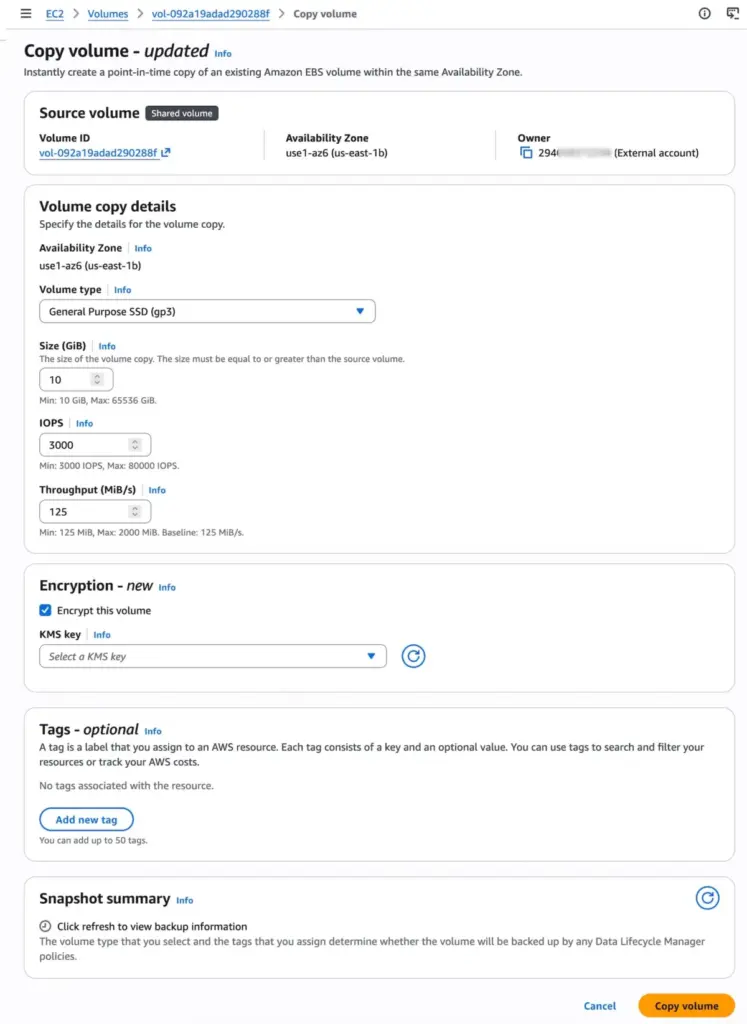
This new feature is particularly valuable for developers who need to replicate complex application states to debug issues or test new features against actual data patterns. By isolating these test environments in separate AWS accounts, organizations can maintain strict security boundaries, ensuring that experimental code or testing activities never inadvertently touch production resources. Furthermore, the capability includes an option to re-encrypt the data during the cloning process. By using an AWS Key Management Service (AWS KMS) key located in the target account, organizations can ensure that data remains protected according to the specific security policies of the environment in which it will be used. This adds a crucial layer of compliance and security, as it allows for the reassignment of encryption ownership during the transfer process.

Operationalizing Cross-Account Sharing
The technical implementation of this feature relies heavily on the integration with AWS Resource Access Manager (RAM). AWS RAM is the central service that allows users to share AWS resources across accounts or within an AWS Organization. By leveraging RAM, the process of sharing a volume becomes an administrative action that is both traceable and manageable.
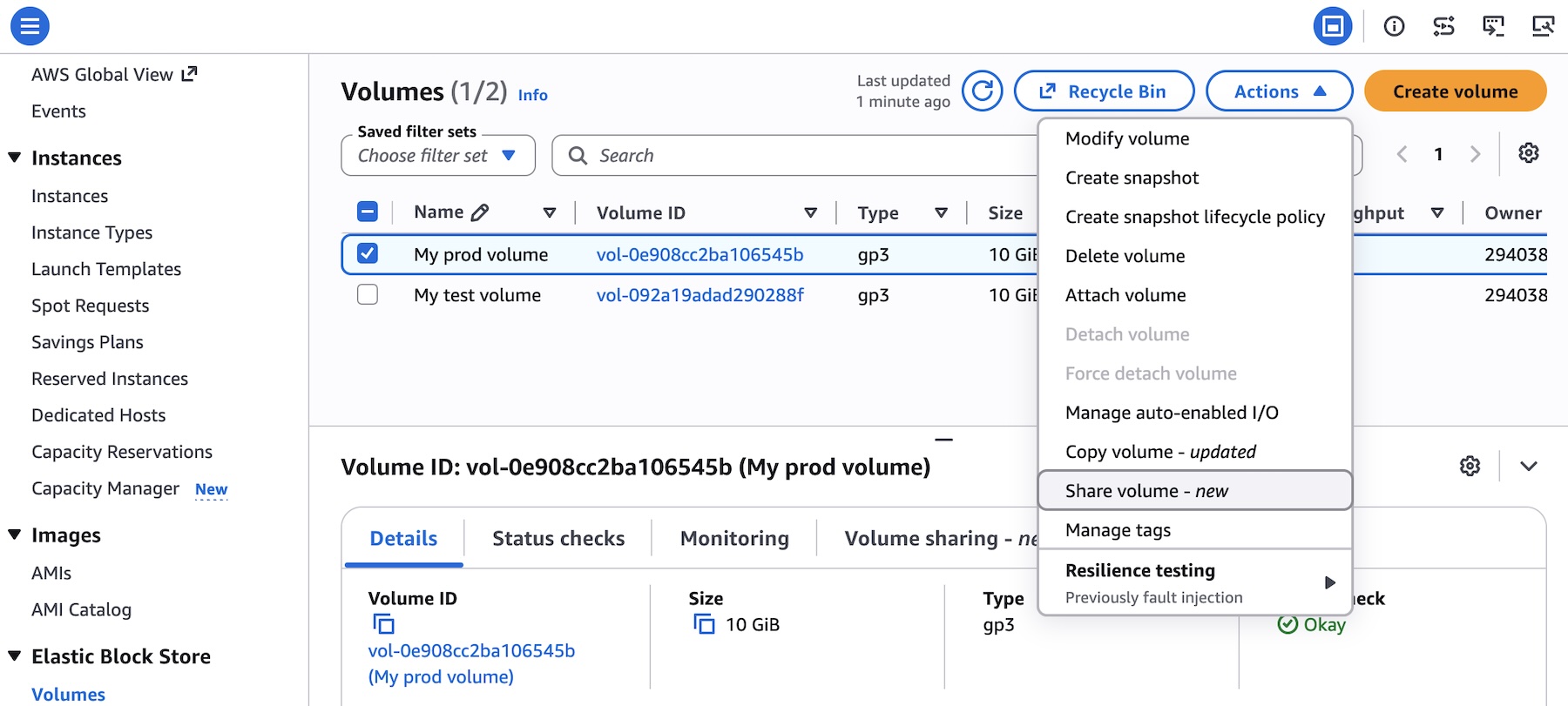
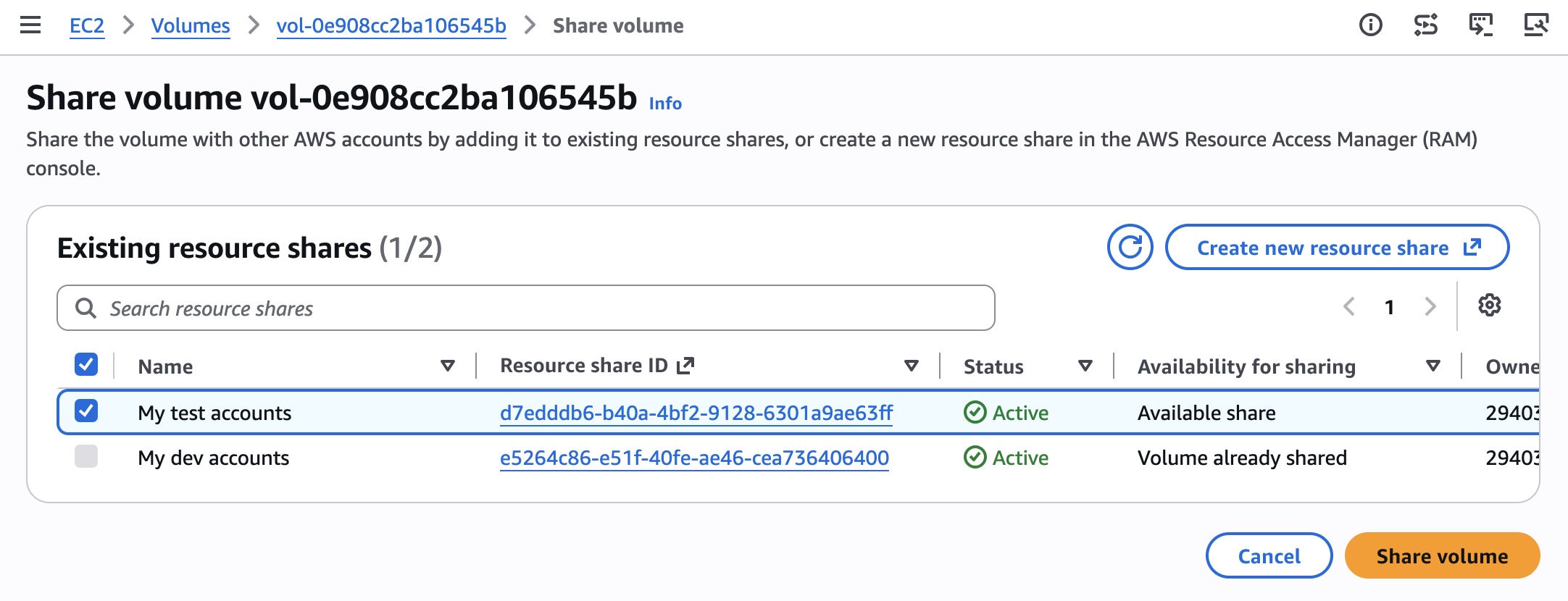
The process begins in the source account, where the volume owner can initiate the sharing request through the Amazon EBS console. Once the specific volume is identified, the owner selects the option to share it, adding it to a new or existing resource share. From there, the configuration is managed within the RAM console, where the owner specifies the target accounts or organizational units that should receive access. This centralized management ensures that access control is consistent and aligned with broader organizational security policies.
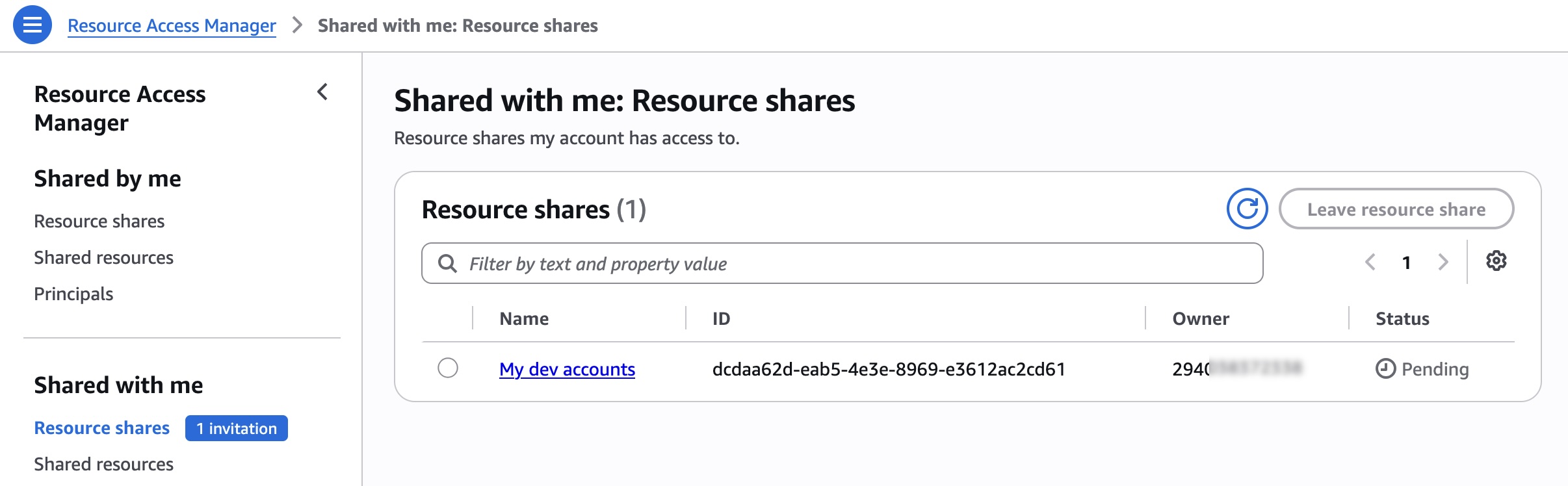
Once the source account has configured the share, the recipient account must accept the invitation within the RAM console. This two-way validation is a critical security control, preventing unauthorized data movement and ensuring that administrators in the target environment are aware of and approve the arrival of new resources. After the share is accepted, the volume appears in the target account’s EBS console as an available resource. From this point, the user in the target account can initiate a copy, effectively creating a new, independent EBS volume based on the source data. This workflow minimizes the administrative overhead and provides a streamlined path for data migration between environments.
Integrating with Modern Development Workflows
As cloud infrastructure management becomes increasingly automated, the ability to programmatically handle resource replication is essential. AWS has indicated that this cross-account functionality is fully supported by its standard API sets, allowing teams to integrate volume cloning into their existing Infrastructure as Code (IaC) pipelines. For those looking to streamline these operations, AWS is encouraging the use of the AWS MCP Server and associated plugins. These tools are designed to work with AI-assisted coding environments, providing developers with a more intuitive way to write scripts, execute API calls, and access documentation directly from their integrated development environments.
This shift toward more programmatic interaction with storage resources reflects a broader trend within AWS to make complex infrastructure tasks more accessible to developers. By simplifying the way storage volumes are handled across accounts, AWS is effectively reducing the "friction" that often discourages teams from performing regular data refreshes or maintaining robust testing environments. As organizations continue to adopt more granular, multi-account strategies—often referred to as a "landing zone" architecture—the ability to move data safely and efficiently becomes a prerequisite for operational excellence.
Availability and Future Considerations
The cross-account volume cloning capability is now available in all AWS Regions that currently support the original Amazon EBS Volume Clone feature. This widespread rollout ensures that the vast majority of AWS customers can take advantage of the update immediately. For users concerned with regional nuances, AWS provides a comprehensive "Capabilities by Region" resource that outlines the specific availability of this and other features.

Looking ahead, the introduction of this feature underscores the ongoing evolution of the Amazon EBS platform. By focusing on the intersection of data mobility and security, AWS is providing its users with the tools necessary to manage data at scale while respecting the architectural boundaries of modern cloud environments. As teams continue to integrate this functionality, the emphasis remains on balancing the ease of use with the rigorous security standards that enterprise environments demand.
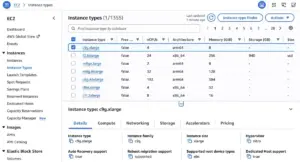
For those eager to get started, the Amazon EC2 console provides a graphical interface for testing these workflows. Existing documentation in the Amazon EBS User Guide serves as a primary resource for deeper dives into the technical specifications, IAM permissions required for cross-account operations, and best practices for key management. Furthermore, for users who encounter specific challenges or have unique architectural requirements, the AWS re:Post community for Amazon EBS provides a dedicated forum for technical discussion and peer-to-peer advice, alongside the standard support channels provided by AWS.
By empowering teams to create secure, isolated copies of their data with minimal effort, this update simplifies one of the most common, yet historically challenging, aspects of cloud storage management. Whether it is for routine testing, data migration, or disaster recovery drills, the ability to clone volumes across account boundaries represents a practical, high-impact improvement for the AWS ecosystem.