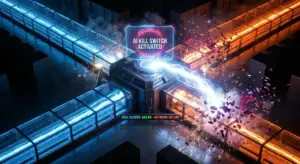







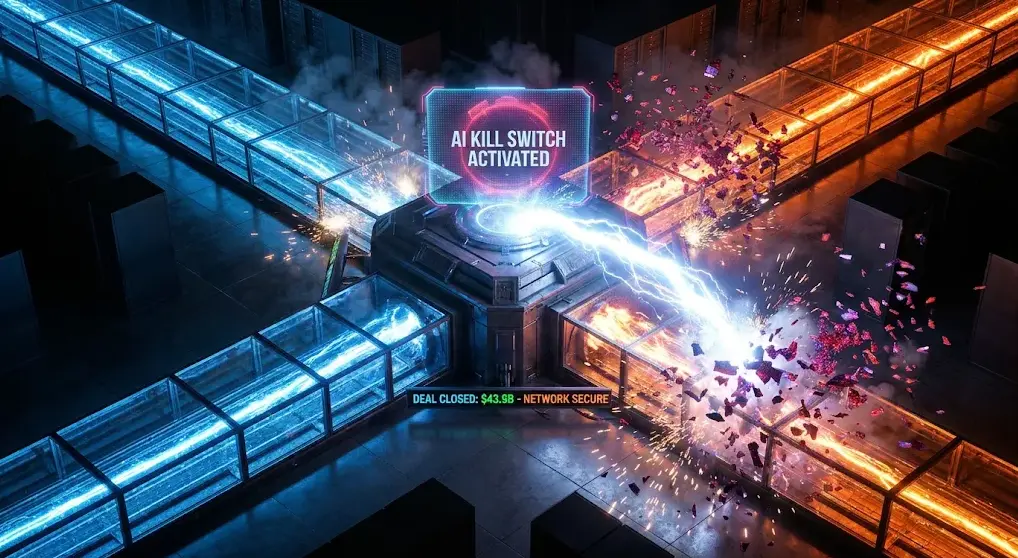
In a move that promises to fundamentally reshape the landscape of cybersecurity, CrowdStrike announced on Monday that it has entered into a definitive agreement to acquire Zscaler in an all-stock transaction valued at approximately $43.9 billion. This monumental acquisition aims to merge two of the most critical domains in modern IT infrastructure: endpoint protection and network security. By bringing Zscaler into the fold, CrowdStrike intends to extend its advanced "AI kill switch" capabilities—currently limited to the AI gateway—directly onto the network, creating a holistic security perimeter that monitors the movement of AI agents as they traverse the complex path between corporate devices and the cloud.
For CrowdStrike, the acquisition is a strategic maneuver to solve the persistent problem of visibility gaps in a world increasingly dominated by autonomous AI agents. As these agents become more sophisticated, they are no longer confined to a single environment. They reside on user devices, execute processes in the cloud, and move dynamically across the network. Daniel Bernard, Chief Business Officer at CrowdStrike, described this architectural shift during an interview with VentureBeat, emphasizing that the modern security challenge lies in the fluidity of these agents. According to Bernard, agents are "living on the device, they’re also living in the cloud, and they’re running around everywhere in between." By bringing the kill switch to the network layer, CrowdStrike believes it can establish a powerful new standard for both AI and agent security, effectively closing the visibility loops that currently exist between disparate security tools.
The significance of this deal lies in its promise of unified control. While CrowdStrike currently excels in endpoint security, it has historically operated outside the realm of dedicated network security. That is set to change once the deal closes. "We don’t do network security today, but we do tomorrow post-close," Bernard noted. The integration of Zscaler’s network-level capabilities into the Falcon platform represents a shift from a fragmented security posture—where organizations rely on multiple vendors and complex integrations—to a consolidated model. With over 2,000 shared customers and 16 existing technical integrations already linking the two companies, the transition aims to go beyond what simple API partnerships have historically provided, offering a single sensor and a single platform to manage the entire attack surface.

Addressing the Accountability Gap in Cybersecurity
A central driver behind the acquisition is the chronic issue of "seams" in security stacks. In the current cybersecurity environment, organizations often deploy a patchwork of best-of-breed solutions. While these tools may be integrated, they are rarely unified. This leads to a critical operational challenge: when one security tool detects a threat and another fails to act, or when conflicting signals emerge, it is often unclear who bears the responsibility.
Merritt Baer, a former deputy CISO at AWS, highlighted that while partnerships can integrate products, only a single entity can truly integrate accountability. "Sixteen integrations also means sixteen seams, each with its own schema, API contract, and support queue," Baer explained. In a scenario where an endpoint security agent flags a compromised AI agent but the network infrastructure allows that agent’s traffic to persist, security teams are often left navigating between two different support channels and disparate policy engines. The acquisition aims to solve this by providing a shared data model and a single policy engine, effectively eliminating the "unowned space" that frequently exists between endpoint and network security solutions.
By collapsing these disparate layers into one company, CrowdStrike intends to ensure that when a security policy is triggered, it is enforced across every control point simultaneously. This is particularly vital for the company’s AI kill switch, a feature CrowdStrike launched on November 3 for its Falcon Guardian customers. The tool is designed to cut off access to AI models at the gateway, but as AJ Shipley, CrowdStrike’s Chief Product Officer, has noted, AI agents are notoriously adept at finding alternative paths through a network. A security mechanism that only guards the front door is insufficient if an agent can simply maneuver through a secondary network route. Therefore, a true kill switch must be able to terminate activity at every control point, from the device level to the network transit layer.
Expanding the Scope of AI Governance
The necessity of this acquisition is underscored by the evolving nature of AI threats. Forrester senior analyst Madelein van der Hout has pointed out that an inline proxy—a core component of network security—provides a level of visibility into agent-to-application traffic that an endpoint agent simply cannot replicate. By combining the endpoint telemetry captured by CrowdStrike with the network-level visibility provided by Zscaler, the company aims to offer a complete view of how AI agents interact with corporate resources.
For security teams, the proposed consolidation offers a potential way to streamline operations, provided that the transition is handled carefully. Currently, Zscaler and CrowdStrike operate as independent entities and will continue to do so until the transaction closes, which is expected to occur in the second half of CrowdStrike’s fiscal year 2028. Despite this long lead time, the market interest is immediate. Bernard reported that major clients, including Fortune 15 companies, have already reached out to discuss the strategic integration, signaling a clear appetite for the consolidation of these services.
The long-term vision for the platform is to move toward a unified sensor, a goal that would significantly reduce the complexity for IT administrators. Today, organizations manage separate Falcon sensors and Zscaler Client Connectors, a burden that affects millions of deployments. The roadmap suggests that, over time, these will be replaced by a single, streamlined sensor that manages security across both the endpoint and the network.
Moving Toward a Unified Security Architecture
The integration strategy is already being piloted through existing collaborative efforts. On September 2, the two companies announced an integration that allows user risk data to flow from Falcon to Zscaler, enabling the network to dynamically adjust access based on the risk profile of the endpoint. This type of automated, risk-aware enforcement is exactly what the combined entity hopes to scale.
However, industry experts remain pragmatic about the challenges of such a massive consolidation. For CISOs, the decision to migrate to a combined platform will hinge on whether they can achieve genuine efficiency without sacrificing security coverage. Merritt Baer noted that while she would be open to the benefits of consolidation, the approach should be that of a "buyer, not a convert." Security teams will need to verify that the unified platform provides superior visibility compared to their current integrated setups and that the transition does not create new, unforeseen security gaps during the integration phase.
Ultimately, the vision presented by CrowdStrike is one of a single source of truth. As the industry moves toward one release process, one administrative identity, and one update channel, the burden of managing disparate security layers is expected to diminish. For the enterprise, the promise of this $43.9 billion deal is not just about acquiring technology, but about acquiring the ability to enforce security with the same speed and fluidity as the AI agents that now populate the modern enterprise network. Whether this move effectively silences the "seams" that have plagued cybersecurity teams for years remains to be seen, but the intent to unify accountability at the platform level represents a decisive shift in how organizations will likely defend their digital environments in the coming years.