Large language models have proven themselves to be remarkable text generators, yet they remain anchored by a well-documented and persistent vulnerability: they hallucinate. When operating without direct access to verified, up-to-date information, these systems frequently produce plausible-sounding answers that are factually incorrect. To combat this limitation, Retrieval-Augmented Generation, commonly known as RAG, emerged as the industry standard solution. By grounding model outputs in external knowledge sources, RAG dramatically reduced instances of hallucination across a wide spectrum of enterprise applications.
However, as organizations increasingly push these artificial intelligence systems into more complex operational workflows, a new architectural bottleneck has surfaced. Standard RAG pipelines are inherently linear, executing a single retrieval operation, passing those initial results directly to the model, and prompting it to generate a final answer. While this straightforward approach works reliably when handling simple queries and well-structured knowledge bases, the pipeline begins to crack under heavier pressure. When a user request demands multi-step reasoning, cross-referencing across multiple disparate sources, or synthesizing information that is absent from a single document, the traditional framework falls short.
This operational friction has accelerated the adoption of Agentic RAG. Rather than treating information retrieval as a singular, static step in a pipeline, agentic systems grant the underlying architecture the ability to reason about how to search, evaluate the quality of what it finds, and iterate continuously until it arrives at a genuinely satisfying answer.

Understanding this evolution requires examining how both architectures function, analyzing the specific operational thresholds where standard RAG reaches its limits, and evaluating the advanced capabilities that make agentic systems uniquely suited for handling intricate enterprise tasks.
The Baseline: Understanding Naive RAG
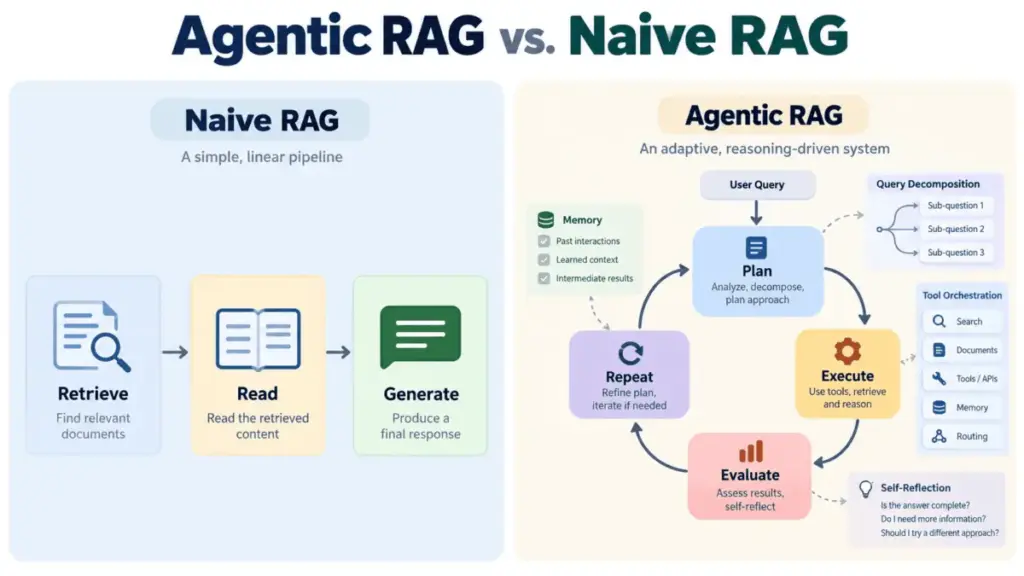
To fully appreciate the trajectory of modern retrieval systems, it is essential to examine the foundation upon which they were built. Naive RAG, frequently referred to as standard RAG, follows a rigid and predictable three-stage pipeline consisting of retrieval, reading, and generation.
When a user submits a query to the system, it is first converted into a vector embedding. The system then executes a similarity search against a vector database, retrieving the top document chunks deemed most relevant, and injects those chunks directly into the large language model as reference context. The model subsequently formulates its response strictly from the provided material.
This workflow functions similarly to a student preparing for an examination inside a massive library by typing a single keyword into the catalog, grabbing the first three books on the shelf, and writing an essay derived solely from those immediate sources, without pausing to verify whether the material actually addresses the core question.
Under the hood during ingestion, documents are systematically segmented into smaller chunks and transformed into dense vector representations via specialized embedding models. These vectors reside within databases optimized specifically for approximate nearest-neighbor searches. At inference time, the incoming user query is embedded using the identical model, prompting the database to return the chunks residing closest in high-dimensional space.
This mechanism represented a genuine breakthrough for enterprise technology. Naive RAG enabled the rapid deployment of question-and-answer platforms, internal knowledge assistants, and automated document summarizers that remained tethered to verified enterprise data. For many straightforward applications, this baseline architecture remains an exceptionally reliable and cost-effective choice.
The Bottleneck: Where Naive RAG Breaks Down
Despite its widespread adoption, the core vulnerability of the standard architecture lies in its strict linearity. A single retrieval pass either succeeds in surfacing the right information or it fails entirely. If the initial query is imperfectly formulated, if the critical information is fragmented across several distinct documents, or if the question demands multi-tiered reasoning, the pipeline lacks any mechanism for recovery.
Naive RAG is restricted by its single-pass limitation, affording the system only one opportunity to fetch relevant data. If the vector representation of the query fails to surface the correct database chunks, the language model is forced to generate an answer based on incomplete or entirely irrelevant context. It possesses no internal awareness that the retrieval step failed and cannot independently alter its strategy.
This structural rigidity becomes glaringly apparent during multi-hop reasoning tasks. Consider a complex query regarding regulatory policies followed by the parent company of WhatsApp within the European Union. Answering this accurately requires a sequential breakdown: first identifying the acquiring company, and subsequently querying the regulatory framework governing that specific entity within the EU. A single vector search targeting the initial phrase will routinely fail to bridge this analytical gap, particularly when the necessary data points reside in separate repositories. Standard pipelines cannot decompose such queries, execute intermediate searches, and synthesize the findings.
Furthermore, the architecture exhibits high susceptibility to poor retrieval results. When the initial search yields irrelevant chunks, the model faces an untenable choice: it can either ignore its grounding context and risk generating a hallucinated response, or it can provide an honest but unhelpful admission of lacking sufficient information. Within high-stakes corporate environments, neither outcome satisfies business requirements.
Agentic RAG: Giving the System a Brain
Agentic RAG approaches the retrieval challenge from an entirely different perspective. Instead of relegating the language model to the role of a passive text generator that simply consumes provided context, the agentic framework positions the model as an autonomous reasoning engine actively orchestrating the entire information retrieval lifecycle.
Where the traditional approach functions as a rigid pipeline, Agentic RAG operates as a dynamic feedback loop involving planning, execution, evaluation, and iteration. Returning to the library analogy, a dedicated professional researcher does not merely snatch the first few books off a shelf and begin drafting a report. Instead, they examine initial source material, recognize the absence of critical evidence, open an alternative database, cross-reference conflicting claims, and only compose their final work once confident in the sufficiency of their sources. Agentic RAG embeds this adaptive behavior directly into the software architecture.
The language model transforms from a downstream consumer of text into the active orchestrator of the search process. It determines what information needs to be retrieved, identifies the optimal database or repository to query, assesses whether the returned results meet quality standards, and dictates the subsequent course of action if shortcomings are detected. This turns retrieval from a fixed pre-processing step into a continuous, self-correcting operation.
Four Mechanisms That Make RAG Agentic
The functional divergence between a naive pipeline and an agentic system is defined by the integration of four distinct mechanisms. Each of these components directly addresses a specific failure mode inherent to linear retrieval.
Query routing allows the system to determine the ideal data source prior to executing a search. Because different questions require different environments—such as financial metrics residing in a structured SQL database, corporate policies stored in unstructured text documents, or current events requiring live web access—an agentic system examines the incoming query and selects the appropriate tool from a predefined registry. This prevents the frequent operational failure of forcing every distinct inquiry through a single semantic search mechanism.
Query decomposition tackles complex prompts by breaking them down into smaller, independently addressable sub-questions before any database retrieval occurs. Returning to the corporate acquisition example, rather than searching for a multifaceted phrase as a single unit, the agentic framework first identifies the parent company, retrieves that intermediate answer, and constructs a second, highly targeted query based on those findings. This sequential chain of focused retrievals builds toward a complete, accurate response.
Self-reflection and critique represent arguably the most consequential capabilities within the agentic toolkit. Following a retrieval operation, the system pauses to evaluate whether the fetched document chunks genuinely answer the prompt and whether they contain relevant information rather than noise. If the model determines the context is insufficient or contradictory, it rewrites the query and initiates a subsequent retrieval pass. This evaluation loop continues until the system reaches a defined confidence threshold or an iteration cap, preventing runaway loops while successfully catching retrieval failures in real time.
Finally, tool use and function calling expand the operational boundaries of the retrieval system. Rather than being restricted exclusively to text databases, the language model can invoke external computational tools mid-reasoning. These tools can include calculators for mathematical operations, live web search application programming interfaces for real-time updates, or specialized internal APIs for domain-specific lookups. The model dynamically selects the appropriate tool for each sub-task, merging retrieved text with live computation within a single cohesive workflow.
Making the Choice: When to Use Which
Organizations evaluating these architectures face a fundamental trade-off between implementation cost and operational capability.
Naive RAG requires a single embedding operation and one language model inference call, resulting in low latency, predictable costs, and straightforward debugging. Conversely, Agentic RAG involves multiple reasoning steps, with each iteration adding incremental latency and token consumption. A complex query demanding multiple retrieval cycles and active tool calls will naturally incur higher computational overhead than a single-pass search.
Industry practitioners generally recommend deploying naive pipelines for straightforward applications characterized by high-volume, repetitive queries against well-curated, uniform knowledge bases where questions are simple and direct. Agentic architectures are better suited for environments involving complex multi-step reasoning, heterogeneous data silos, and stringent accuracy requirements where retrieval failures carry significant business consequences.
Many production environments successfully employ a hybrid strategy, routing routine, high-volume queries through rapid naive pipelines while reserving the more resource-intensive agentic loops specifically for complex or high-stakes inquiries flagged by the system.
Vinod Chugani, an artificial intelligence and data science educator specializing in agentic workflows and machine learning applications, notes that the distinction between these architectural paradigms reflects a broader design pattern across modern software engineering: the evolution from rigid pipelines to adaptive, self-correcting loops.
As organizations continue to refine their artificial intelligence deployments, understanding the specific operational demands of their data environment remains the most reliable guide for determining whether a simple retrieval pipeline or a fully agentic reasoning engine is required.