












The landscape of professional and consumer computing is on the cusp of a significant visual transformation. According to a newly released report from Counterpoint Research, the upcoming shift toward OLED technology in Apple’s next-generation MacBook Pro is set to act as a primary catalyst for a surge in the notebook display market. As the industry looks toward 2026, the transition from traditional LED and MiniLED backlighting to sophisticated OLED panels is expected to gain unprecedented momentum, fundamentally altering the hardware standards for high-end laptops.
New MacBook Pro and Premium AI PCs Expected to Fuel Demand
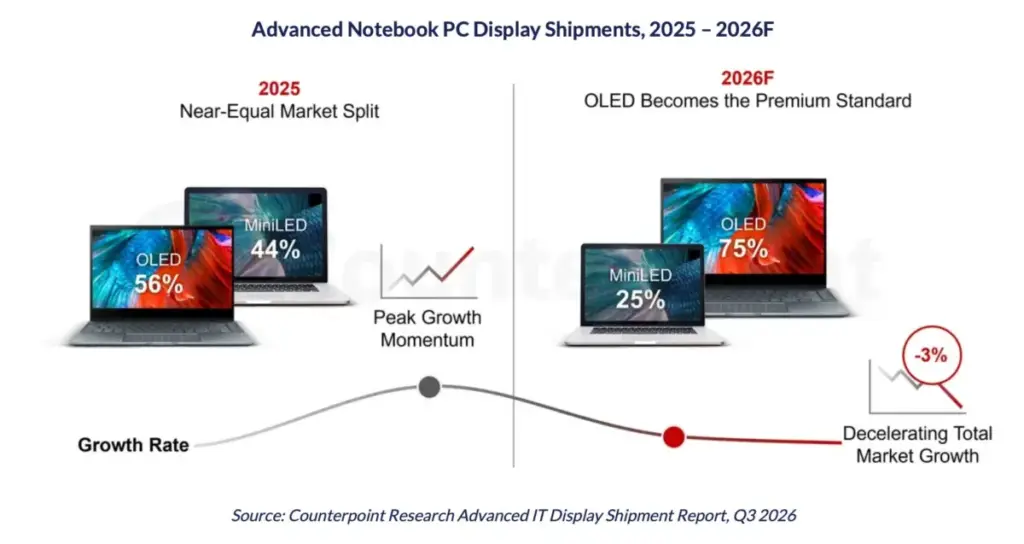
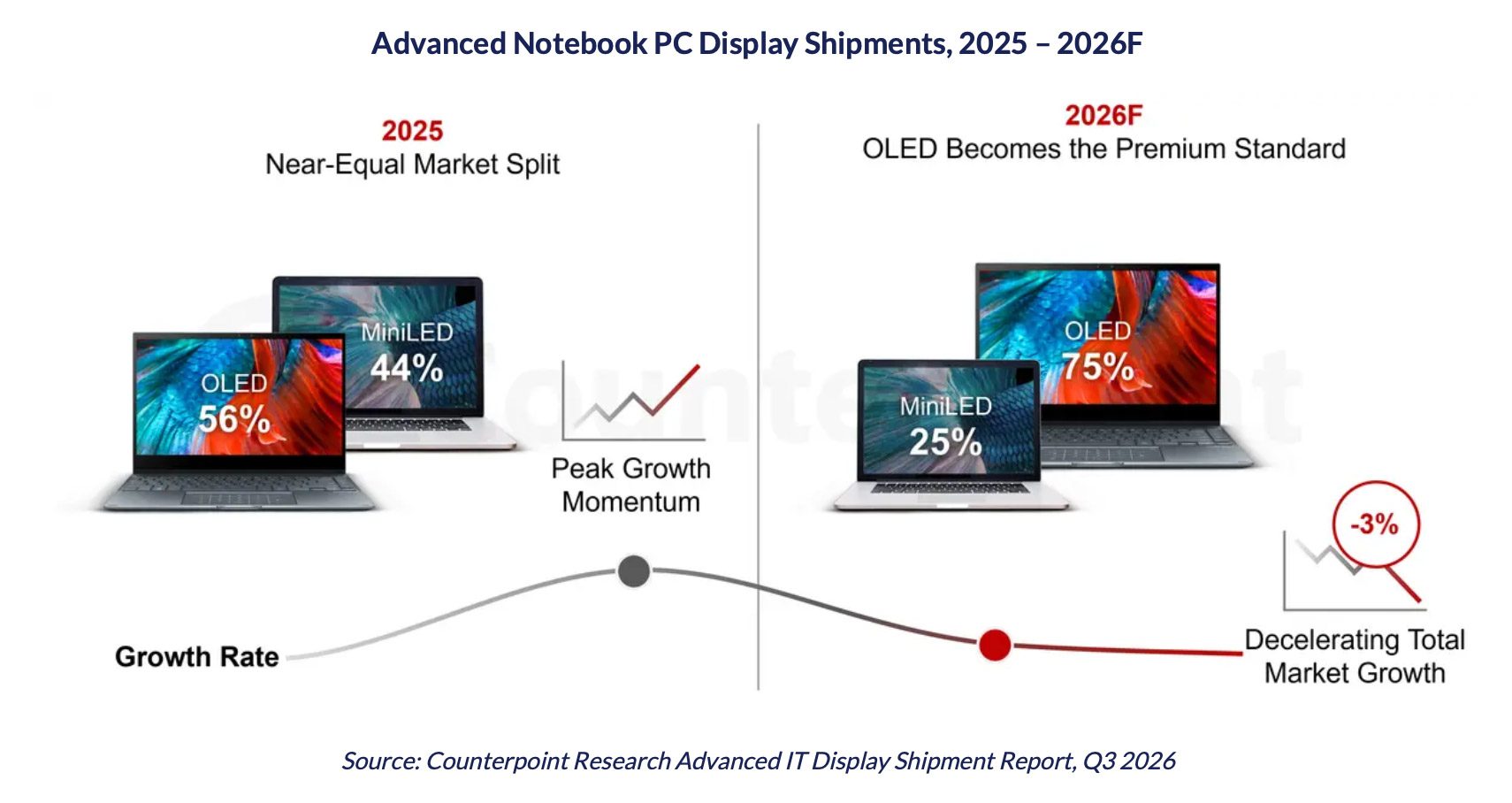
The latest data from Counterpoint Research paints a clear picture of a market in flux. While the broader notebook display market is projected to face a slight contraction, with a forecasted 3% year-over-year decline in total shipments, the "advanced" display segment is bucking this trend. Counterpoint projects that advanced notebook display shipments—which encompass high-performance options like OLED and MiniLED—will experience an 11% growth in 2026 compared to 2025.
Within this growth, the standout performer is undeniably OLED. The research firm anticipates a staggering 50% increase in OLED notebook display shipments during 2026. This surge marks a pivotal transition in the industry’s hierarchy of display technologies. In 2025, OLED held a 56% share of the advanced notebook display market, with MiniLED accounting for the remaining 44%. By the close of 2026, Counterpoint forecasts that OLED will dominate the landscape, capturing 75% of shipments, while MiniLED’s share is expected to compress to 25%.

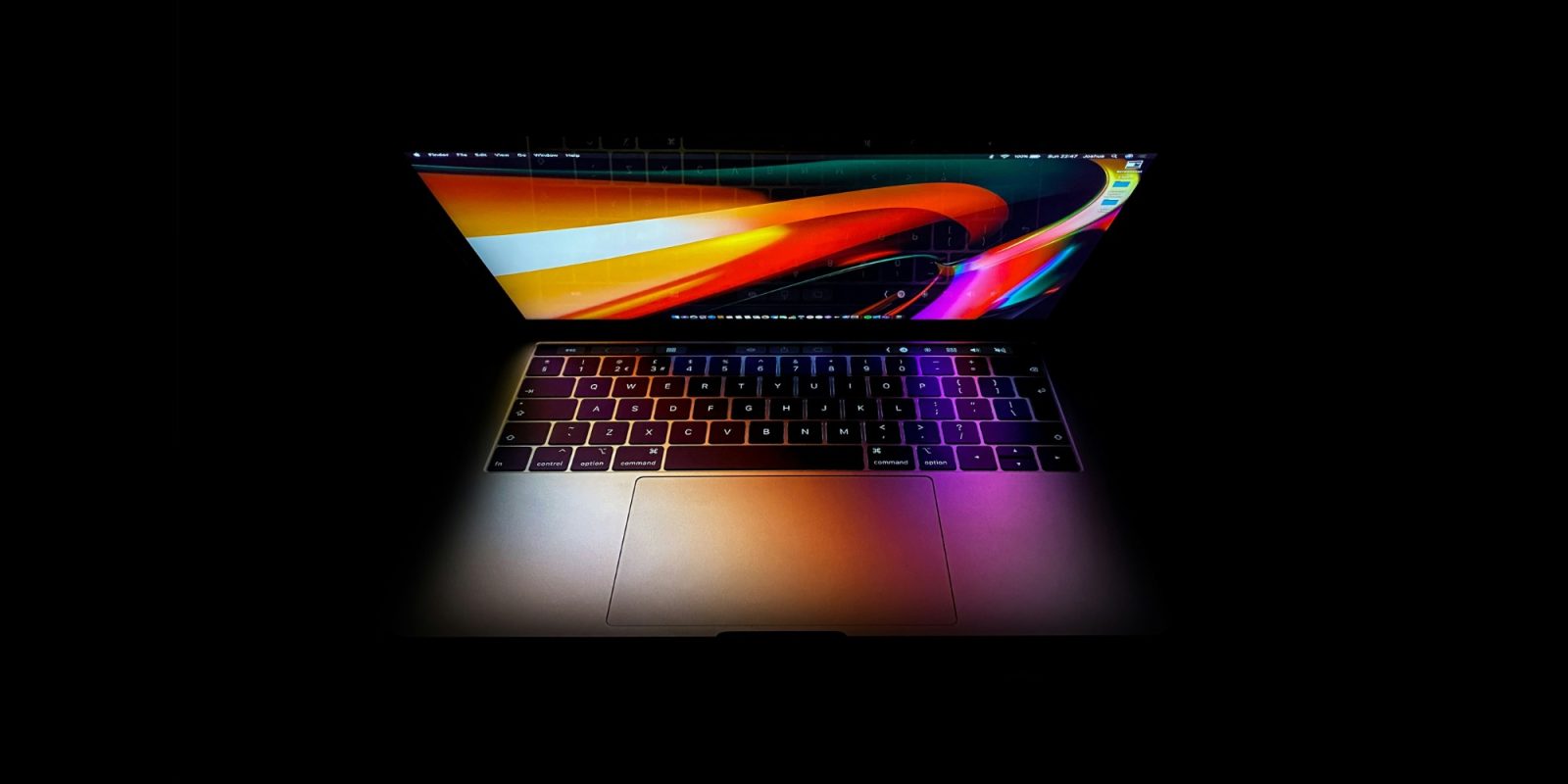
The primary driver behind this rapid adoption is the anticipation surrounding Apple’s hardware roadmap. Industry analysts and supply chain observers have long speculated that Apple is preparing to integrate OLED technology into its professional-grade laptops. Current reports suggest that a redesigned, significantly lighter MacBook Pro—potentially featuring a long-awaited touchscreen interface—is slated for an announcement on October 27. This move is widely viewed by analysts as the "tipping point" for the widespread adoption of OLED panels in the premium notebook sector.
Counterpoint’s analysis explicitly highlights this correlation: "OLED notebook display shipments are forecast to rise 50% in 2026 and another 24% in 2027. Apple’s anticipated adoption of OLED in next-generation MacBook Pro models, alongside continued demand for premium AI PCs, is expected to drive this growth."
The Rise of Tandem OLED Architecture
The rapid scaling of OLED technology is not merely a matter of manufacturer preference; it is supported by significant advancements in panel engineering. A critical factor in this transition is the emergence of "tandem OLED" architectures. Historically, OLED panels for laptops were limited by concerns regarding brightness, power consumption, and long-term durability—specifically the risk of image retention or "burn-in."
Tandem OLED technology addresses these limitations by stacking two emission layers of organic light-emitting diodes on top of one another. This dual-layer approach allows the display to achieve significantly higher levels of full-screen brightness while maintaining better power efficiency compared to single-layer configurations. Because the display can produce the same luminance with less electrical current flowing through each layer, the risk of degradation is substantially reduced, extending the usable lifespan of the panel.
This is a technology Apple has already successfully implemented in its current generation of iPad Pro models. By utilizing a two-stack tandem OLED architecture, the iPad Pro has set a new benchmark for tablet displays, offering deep blacks, high contrast ratios, and exceptional peak brightness. It is now widely expected that Apple will apply this same manufacturing strategy to its 14-inch and 16-inch MacBook Pro models. By migrating this proven technology from the tablet form factor to the professional notebook, Apple is expected to provide users with a display experience that exceeds current MiniLED capabilities, particularly in terms of motion clarity and color accuracy.
Sustained Growth and Market Outlook
The implications of this shift extend well beyond the immediate product launch cycle. Counterpoint Research suggests that the move to OLED is a long-term strategic evolution for the PC industry. Between 2024 and 2030, the research firm expects OLED notebook panel shipments to grow at a compound annual growth rate (CAGR) of 26%. Even more striking is the projected revenue growth for these panels, which is forecast to increase at a rate of 35% per year over the same period.

This revenue growth highlights the premium nature of these displays. As consumers and professionals increasingly prioritize display quality for creative workflows, high-end gaming, and media consumption, the value proposition of OLED becomes more compelling. When combined with the rising demand for "AI PCs"—laptops equipped with high-performance NPUs (Neural Processing Units) that require top-tier display hardware to complement their processing capabilities—the market for OLED is essentially being pushed from both ends: by the desire for superior visual quality and the necessity of premium specifications for modern software.
While MiniLED has served as a capable bridge technology for Apple and other manufacturers, offering high brightness and excellent HDR performance, it remains limited by its reliance on a localized dimming zone structure. OLED, by contrast, offers per-pixel lighting control, allowing for "true black" levels and instantaneous response times that MiniLED simply cannot replicate.
As the October 27 launch date approaches, the industry is closely watching how Apple implements this transition. The inclusion of a touchscreen, if confirmed, would represent a significant departure from Apple’s long-standing design philosophy for the Mac. Combined with the rumored weight reduction and the superior display technology, the new MacBook Pro is shaping up to be a defining product for the company.

For the broader market, the success of these new notebooks will likely dictate the speed at which competitors accelerate their own OLED transitions. If Apple can successfully navigate the manufacturing challenges associated with large-format tandem OLED panels, it will almost certainly solidify the technology as the gold standard for notebooks for the remainder of the decade. The data provided by Counterpoint Research suggests that the industry is not just preparing for a new product, but for a fundamental shift in how notebook users interact with their machines. Whether through the lens of power efficiency, professional-grade color fidelity, or the integration of new touch-based interactions, the transition to OLED represents the most significant update to laptop hardware in recent years.