The online community dedicated to open source advocacy and storytelling is currently experiencing a period of quiet transition. Behind the scenes, community members and organizers are hard at work building something entirely new, marking the next evolution for a platform that has spent over a decade serving as a digital home for the global open source movement.
While specific details regarding the upcoming project remain tightly under wraps and official announcements are yet to be made, there is already plenty of momentum and discussion building across the ecosystem. To understand the significance of this next phase, the community is looking back at the foundational principles that brought everyone together in the first place—starting with the very structure of the internet itself.
The Internet and the Evolution of Top-Level Domains
To understand how digital communities organize, one must look at the foundational architecture of the internet. By definition, a network is a group of connections. In fact, the word "internet" is a portmanteau derived from "interconnected" and "network," describing a sprawling matrix of linked computer networks.


In its earliest days, the internet consisted primarily of two distinct networks: a military network and an academic network. As the technology matured and gained popularity far beyond those initial, specialized groups, it quickly became apparent that distinct designations were necessary to differentiate various types of entities inhabiting the digital space. Society needed a way to instantly recognize whether a digital address belonged to a commercial enterprise, a charitable organization, an academic institution, or a governmental department.
These critical designations became known as top-level domains, or TLDs. While the modern domain name system offers a vast array of available suffixes today, the internet operated for a long time with only a small handful of choices. These original TLDs remain deeply popular and universally recognized. Most internet users intuitively understand that visiting a website ending in .com typically leads to a commercial site, while navigating to a .org address directs them to a non-profit organization. These suffixes serve as digital neighborhood markers, signaling the intent and nature of the entities behind the screens.
Open Source as a Human Network
Open source, much like the internet itself, can manifest in many different ways. It can be commercialized, it can operate as a non-profit endeavor, it can stem from academic research, or it can drive cultural movements. However, regardless of the specific form it ultimately takes, open source is fundamentally and unchangeably a network.

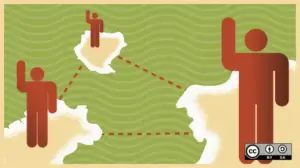
Sometimes that network consists of physical computers collaborating across continents through code repositories and shared infrastructure. But more importantly, at its core, open source is a network of people. Whether individuals are gathering in person at massive international conferences, chatting informally over drinks at a local pub, or collaborating continuously in real-time online chat rooms, the open source movement is driven entirely by human connection and shared community.
For the past twelve years, the publication Opensource.com has received support from a commercial entity, helping it grow into a prominent digital publication. Yet, the people who truly constitute the beating heart of the Opensource.com community—the writers, editors, advocates, contributors, and readers—are not commercial entities themselves. They are human beings united by a shared passion for open principles, collaborative creation, and the free exchange of ideas.
As the community looks toward the horizon, preparations are underway to resolve the structural misalignment between a human-driven community and its supporting framework. In just one month, Opensource.com is set to take a major step forward in addressing this chapter of its evolution. Stay tuned as more details emerge regarding this new chapter for the open source community.