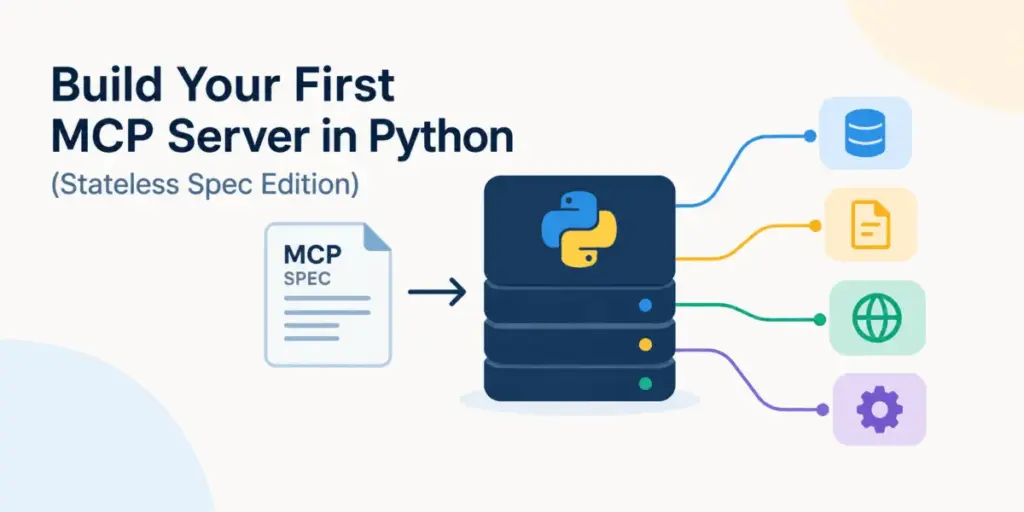
The landscape of AI tool integration experienced a fundamental architectural shift this summer with the implementation of a stateless core in the Model Context Protocol (MCP). According to updates from the protocol maintainers, the revised specification eliminates the requirement for modern clients to establish an upfront protocol session before issuing requests. Furthermore, servers no longer need to depend on Mcp-Session-Id headers for ordinary request handling. This evolution significantly simplifies the deployment of MCP servers behind standard HTTP infrastructure and normal load balancers.
Concurrently, the official Python SDK has advanced to version 2 as its stable line, introducing a higher-level MCPServer application programming interface. This interface allows developers to define tools, resources, and prompts using regular Python functions, streamlining the integration between large language models and backend services. To demonstrate these capabilities, developers can construct a developer knowledge-base server that operates over Streamable HTTP, inspects locally, and connects directly through a Python MCP client without traditional framework boilerplate.
The Architectural Shift to a Stateless Core
The core modification in the recent specification alters how clients and servers communicate. Under older iterations of the protocol, interactions required a formal initialization handshake followed by a persistent session identifier. This previous model required multi-instance deployments to rely on sticky routing or shared session infrastructure to ensure subsequent requests reached the correct worker node.
The modern protocol transforms this interaction into a self-contained request and response model. Individual calls no longer require a protocol session to tie them together, allowing requests to be distributed seamlessly across multiple server instances. The MCP maintainers describe this transition as moving away from a bidirectional, stateful protocol core toward a stateless architecture that aligns more closely with standard web microservices.
Despite the stateless nature of the protocol itself, application-level state remains fully manageable. Developers can maintain state by passing explicit identifiers, such as basket or session tokens, directly through the function arguments visible to the model. This explicit-handle pattern shifts the responsibility of tracking state from the underlying protocol session to the application layer itself, facilitating horizontal scaling and simpler deployment topologies.
Implementing the Python SDK v2 API
The current stable line of the Python SDK requires Python 3.10 or newer and offers a streamlined developer workflow. By utilizing modern package managers like Astral’s uv or standard pip installations with the CLI extra, developers gain access to local development commands and the MCP Inspector tool. The primary high-level interface, MCPServer, allows developers to instantiate a server instance with custom instructions and metadata while avoiding manual JSON schema creation or complex tool manifests.
In a typical developer knowledge-base implementation, the SDK automatically derives input schemas from standard Python function signatures and type hints. For instance, a search function designed to query support articles utilizes standard string parameters and optional integer limits. The Python type hints translate directly into the necessary input schema for the model, while default values designate optional parameters. This approach ensures that writing MCP tools feels analogous to writing standard Python code, relying on docstrings and type annotations to define the interface.
Beyond traditional action-oriented tools, the SDK supports resources and prompts through comparable decorator patterns. Resources expose information that host applications can read directly into context, functioning conceptually similar to GET-like endpoints. Conversely, tools act as functions that perform work, resembling action-oriented POST requests. Reusable prompt templates can also be exposed through simple decorators, allowing hosts or users to initiate structured interactions without requiring autonomous model invocation.
Local Inspection and Deployment Strategies
Development workflows benefit from integrated tooling provided by the SDK. Launching the server through development commands opens an MCP Inspector interface in the local environment, providing a user-friendly graphical interface to review registered tools, resources, and prompts, and to execute test queries interactively. This environment allows engineers to verify that search parameters and return structures function correctly before deploying to production.
When moving beyond local development, servers can operate over Streamable HTTP using the built-in runtime execution or integrate directly into larger web applications. Because the MCPServer class can generate a standard Starlette-compatible ASGI application, developers can mount the MCP endpoint into existing frameworks like FastAPI or Starlette. This flexibility permits teams to run their MCP servers behind standard ASGI servers like Uvicorn, scaling across multiple worker processes without worrying about session affinity or sticky routing constraints.
Verifying the deployment can be accomplished through dedicated client scripts utilizing the updated v2 Client class. By establishing an asynchronous context manager connected directly to the HTTP endpoint, clients can automatically negotiate the protocol version, list available tools, and execute remote tool calls while processing structured responses seamlessly. This client-server interoperability highlights the practicality of the stateless specification for modern AI application architectures.