









Many technology companies operate under a sweeping, unexamined assumption: that everyone constantly craves new artificial intelligence features. Industry leaders often act on the belief that consumers and employees are eagerly waiting for new AI products, workflows, and tools that will magically replace outdated practices and broken ways of working. Yet, a widening gap between corporate expectations and everyday reality suggests that most people do not actually want more AI—at least, not in the intrusive, disruptive ways leadership envisions.
Unsurprisingly, many newly launched AI features suffer from remarkably low adoption rates and poor user retention. This disconnect carries a very high cost of delivery for organizations and introduces a significant risk of reputational damage. As companies rush to stamp "powered by AI" onto every software update and product line, a growing body of evidence indicates that the technology is often solving problems people never asked it to solve while complicating the tasks they already know how to do.
The AI People Don’t Need
Making a strong, critical argument against the AI tide remains remarkably difficult when dealing with senior corporate leadership. However, fundamental product truths still apply: AI is not a standalone value proposition. Simply bolting on generative AI capabilities does not automatically result in happy or excited customers. Because AI features are frequently introduced as separate, disconnected tools that employees must deliberately access, they typically pull workers completely out of their regular, efficient ways of working.
Rather than solving deep operational issues, AI often proves remarkably efficient at amplifying existing shortcuts and shortcomings within organizations. From poor data quality to flawed decision-making processes, technology cannot magically erase years of accumulated quick patches, technical debt, broken internal cultures, and messy office politics. If anything, those underlying inconsistencies and conflicting priorities become even more visible when filtered through AI, handing the resulting confusion directly to users who are then left to clean up the mess.
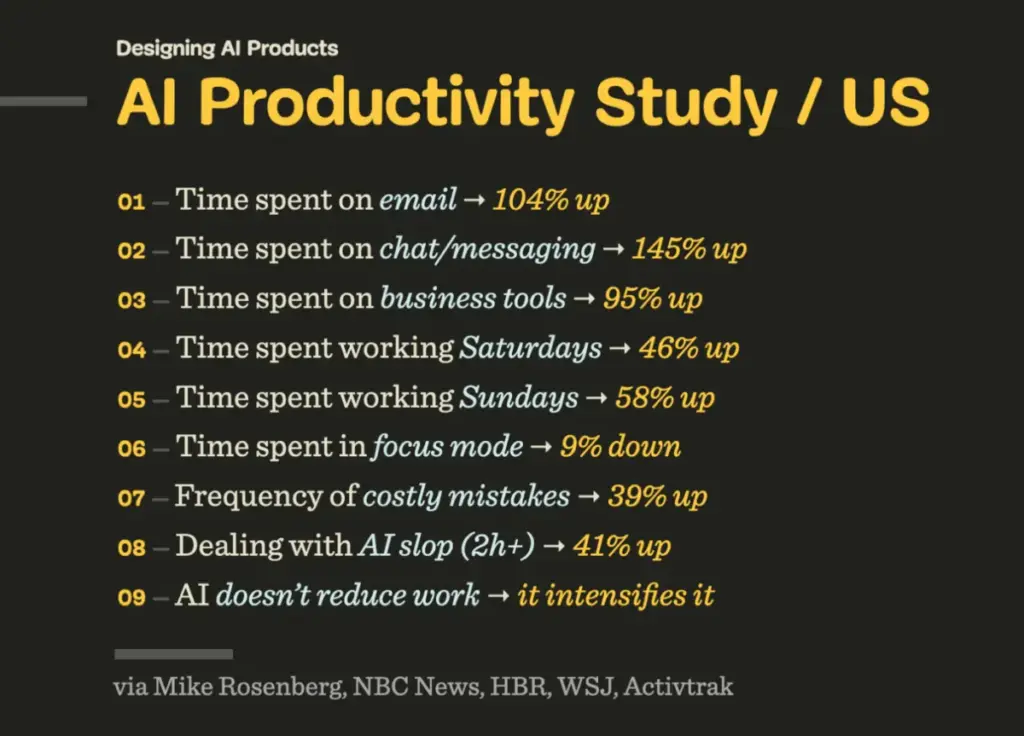
In most workplaces, daily tasks already require hopping on and off a fragmented landscape of disconnected software systems. Introducing a new, standalone AI tool merely adds yet another system that employees must navigate. Instead of eliminating friction, it frequently generates more work—and rarely the kind of rewarding, engaging work that keeps employees motivated.
Furthermore, workers are acutely aware of the hidden costs associated with finding and fixing AI hallucinations. While prompting an algorithm to generate a response may feel faster and easier than writing or building from scratch, verification carries a heavy cognitive toll. Workers must meticulously fact-check outputs, rewrite awkward phrasing, and ensure compliance, turning what should have been a time-saving shortcut into an exhaustive editorial review process.
For many individuals, AI is not a tool they can proactively choose and explore on their own terms. Instead, it arrives uninvited, forced upon them at someone else’s corporate pace. Combined with widespread public messaging and headlines amplifying fears about automation replacing human labor, it is hardly surprising that the popular perception of corporate AI initiatives is rarely excitement. Instead, it breeds resistance to change and deep-seated anxiety about one’s place in a professional world that seems to be transforming without their consent.
At best, forced AI features are silently tolerated or nodded away with reluctant acceptance. At worst, they raise immediate concerns, doubts, and a healthy dose of professional skepticism. Unlike traditional software features that behave predictably every time they are engaged, AI introduces a distinct layer of unpredictability and liability.

Consumers face a similar fatigue in their personal lives. People are not waking up dreaming of AI art museums, smart refrigerators that require constant troubleshooting, AI hotel receptionists, or AI-narrated children’s books. They do not wish to foster romantic relationships with artificial companions, nor do most people want to actively manage and clean up after an autonomous swarm of AI agents roaming through their bank accounts and executing real-world transactions on their behalf. Above all, they do not want a magical box that demands constant conversation or typing just to perform basic domestic tasks.
The AI People Actually Need
Industry discussions frequently compare the utility of artificial intelligence to the inherent unreliability of human beings. Yet, everyday users do not compare software to human colleagues; they compare feature to feature. If one feature within a software product proves unreliable while a competing tool operates flawlessly, users will invariably choose the latter. The core debate is not strictly about whether a tool uses AI, but rather what works consistently and reliably, and what ultimately fails.
Many corporate conversations about artificial intelligence center entirely on the speed of delivery. Yet for many professionals, increasing the sheer volume of output holds little intrinsic value. They want to execute tasks thoroughly and well, with adequate time to think, reflect, and make sound decisions. They want to enjoy the time they spend on their craft rather than merely rushing products out the door at an unsustainable pace. That deep sense of professional reward and personal achievement slowly erodes, one hastily deployed, vibe-coded iteration at a time.
Human nature changes very slowly. After decades of technological evolution, people still primarily desire features that are fast, accessible, reliable, predictable, and useful on every single invocation. They do not want tools that disrupt or replace their entire workflow; they want utilities that thoughtfully augment their existing habits. They want technology that takes over the most mundane, repetitive, and exhausting administrative burdens—tasks that offer no personal pleasure or professional fulfillment.

While many modern jobs possess a high exposure to AI automation, nearly all of these roles retain a rewarding, creative core that requires genuine human taste, subjective perspective, and intuitive judgment. If artificial intelligence can safely shoulder the tedious, mechanical elements of those jobs, it becomes a distinct advantage for everyone involved. That is where productivity genuinely grows, bringing a renewed sense of engagement to daily work.
The value of AI becomes immediately clear when it relieves mental exhaustion and eliminates friction. However, to achieve this, the technology cannot feel like an awkward, bolted-on addition. It must be deeply integrated into the workflows people have spent years or decades refining. AI should adapt organically to existing human mental models and decision-making frameworks, rather than forcing users to completely restructure how they think.
Ultimately, it matters very little whether these background features are marketed under the labels of artificial intelligence, smart computing, or traditional automation. They must simply function seamlessly for the people relying on them. This requires users to be clearly educated on practical use cases where technology genuinely helps, inspiring them to discover additional applications on their own.
Ironically, the software tools that achieve this balance are rarely "AI-first"—they are "AI-second." They operate with subtlety, humility, and calm ambient awareness, taking a supportive role in the background to handle the remarkably dull and unnecessary tasks that would otherwise drain human energy.

As enterprise designer and strategist Bo Young Lee noted in widely shared reflections on the state of the technology, most people do not want synthetic literature, artificial fine art, robotic teaching assistants, synthetic therapy, or automated medical diagnosis. Instead, they want machines to manage the physical and mental overhead that exhausts them, leaving them free to read books written by humans, visit physical galleries to experience art created by people, and connect meaningfully with the world around them. They want tools that make life manageable without forcing individuals to fundamentally alter who they are.
Perhaps this perspective sounds traditional to technology executives racing toward full automation, but it underscores a fundamental truth: human stories, thoughts, emotions, enthusiasm, and shared laughter remain irreplaceable. While artificial intelligence can certainly streamline isolated operational hurdles, so can human collaboration. Between the two, people consistently prefer spending time with other humans—imperfections and all—over interacting with machines.
Ultimately, people do not need more artificial intelligence embedded into every facet of their existence. They need technology to quietly handle the routine administrative burden of daily life, giving them back the time and headspace required to pursue the things they genuinely love. That does not mean spending more time interacting with algorithms, but rather spending more time engaging with the people and experiences that matter most.
For professionals interested in exploring how to design interfaces that respect human workflows rather than disrupting them, resources such as Vitaly Friedman’s video course, "Design Patterns For AI Interfaces," offer practical examples and UX training drawn from real-world digital products.