








For nearly four0 years, John Steinbach has lived comfortably in his Manassas, Virginia, home. However, that sense of stability was shaken in January 2026 when he opened an electricity bill totaling $281, a steep jump from roughly $100 just a month prior. Speaking with Consumer Reports, Steinbach voiced a concern that is rapidly echoing across households nationwide: he wants to know where utility rates are heading next as a wave of power-hungry artificial intelligence data centers continues to plug into the local electrical grid.
Steinbach is far from alone in his anxiety. A Gallup poll conducted in March 2026 revealed that seven in 10 Americans oppose the construction of AI data centers in their local areas, with 48% registering strong opposition. Notably, this skepticism transcends traditional political lines, drawing solid majorities of disapproval from Democrats, Republicans, and independents alike.
This widespread grassroots resistance has already upended infrastructure planning across the country. According to tracking data from Data Center Watch, local pushback successfully disrupted approximately 120 projects during the first half of 2026 alone. This includes at least 45 major developments valued at roughly $68 billion that stalled out during the second quarter.

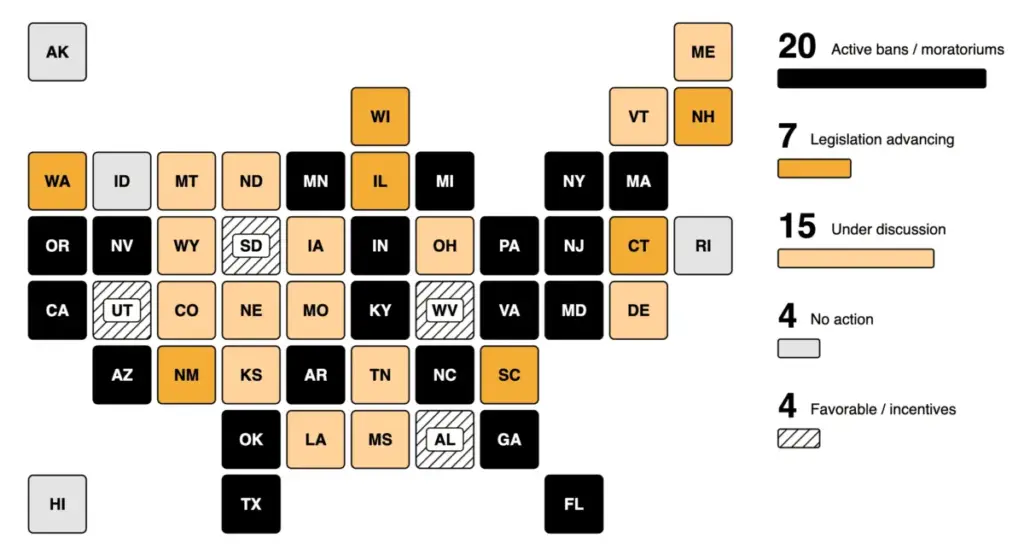
Across the United States, roughly 379 jurisdictions have enacted moratoriums or outright bans on data center construction. Municipalities are increasingly hitting the brakes on digital infrastructure as residents push back against soaring utility demands and environmental strains. For instance, the Indianapolis City Council voted 23–1 in August to suspend new construction through 2027. Meanwhile, Charlotte officials approved a 150-day moratorium following a municipal survey that revealed 78% local opposition. According to the Brookings Institution, political candidates from both major parties are increasingly running campaign advertisements targeting the massive facilities.
At its core, the public debate is typically framed around a simple question: whether data centers should be built at all. Yet, a much more complicated dilemma lies underneath the surface regarding who pays the bills and who makes the final decisions. The financial and environmental costs of these facilities land locally and immediately, while the economic benefits often materialize regionally or nationally over a much longer timeline. Furthermore, the regulatory frameworks governing how these costs and rewards are split were established long before the advent of AI-scale power demands.
Why AI Changed the Math
To understand the scale of the current controversy, industry analysts point to a fundamental shift in computing architecture. Traditional cloud data centers relied primarily on general-purpose servers designed to handle variable user traffic, meaning their power loads would rise and fall throughout the day. In contrast, modern AI clusters pack power-hungry graphics processing units much more densely. These systems throw off significantly more heat per rack and demand continuous power around the clock during intensive training runs. Consequently, the operational footprint of a single AI campus places unprecedented demands on local electrical grids and municipal water systems.
Data centers across the United States consumed approximately 176 terawatt-hours of electricity in 2023, accounting for roughly 4.4% of the nation’s total power supply, according to a report prepared for the Department of Energy by the Lawrence Berkeley National Laboratory. However, the projected growth of this energy consumption remains a primary flashpoint for policymakers and utilities.
A power report published in January 2026 by Bloom Energy projected that the total IT load for U.S. data centers will nearly double, climbing from approximately 80 gigawatts in 2025 to roughly 150 gigawatts by 2028. While this forecast comes from a company that manufactures on-site power generation systems and holds a vested interest in market expansion, it highlights a legitimate structural bottleneck. Utility providers currently expect to deliver required electrical infrastructure 1.5 to 2 years later than developers intend to build. To bridge this gap, developers project that roughly a third of all new data centers will run entirely on on-site power generation by 2030, effectively establishing private power plants when the public grid fails to keep pace.
Electricity Bills: Who Pays for the Next Grid
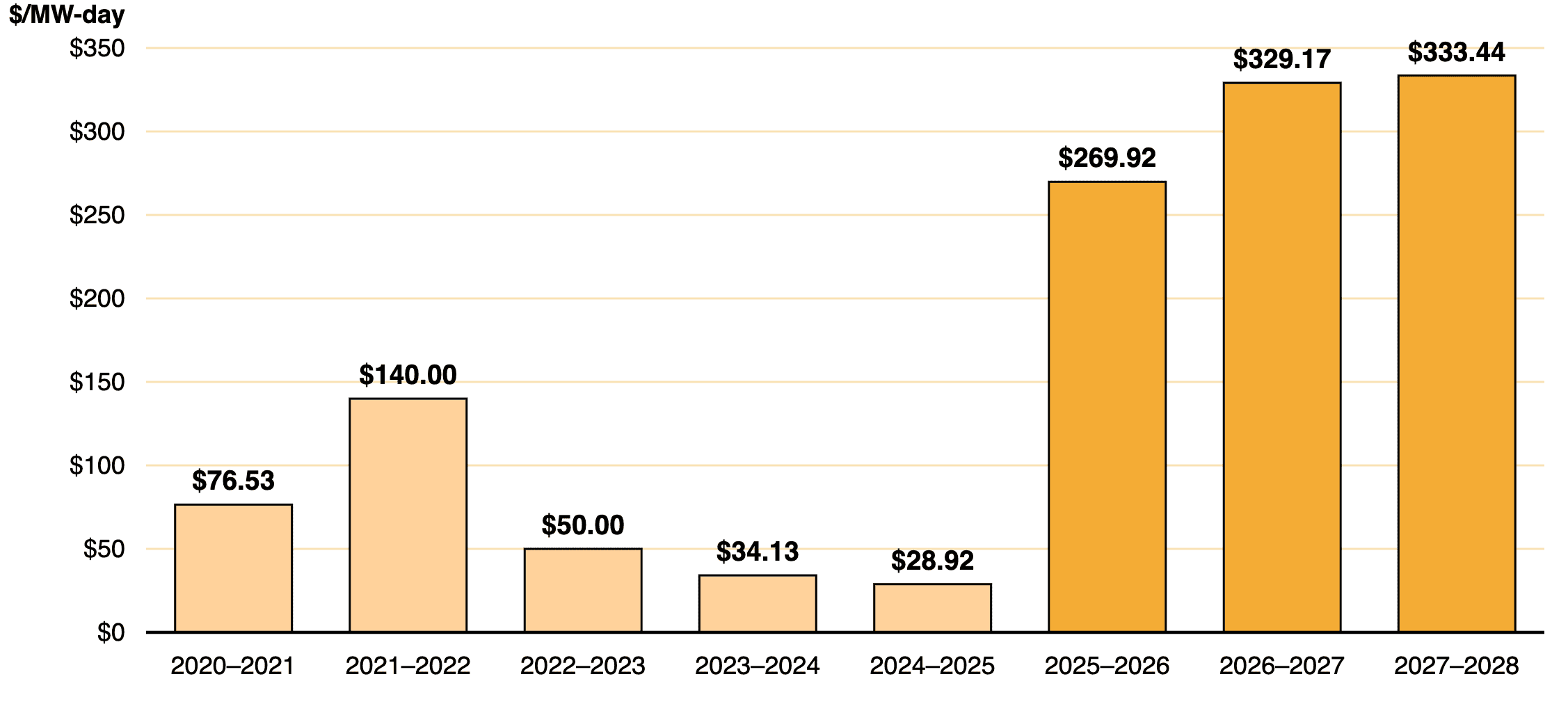
Public concern regarding utility rates begins within regional power markets like PJM Interconnection, the grid operator serving 13 states and the District of Columbia. PJM runs capacity auctions designed to pay power plants to remain available during peak demand periods. The financial impact of these auctions has been dramatic. The clearing price jumped from $28.92 per megawatt-day for the 2024–2025 period to $269.92 for 2025–2026, eventually hitting the maximum price cap in subsequent auctions at $329.17 and $333.44. PJM’s independent market monitor attributed 63% of the 2025–2026 price increase—amounting to roughly $9.3 billion—directly to rising data center demand.
Other economic indicators point toward a similar trend. Energy Information Administration data shows that residential electricity prices in Virginia rose by about 13% over a 12-month period. A survey conducted in January 2026 by the Global Strategy Group and the Chesapeake Climate Action Network Action Fund found that nearly three-quarters of Virginia voters blamed data centers for the rising costs.
Looking toward the end of the decade, a peer-reviewed modeling study conducted by researchers from North Carolina State University, Carnegie Mellon University, and other institutions projects that wholesale electricity prices will be 6% to 29% higher nationally by 2030 compared to a baseline scenario without data center growth. In the hardest-hit regions, those increases could spike by as much as 57%, though researchers noted these figures reflect wholesale market prices rather than direct retail utility bills.

Conversely, the technology industry argues that large industrial customers typically help lower overall rates for standard consumers. An Electric Power Research Institute study analyzing data from 2015 to 2024 found that each doubling of data center capacity correlated with a 3.5% decrease in average retail prices. This dynamic occurs because large, steady power loads allow utilities to spread fixed operational costs across a broader sales base.
Additional research funded by Amazon and conducted by the energy consultancy E3 concluded that Amazon’s utility payments in four distinct service territories met or exceeded the actual cost of servicing its data centers, leaving an average net surplus of about $3.4 million per site. A separate E3 report funded by the Data Center Coalition estimated that load growth accounted for roughly 50% of the 2025–2026 PJM price increase, a figure notably lower than the market monitor’s assessment. Meanwhile, the Institute for Energy Research found no statistically significant correlation between a state’s total number of data centers and its average electricity prices.
Academic evaluations often describe the current financial impact as a matter of timing. The Rutgers New Jersey State Policy Lab analyzed utility-level data through 2024 and found no statistically significant effect on residential bills, though researchers cautioned that "not yet" is not synonymous with a lack of future risk. Historically, any financial benefits derived from large industrial loads depended entirely on the existence of spare grid capacity. If infrastructure is built to accommodate projected demand that ultimately fails to materialize, the fixed costs of those capacity upgrades will inevitably be distributed across a smaller population of regular ratepayers. With other operational costs climbing—such as transmission and distribution spending for grid hardening and expansion highlighted in Berkeley Lab’s 2026 price-trends update—the central policy question remains centered on who will finance the next wave of inevitable grid expansion.
Water: National Totals, Local Stress
Beyond electrical demands, water-cooled data centers present severe logistical challenges for municipal utilities. These facilities can consume millions of gallons of water on a single hot summer day, a reality that creates intense friction in arid regions facing severe resource constraints. Arizona, for instance, is currently navigating a federal mandate that reduces its allocation from the Colorado River by 760,000 acre-feet, representing a cut of up to 30%.
This environmental backdrop heavily influenced recent municipal decisions. The Tucson City Council unanimously rejected Amazon’s proposed Project Blue in August 2025, and officials in Chandler, Arizona, similarly voted down another data center proposal in December of that year. In Florida, the Orange County vice mayor proposed a one-year moratorium on new facilities, citing a projected regional groundwater shortfall of 96 million gallons per day by 2045.
Discussions surrounding water consumption often encounter starkly different metrics. While viral estimates derived from early artificial intelligence research suggested that a typical 100-word AI prompt consumes roughly half a liter of water, Google’s updated 2025 figures indicate that a median Gemini text prompt requires about 0.26 milliliters—roughly five drops—though that calculation measures only direct water usage on site.
From a macro perspective, Lawrence Berkeley National Laboratory estimates that U.S. data centers consumed approximately 17.5 billion gallons of water directly in 2023, a figure that could quadruple by 2028. Defenders of the industry often point out that this national total accounts for a fraction of total freshwater consumption. Analysts comparing Google’s Iowa facilities to regional agricultural demands note that commercial tech campuses utilize a fraction of the water consumed by standard agricultural operations or local golf courses. Furthermore, an Arizona State University study found no measurable rise in water use among central Arizona power suppliers despite local data center growth, noting that agriculture accounts for roughly 72% of the state’s total water consumption.
However, researchers emphasize that national consumption aggregates often obscure severe local stress points. In Botetourt County, Virginia, a planned Google campus could consume up to 2 million gallons of water daily—with potential peaks reaching 8 million gallons—in a rural county where many residents rely entirely on private residential wells. To accommodate the project, the county is allocating $300 million toward a new regional water supply, funded in part by anticipated tax revenues from the development.
Jobs and Tax Revenue: A Strong Case and a Thin One
The economic development argument remains the tech industry’s strongest defense against local opposition. Data centers across Northern Virginia contributed an estimated $1.3 billion in local property taxes in 2024, while total municipal revenue supported by the sector surpassed $2 billion, according to data from the Chamber of Progress.
Quincy, Washington, is frequently cited as a successful model for small-town integration. In that agricultural community, roughly 30 data centers account for an estimated 57% of the local property tax base. This substantial revenue stream has helped finance a $120 million high school, a local hospital, new police and fire stations, and a $30 million water reuse facility constructed in partnership with Microsoft.
Texas industry figures cited by the Texas Tribune indicate that data centers supported 61,060 direct jobs and contributed $3.5 billion in state and local taxes in 2023. Company representatives have estimated that a proposed $10 billion campus would generate $50 million annually for Lacy Lakeview, a municipality of about 7,000 residents. Legislative auditors in Virginia similarly reported that the state’s data center tax exemption ranks as its second-most productive economic incentive, generating $6.1 million in personal income for every $1 of forgone revenue.
Despite these significant tax contributions, the direct employment generated by data centers is relatively modest. An analysis by the Brookings Institution examining roughly 1,500 facilities found that the arrival of a county’s first large data center typically creates between 100 and 200 permanent jobs over a decade, with little to no measurable impact on local wage levels.
State incentive programs frequently reflect this low employment yield. Texas grants sales tax exemptions to facilities encompassing at least 100,000 square feet that create 20 jobs, while Maryland requires a minimum of five jobs and a $2 million investment in targeted areas. While construction employment provides a temporary economic boost, those positions end once the physical infrastructure is completed.
Consequently, state governments are recalibrating their incentive frameworks. Governors in Illinois, Massachusetts, Nebraska, Nevada, and Ohio temporarily paused or restructured data center tax breaks, and Arizona temporarily froze new award approvals. Meanwhile, Virginia preserved its core sales tax exemption but instituted a temporary electricity tax of 1.1 cents per kilowatt-hour on data centers, running through June 2028 with an annual cap of $600 million.
Air Pollution and On-Site Power: The Memphis Case
While most data centers rely on the public electrical grid, extreme examples highlight the environmental fallout when companies bypass traditional utility connections to accelerate deployment schedules. To bring its Colossus 1 supercomputer online in Memphis, Tennessee, xAI deployed trailer-mounted methane gas turbines in South Memphis—reaching as many as 35 units, according to aerial imaging from the Southern Environmental Law Center. The equipment was positioned near Boxtown, a residential neighborhood already burdened by decades of heavy industrial pollution. For its subsequent Colossus 2 installation, the company placed dozens of additional turbines just across the state line in Southaven, Mississippi.
Initially, these power units were classified as mobile non-road engines, allowing the company to bypass standard air quality permits. However, an Environmental Protection Agency rule issued in January 2026 confirmed that large gas turbines operating in such capacities qualify as stationary sources requiring formal environmental permits. SpaceX, which acquired xAI, ultimately retained dozens of the turbines while transitioning toward a permanent 1.2-gigawatt gas power plant. The situation prompted lawsuits from the NAACP, represented by the Southern Environmental Law Center and Earthjustice, alleging violations of the Clean Air Act.
The deployment drew intervention from federal authorities, with the U.S. Department of Justice filing arguments in support of the installation, framing the power generation units as a matter of national economic and energy security. Independent environmental assessments yielded conflicting data regarding local air quality impacts. A University of Tennessee analysis utilizing satellite observations identified measurable increases in nitrogen dioxide concentrations near the site, while University of Memphis researchers modeling fine particulate matter noted smaller statistical variances. Nevertheless, environmental advocates emphasized that even incremental emissions exacerbate conditions in a neighborhood where air quality already frequently exceeds federal benchmarks.
Local Control and the Demand Risk
A significant portion of the public backlash surrounding data center developments centers on procedural transparency as much as environmental impact. Major projects have frequently advanced under strict nondisclosure agreements signed by local officials and state legislators before public announcements are made. In Louisiana, Applied Digital’s $3.6 billion campus initially proceeded under internal project codenames backed by confidentiality pacts signed by elected officials. In response, lawmakers in states such as Michigan, Oklahoma, Kentucky, and Ohio introduced legislation to ban government-backed nondisclosure agreements for industrial developments, while Pennsylvania Governor Josh Shapiro barred state agencies from entering into similar pacts.
Zoning regulations have also complicated local oversight. In Aurora, Colorado, a proposed 500-megawatt campus could be approved administratively without public hearings because existing zoning classifications already permit data center operations, despite the facility drawing a fraction of the electricity consumed by nearby regional airports.
State-level authorities have increasingly intervened to manage the friction between local municipalities and tech developers. In August 2026, Texas Governor Greg Abbott ordered an operational audit of every data center seeking a grid connection, subsequently halting state-level permits for new projects until the review concludes. Across the country, lawmakers in more than a dozen states have introduced moratorium legislation to reevaluate local zoning authority and resource allocation.
As policymakers weigh these competing interests, both critics and industry boosters share a foundational assumption that long-term electrical demand will continue to rise exponentially. Prominent financial forecasts project global capital spending on data centers to reach approximately $6.7 trillion by 2030. However, if that projected demand eventually falls short, the financial burden of overbuilt utility infrastructure will not simply disappear. Utilities that construct expensive generation and transmission capacity for projects that are later downsized or canceled are still legally permitted to recover those costs from the remaining customer base.
This underlying financial risk explains why modern regulatory policy increasingly focuses on minimum contractual payments and strict exit terms. In Virginia, state regulators already require large commercial customers to cover at least 85% of their contracted transmission demand and 60% of generation demand, regardless of whether those resources are fully utilized. As statehouses continue debating the future of digital infrastructure, the central question for communities evaluating new proposals remains consistent: if the promised economic growth fails to materialize, who will ultimately pay for the grid?