The United Kingdom has launched a significant crackdown on the illicit cryptocurrency infrastructure supporting the Russian wartime economy, issuing comprehensive economic sanctions against the notorious digital asset platform Cryptomus. The move represents a major escalation in international efforts to dismantle a complex, chameleonic network that experts identify as a primary conduit for ransomware payments, narcotics trafficking, darknet market activity, and sophisticated fraud schemes.
On October 8, the U.K. government officially formalized these sanctions, effectively freezing any assets associated with Cryptomus held within British financial institutions. Furthermore, the directive bars all British companies from engaging in any business dealings with the platform, whether through virtual services or otherwise. The sanctions also cast a wider net, targeting several other virtual payment entities including VexPay, TokenSpot, and the Tsunami Payments service, all of which have been identified as vital cogs in the machinery facilitating the circumvention of existing financial restrictions against Russia.
The sanctions arrive following a period of intense scrutiny by international investigators and blockchain forensics firms. Cryptomus, which has operated under various aliases—including Certa Payments and Xeltox Enterprises—has long been accused of serving as a go-to payment processor for an array of Russian cryptocurrency exchanges and websites dedicated to providing cybercrime-as-a-service.

The platform’s history is one of constant rebranding and evasion. Following a record-breaking CAD $176 million fine levied by Canadian authorities in October 2025 for severe anti-money laundering violations, the platform quickly pivoted. Reports indicate that the operators launched "Heleket" as a parallel service to continue processing transactions without the oversight of "know your customer" (KYC) requirements. Despite claims from the Heleket support agents on Telegram—who have insisted the service is entirely unaffiliated with Cryptomus—the operational patterns suggest a direct continuity of the illicit enterprise.
Blockchain intelligence firm Chainalysis noted that the U.K. sanctions are strategically aimed at the broader infrastructure that sustains Russia’s financial survival amid ongoing international pressure. In an October 8 analysis, the firm highlighted the alarming scale of the activity, noting that Cryptomus and Heleket had morphed into major hubs for illicit capital. According to Chainalysis data, these services witnessed a surge in illicit counterparties, exceeding 900 in a single month in late 2025, a volume that surpassed even the specialized cryptocurrency mixers previously tracked by the firm.
The sheer scale of the operation is staggering. In April 2026, TRM Labs, a leader in blockchain analysis, reported that Cryptomus had processed more than $7 billion in transactions since its emergence in 2022. The firm’s research identified that this massive flow of capital was inextricably linked to some of the most dangerous corners of the internet, including vendors of child sexual abuse material, global terrorist financing networks, and large-scale human trafficking operations.

TRM Labs observed a distinct tactical shift in how these platforms operate. While Cryptomus experienced a significant cratering in transaction volume after being forced to implement KYC protocols, the subsequent launch of Heleket allowed the operators to maintain a "no-KYC" pipeline for bad actors to bypass these safeguards.
Richard Sanders, a dedicated blockchain investigator who spent months mapping the intricate infrastructure of these payment processors, suggests that the U.K. action is a critical turning point. He points out that while the Canadian fine against Cryptomus was a headline-grabbing regulatory action, it ultimately proved unenforceable and uncollectible, failing to halt the platform’s day-to-day operations.
"A fine doesn’t stop a cryptocurrency payment processor from processing payments," Sanders remarked in a recent assessment. "Sanctions kill the operation. The distinction matters."
For Sanders, the significance of the U.K. action extends beyond the immediate impact on Cryptomus. He notes that this is the first documented instance of a "Five Eyes" nation—comprising Australia, Canada, New Zealand, the U.K., and the U.S.—imposing sanctions on a cryptocurrency operation incorporated within another Five Eyes jurisdiction. This cross-jurisdictional cooperation marks a new, more aggressive phase in how Western governments are approaching the "chameleonic" nature of platforms that hide behind multiple corporate identities.
The origins of these platforms reveal a bizarre and elaborate scheme involving the fabrication of regulatory legitimacy. Investigative work conducted in late 2024 into the parent company of Cryptomus, Certa Payments, uncovered a web of deception that traces back to a 25-year-old Ukrainian woman. She was found to be the sole shareholder of Certa Payments, while also managing several other firms, including the "WS Management and Advisory Corporation."
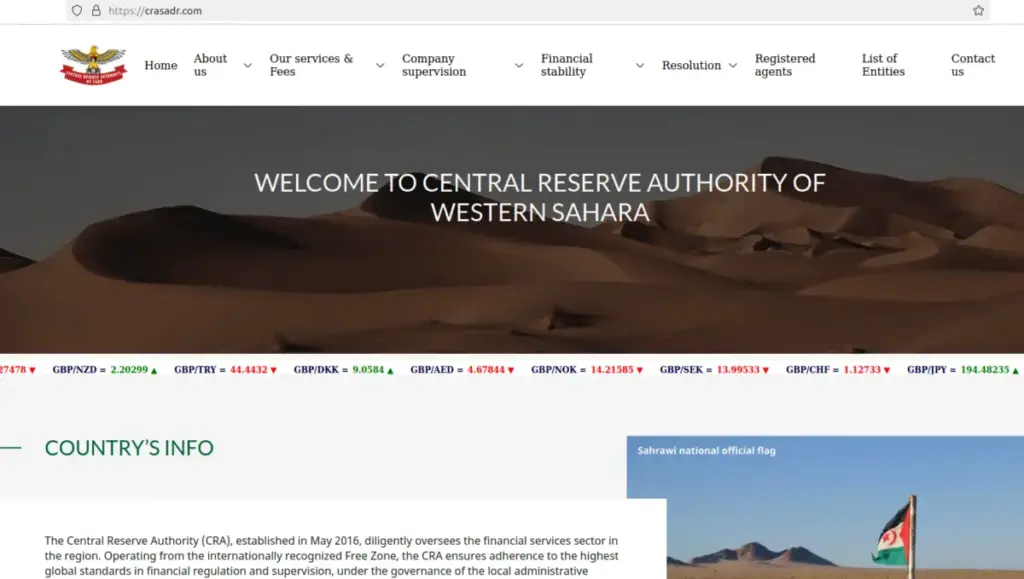
This advisory firm presents itself as a legitimate regulatory body responsible for overseeing cryptocurrency licenses, foreign exchange, and online gaming businesses incorporated in the Western Sahara, a disputed region in northwest Africa. The regulatory body’s website, crasadr.com, offers services ranging from bank setup and corporate formation to the licensing of financial brokers.

The depth of this charade was further evidenced by the shared server infrastructure of these entities. Certa Payments’ former web domain, certa.website, was found to be hosted alongside 12 other domains, including rasd-state.ws—a site claiming to represent the Central Reserve Authority of the Western Sahara. This "Central Reserve Authority" functioned as the primary vehicle for granting the licenses that companies like Cryptomus utilized to project an air of legitimacy to their unsuspecting clients and potential banking partners.
The sudden nature of the crackdown has left users and operators scrambling. On the day the U.K. sanctions were announced, the Cryptomus support bot on Telegram was flooded with inquiries from users reporting that the platform had suddenly lost its ability to process transactions. For the operators behind this web of shell companies and fake regulatory bodies, the U.K.’s decisive action represents more than just a regulatory hurdle; it signals a coordinated, international attempt to sever the financial lifelines that allow cybercriminals to thrive.
As the fallout from these sanctions continues to unfold, the case of Cryptomus serves as a stark reminder of the challenges posed by digital asset platforms that operate in the shadows of global law. The ability of these services to reinvent themselves, switch names, and exploit jurisdictional loopholes has historically kept them one step ahead of regulators. However, by targeting the core infrastructure and imposing strict prohibitions on financial interaction, the U.K. is testing a new strategy intended to render such platforms not just legally non-compliant, but operationally non-viable.
The investigation into these networks remains ongoing, with intelligence agencies and blockchain analysts continuing to monitor the movement of funds associated with these sanctioned entities. For now, the closure of these payment channels represents a significant victory in the ongoing effort to restrict the financial capacity of those who facilitate illegal acts against international peace and security. The legacy of Cryptomus, built on a foundation of fake regulators and shifting identities, now faces the reality of a global financial system that is increasingly closing its doors to entities that refuse to operate within the bounds of the law.