









The lineage of knowledge transfer stretches back long before the invention of writing in ancient Mesopotamia. Historically, laws, history, myths, and songs were passed down orally through storytelling and instruction. Across human civilization, formal and informal teaching lineages have driven progress: Jesus instructed his twelve disciples, Socrates taught Plato, and Plato established an academy where he taught Aristotle for two decades, setting the stage for revolutions in science, logic, and politics.
In the twenty-first century, this teacher-student dynamic has found a parallel in deep learning artificial intelligence. During the twentieth-century AI winter—a prolonged period when neural networks were widely dismissed as a technological dead end—a lineage of dedicated researchers kept the field alive. Geoffrey Hinton, often regarded as a founding father of modern AI, ran a laboratory where he mentored pioneers such as Yann LeCun, who invented the convolutional neural network, and Ilya Sutskever, a co-founder of OpenAI.
While human-to-human knowledge transfer is intuitively understood, the concept of machine-to-machine knowledge transfer—known as model distillation—is rapidly becoming a cornerstone of modern software engineering. Model distillation addresses a fundamental operational challenge in contemporary artificial intelligence: how to harness the predictive power of massive frontier models without incurring their exorbitant computational and financial costs.

Modern open-source and closed-source models are routinely trained on trillions of parameters, making them exceptionally difficult and expensive to deploy in resource-constrained environments. These expansive networks consume vast amounts of electrical energy and demand specialized, high-end hardware infrastructure. Model distillation offers a viable solution by transferring the learned behaviors of these massive systems into smaller, highly efficient models that are far better suited for practical, real-world deployment.
In essence, distillation operates as a compression technique where a smaller secondary model, designated as the student, learns to mimic the outputs and behaviors of a larger, more complex primary model, known as the teacher. The overarching objective is for the student model to achieve a level of performance that closely rivals the teacher while operating with significantly fewer parameters.
Different distillation methodologies leverage distinct types of knowledge transfer. Some approaches focus strictly on final predictions, while others transfer internal representations, attention maps, intermediate reasoning steps, or the comprehensive behavior of the teacher model.
Response-based distillation represents the classic teacher-to-student paradigm originally introduced by Geoffrey Hinton. This technique relies on understanding the distinction between hard and soft labels during model training. Hard labels deal strictly with fixed categorical targets, classifying an input image as an absolute match for a single category, such as a dog, while assigning zero probability to alternatives like cats or horses. Soft labels, by contrast, incorporate probability distributions, indicating that an image might possess an eighty-five percent probability of being a dog, a ten percent probability of resembling a cat, and a minor probability of being a horse.
By training the student model on the soft targets generated by the teacher, developers transmit what is frequently termed "dark knowledge." This additional probabilistic information enables the smaller model to replicate the nuanced behavior of its larger counterpart, maintaining high performance levels without needing an identical architecture. Response-based distillation is valued for its stability and straightforward implementation, particularly in image classification tasks, though it treats the teacher network essentially as a black box, ignoring internal computational mechanics.
Feature-based distillation addresses this limitation by transferring the internal feature representations of the larger model rather than just its final output. During this training process, the student model is prompted to produce hidden layer activations that align with those of the teacher through mathematical metrics such as mean squared error. This ensures that the student is penalized if its internal functional systems diverge from the teacher’s, an approach widely utilized in convolutional neural networks and vision transformers. However, because the student must continuously process and align internal feature maps, memory and power consumption during training can escalate rapidly.
Attention distillation focuses on the specific regions or input tokens where a larger transformer model concentrates its computational focus. By reproducing the attention maps and probability distributions of the teacher, the student learns precisely where to allocate analytical weight when processing information. While effective, this method introduces substantial computational overhead during training, as complex divergence metrics must be calculated across massive attention tensors.
Self-distillation offers an alternative path where a model trains itself through knowledge transfer between earlier and later versions or across different internal layers. This approach allows a network to enhance its performance capabilities without expanding its physical footprint or relying on a separate, oversized teacher model.
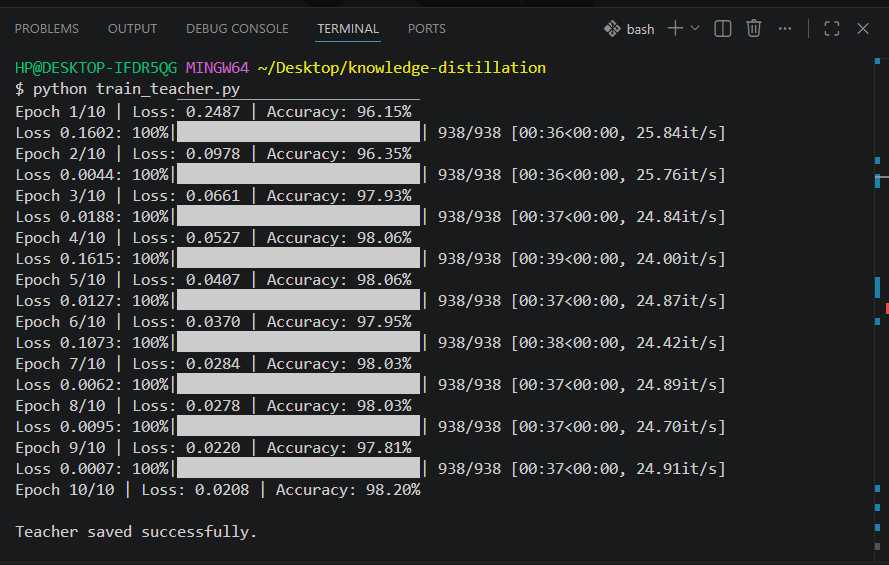
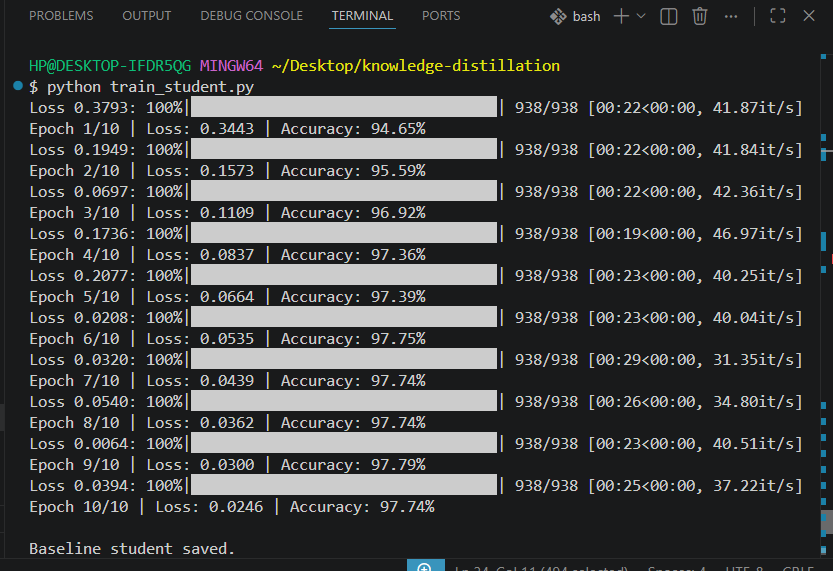
To explore these concepts practically, developers frequently implement knowledge distillation using frameworks like PyTorch and standard benchmark datasets such as MNIST, which comprises seventy thousand grayscale images of handwritten digits. By training a robust teacher network, freezing its parameters, and subsequently training a smaller student network using a combination of hard ground-truth labels and soft probability targets provided by the teacher, engineers can observe direct performance enhancements.
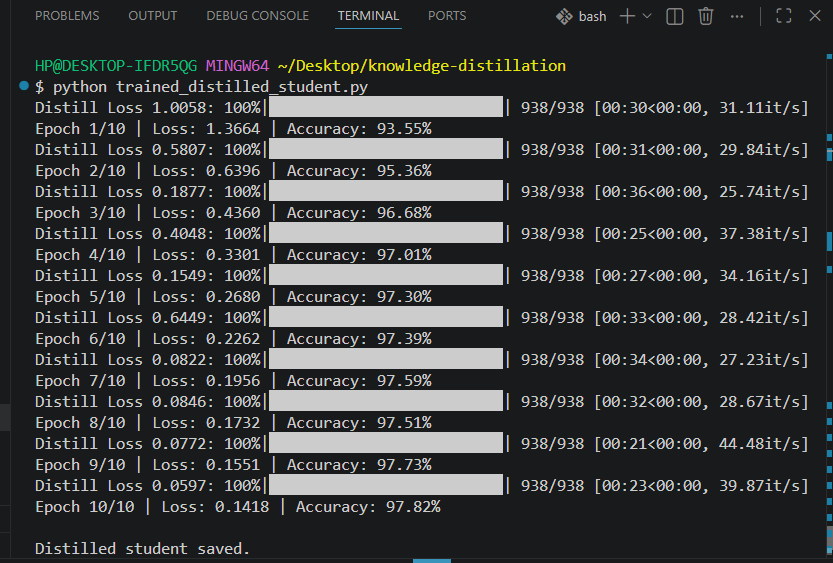
In experimental implementations using baseline architectures and distillation loss functions that combine cross-entropy with Kullback-Leibler divergence, smaller student networks consistently punch above their weight class. While an unguided baseline student model achieves strong accuracy on standard classification tasks, a distilled student model trained under the guidance of a larger teacher network closes the performance gap significantly, nearly matching the accuracy of the substantially larger model.
Beyond knowledge distillation, the broader artificial intelligence landscape features several alternative strategies for reducing model size to mitigate latency, memory footprints, and compute costs. Quantization achieves efficiency by reducing the bit-width of numerical weights and activations within the neural network, targeting memory bandwidth bottlenecks by converting high-precision data types into narrower formats. Pruning operates by systematically removing redundant and low-impact parameters from over-parameterized networks, eliminating weak connections to streamline execution. Low-rank factorization employs linear algebra to simplify the complex matrix multiplications that dominate deep learning architectures.
Choosing among these optimization strategies depends heavily on the specific operational bottleneck a development team aims to resolve. Quantization is generally favored for alleviating memory constraints, whereas pruning and knowledge distillation are designed primarily to reduce computation time and enhance inference speed. Together, these techniques provide a clear pathway for deploying highly capable artificial intelligence systems across edge devices, mobile platforms, and consumer-grade hardware.