









When developers first publish a software package to pub.dev, the official package repository for Dart and Flutter, the initial days are often marked by a surge of excitement. Witnessing download counters tick upward into the hundreds provides a tangible validation of community interest. However, many maintainers soon encounter a puzzling phenomenon: after a strong launch week, the reported download numbers begin to plummet rapidly, dropping from hundreds to mere dozens, even though no code has broken and user adoption has not actually wavered.
This sudden collapse in metrics often stems from a fundamental misunderstanding of how pub.dev calculates and displays download statistics. Rather than presenting a cumulative total of all downloads since a package’s inception, pub.dev operates on a 30-day rolling window. It counts only the downloads executed within the preceding month, rendering everything prior completely invisible. When an initial promotional spike or launch flurry falls outside that moving 30-day window, the displayed download count drops precipitously, creating the misleading impression that a healthy, actively used package is quietly dying.
Driven by this discovery, developers in the ecosystem have begun examining the underlying architecture of pub.dev’s public data interfaces. The realization that the platform’s default user interface obscures long-term growth has inspired new analytical approaches, leading to the creation of independent tools designed to expose the full historical trajectory of Dart and Flutter packages.

Understanding the Mechanics of pub.dev Downloads
To fully grasp why package metrics fluctuate so dramatically, it is necessary to examine how pub.dev records download events in the first place. The platform does not track individual project usage or active installations. Instead, it counts how many times a package archive file has been requested and downloaded directly from its servers.
When a developer runs commands like pub get or flutter pub get within a project directory, the local pub tool first checks a local caching directory known as PUB_CACHE. If the required package version is already stored locally, the system utilizes the cached version, and no download is registered with the server. A download is officially counted only when the package must be fetched fresh from the remote server.
Consequently, download figures serve as an indirect measure of fresh fetches rather than total active users. A widely adopted package utilized by thousands of developers may register very few downloads during periods where development teams work offline or rely on cached assets. pub.dev itself addresses this nuance within its official documentation, explicitly stating that download counts are not a direct measure of total user base due to local client caching.

Layering a 30-day rolling window on top of this caching mechanism means that maintainers only ever see a short-term snapshot. A package that experiences a massive promotional wave on platforms like Twitter or LinkedIn will see those downloads reflected prominently during the first month. As time passes and downloads settle into a steady, sustainable maintenance rhythm, the departure of the initial spike from the rolling window causes the visible counter to crash, masking the ongoing, cumulative adoption occurring beneath the surface.
Uncovering the Public APIs Behind pub.dev
While the standard pub.dev interface restricts viewable metrics to the recent 30-day window, the platform’s underlying application programming interfaces offer a deeper look into historical data for those willing to inspect them. Officially documented endpoints, such as the score endpoint located at /api/packages/package/score, provide the exact metrics powering the main website UI, including the downloadCount30Days field alongside like counts and automated code quality score points generated by the pana analyzer.
Additional official endpoints, such as the package metadata endpoint conforming to the Hosted Pub Repository Specification V2, allow tools to retrieve comprehensive historical records of every published version, alongside their respective release timestamps. Similarly, publisher endpoints identify whether a package is maintained by a verified organization or an individual developer.
However, a more revealing dataset exists within endpoints that are publicly accessible but intentionally omitted from official support documentation. Among these is the metrics endpoint, which pub.dev utilizes internally to populate its own weekly performance graphs. By querying this endpoint, developers can access a scorecard object containing weekly version downloads spanning a full 52-week period.
This dataset breaks down download distributions across major, minor, and patch version ranges for each week of the preceding year. While pub.dev’s standard user interface aggregates only the most recent entries of this data to construct its 30-day window, the complete 52-week array remains accessible within the raw API response, providing the missing historical context for package growth.
Building PubTrace to Expose Historical Trajectories
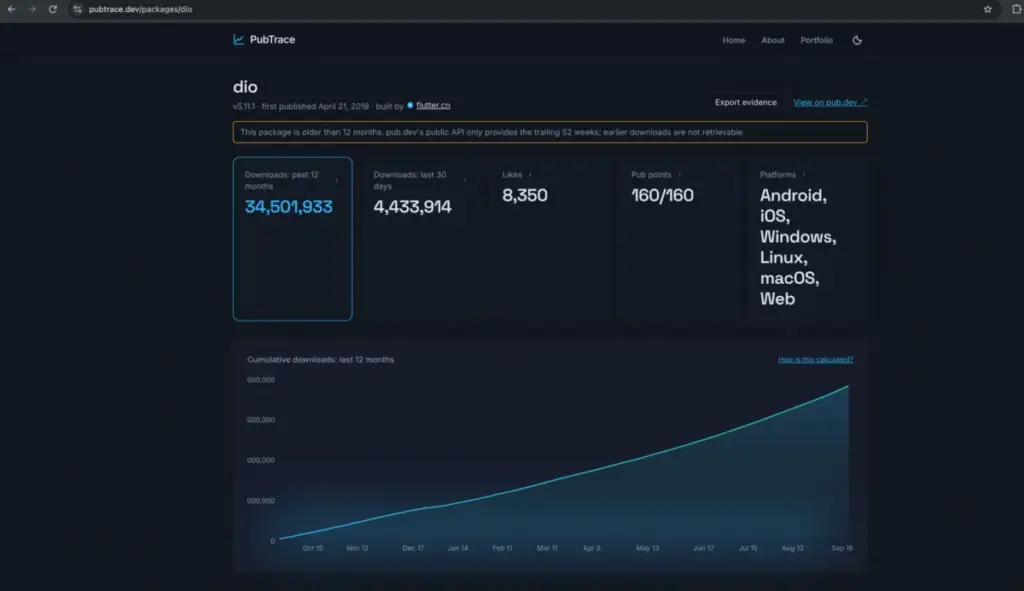
Recognizing the discrepancy between pub.dev’s default display and the deeper data available via its public endpoints, independent developers have begun constructing supplementary visualization layers. One such utility, PubTrace, was developed to provide the Dart and Flutter community with a transparent method for viewing complete annual download trajectories without requiring user authentication or account creation.
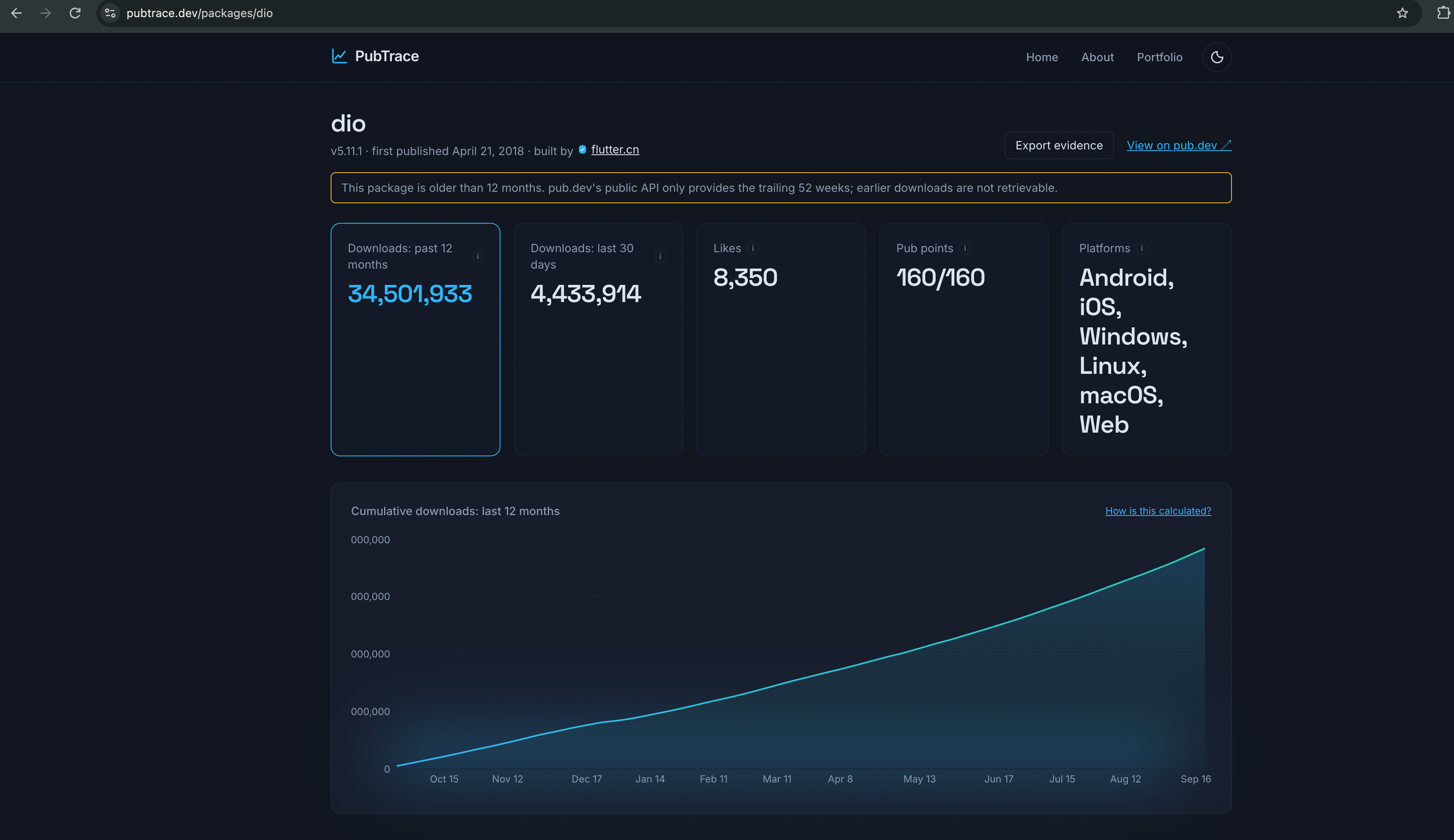
Operating entirely as an open analytical interface, the tool queries pub.dev’s live endpoints to construct cumulative download charts spanning a full year. Rather than relying on a fluctuating 30-day window, it aggregates weekly metrics into a running total, illustrating the true, long-term growth curve of a package. For packages younger than a full year, the system adapts dynamically, displaying the exact number of weeks available since the initial release date without extrapolation or estimation.
A central architectural decision behind these independent analytics tools is the deliberate absence of a proprietary data storage database. Rather than harvesting and archiving historical data on separate servers—which would require users to trust a third-party intermediary—the system fetches live data directly from pub.dev’s APIs at the moment of a user request.
To prevent excessive querying and respect the infrastructure limits of the official repository, responses are cached temporarily for a brief window, with clear timestamps indicating the freshness of the data. Furthermore, verification panels embedded within these tools expose the exact terminal commands utilized to retrieve the information. This transparency allows any engineer to independently execute standard network requests and verify every displayed figure against the source repository’s raw data.
Practical Implications for Package Authors and Engineers
The availability of long-term download analytics offers significant utility for various segments of the software development ecosystem. For package authors, moving beyond the 30-day window provides an accurate reflection of project health. Instead of reacting negatively to a natural drop in rolling download metrics following a launch campaign, maintainers can evaluate stable, long-term adoption trends to guide future feature development and maintenance schedules.
For engineers compiling professional portfolios or applying for senior technical roles, verifiable metrics carry substantial weight. Demonstrating that a published package has achieved steady cumulative growth over several months offers a compelling validation of technical impact compared to a declining short-term counter. By providing reproducible data verification panels, these tools ensure that community contributions can be accurately evidenced during technical evaluations.
Ultimately, the emergence of these analytical approaches highlights a growing desire for transparency within the modern software supply chain. As the Dart and Flutter ecosystems continue to expand, access to honest, unmasked data empowers developers to make informed architectural decisions regarding third-party dependencies, ensuring that community choices are guided by complete historical context rather than arbitrary reporting windows.