





The high-stakes race to bridge terrestrial mobile coverage gaps via space-based technology has triggered a fierce regulatory battle in Washington. As direct-to-device (D2D) services rapidly transform from a luxury feature into a fundamental expectation for mobile operators, America’s leading telecom carriers are sounding the alarm. Major mobile network operators argue that federal plans to open specific, heavily utilized 5G frequency bands for satellite connectivity could severely destabilize their core terrestrial networks, threatening millions of everyday subscribers with degraded service and dropped calls.
The conflict came to a head when executives representing the CTIA, along with leadership from AT&T, T-Mobile, and Verizon, held high-level discussions with senior staff at the Federal Communications Commission (FCC). During the October 20 meeting, the telecommunications heavyweights formally urged regulators to carve out two crucial 5G bands—specifically the 2.5GHz and 3.45GHz ranges—from the newly drafted rules governing Supplemental Coverage from Space (SCS) and direct-to-device connectivity.
The timing of this lobbying push is critical. The regulatory showdown precedes a scheduled FCC vote on a proposed policy item designed to release an additional 482MHz of spectrum across more than a dozen bands for SCS. This regulatory overhaul aims to harmonize rules between emerging SCS frameworks and traditional Mobile Satellite Service (MSS) guidelines. Compounding the urgency, the carrier pushback arrives just as AT&T, T-Mobile, and Verizon actively pursue their own dedicated D2D joint venture designed to expand rural coverage through satellite partnerships.
The Technical Divide: TDD Versus FDD
At the heart of the carriers’ concerns lies a fundamental engineering incompatibility: the clash between Time-Division Duplex (TDD) technology utilized in modern 5G terrestrial bands and the paired Frequency-Division Duplex (FDD) architecture traditionally favored for satellite communications.
In terrestrial TDD networks, uplink and downlink traffic share the exact same frequency band, relying on meticulously synchronized time intervals to send and receive data without colliding. Conversely, FDD systems separate uplink and downlink traffic into entirely independent, non-overlapping channels.
The telecom industry points out that approximately 300 million Americans currently rely on these vital 5G bands for their everyday mobile connectivity. Injecting satellite operations directly into these frequencies, the operators warn, introduces catastrophic interference risks that current technology cannot reliably mitigate.

"Supplemental Coverage from Space is not technically feasible in TDD bands, and the Commission should remove the 2.5 GHz and 3.45 GHz bands from its proposal for inclusion in the SCS framework," the carriers argued in an official ex parte filing documenting the FCC meeting. Furthermore, the operators requested that the FCC amend the formal language of the rules to state that D2D implementations in TDD bands "would"—rather than "could"—create severe coexistence challenges for both in-band and adjacent-band terrestrial systems.
T-Mobile: D2D in the 2.5GHz Band Would Paralyze Our 5G Uplink
T-Mobile subsequently amplified these warnings through a separate, highly detailed filing with the commission. The carrier argued that direct-to-device services cannot safely share the 2.5GHz spectrum without massively degrading the performance of its broader mobile network. For T-Mobile, this specific range serves as the fundamental bedrock of its expansive "Ultra Capacity 5G" footprint.
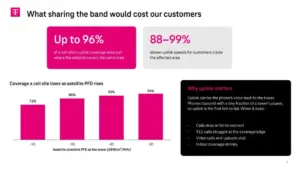
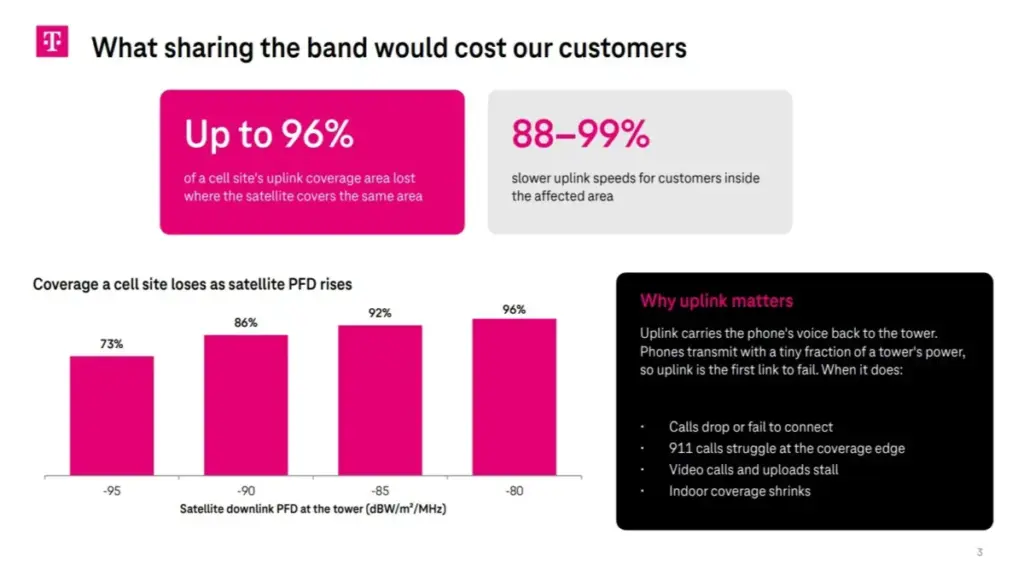
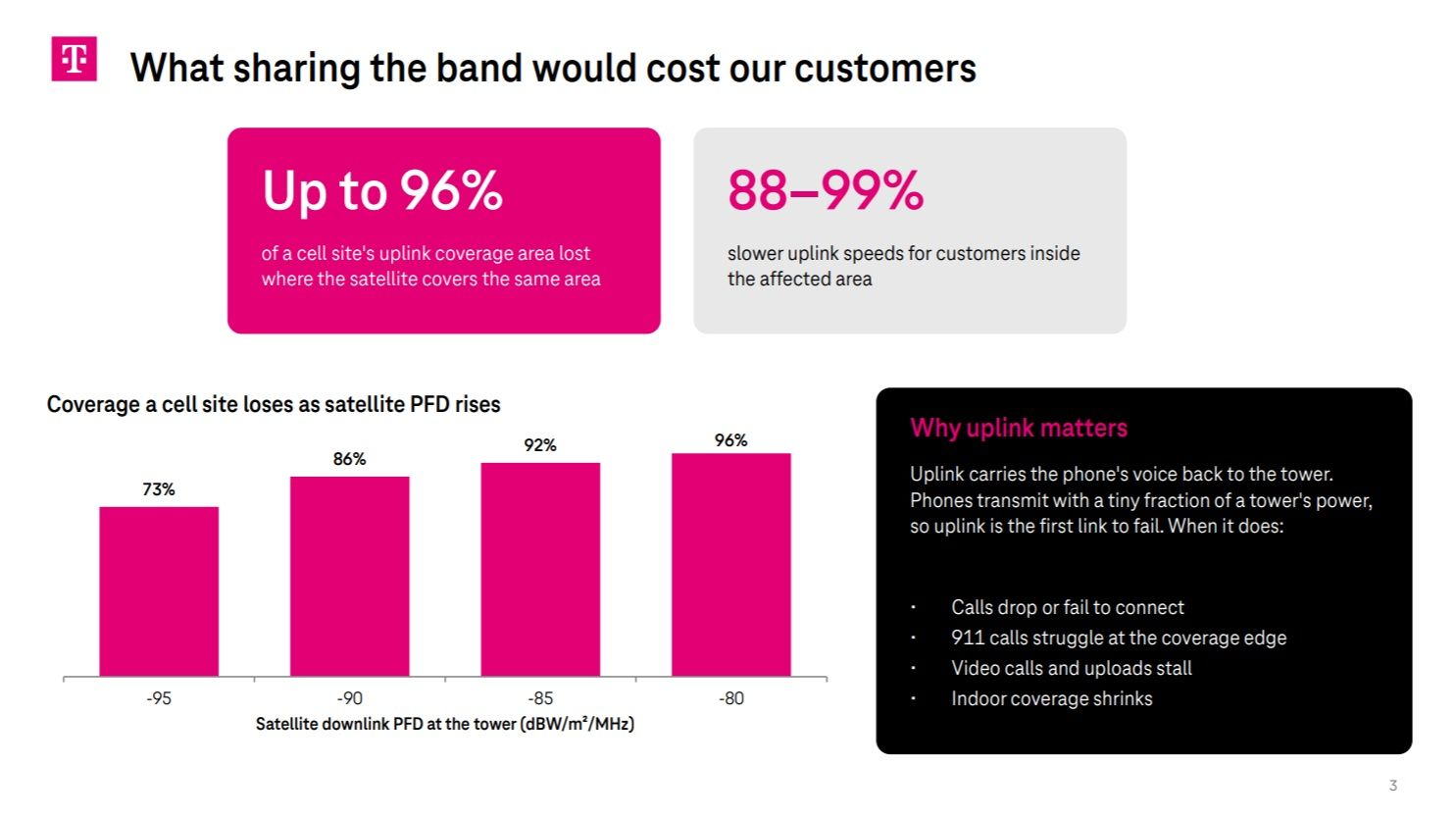
According to T-Mobile’s technical analysis, a satellite signal transmitting in the 2.5GHz band can easily land directly on top of a terrestrial cell tower, colliding head-on with ground-based signals. This interference results in severely delayed uplink transmissions, degraded indoor coverage, and complete call drops. The company emphasized that these disruptive interference issues persist even if terrestrial and satellite transmissions are perfectly synchronized.
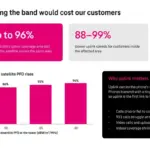
The carrier’s projections paint a grim picture for network reliability. T-Mobile estimates that where satellite coverage bleeds over, up to 96% of a cell site’s uplink coverage area could be effectively neutralized. For consumers caught in these overlapping zones, uplink speeds could plummet by an astonishing 88% to 99%.
Even users located miles away from market boundaries would not be spared. T-Mobile calculated that satellite transmissions could reduce a cell site’s uplink coverage by roughly 35 percent at a distance of 15 miles from a market boundary. Highlighting the severity of the threat, the carrier noted that a single satellite-connected phone operating near a signal boundary has the potential to completely drown out a terrestrial cell site located one to three miles away.
Recalling that the use of 2.5GHz spectrum for D2D was already thoroughly evaluated and rejected by regulators in 2024, T-Mobile urged the FCC to restrict SCS authorizations exclusively to terrestrial spectrum operating under FDD schemes, thereby preserving the interference-free integrity of critical 5G operations.
The ‘Starlink Doctrine’ and Industry Realities
This regulatory clash highlights a deeper philosophical and economic struggle over the ownership and utilization of radio frequency spectrum. Industry analysts view the current friction as a direct collision between traditional telecom licensing models and the aggressive expansion strategies of satellite pioneers.
Roger Entner, an industry analyst and founder of Recon Analytics, addressed the shifting dynamics on his weekly podcast, characterizing the overarching approach of satellite operators as the "Starlink Doctrine." He summarized the philosophy with a blunt appraisal: "What’s mine is mine, and what’s yours is mine, too."
Entner argued that this expansive mindset directly undermines the foundational framework of the commercial mobile industry. "There’s a reason why we have licensed spectrum and there’s a reason why we have unlicensed spectrum. And the people who pay for the license should have the exclusive benefits for that," he noted.
The regulatory outcome will have far-reaching consequences for the entire telecommunications landscape. Mike Dano, lead industry analyst at Ookla and former Light Reading editor, emphasized that the FCC’s forthcoming decisions will dictate how spectrum is deployed across various competing satellite ventures, whether through Starlink, AST SpaceMobile, Amazon’s Leo project, or other emerging competitors. Through bodies like the CTIA, the cellular industry is fighting to ensure its voice shapes that regulatory future.
Adding to the competitive tension, recent market developments suggest that satellite giants are increasingly looking beyond orbit. Starlink has signaled potential moves to develop and build out terrestrial network infrastructure designed to work in tandem with its satellite fleet, blurring the traditional boundaries between space-based and ground-based communications providers.
The mounting regulatory uncertainty and competitive pressure have already begun to ripple through financial markets. The looming shadow of Starlink and the ongoing spectrum dispute weighed heavily on investor sentiment for the nation’s major telecom providers, with shares of AT&T, T-Mobile, and Verizon experiencing notable downward pressure as stakeholders weigh the long-term capital expenditure and network integrity risks ahead of the commission’s definitive vote.