











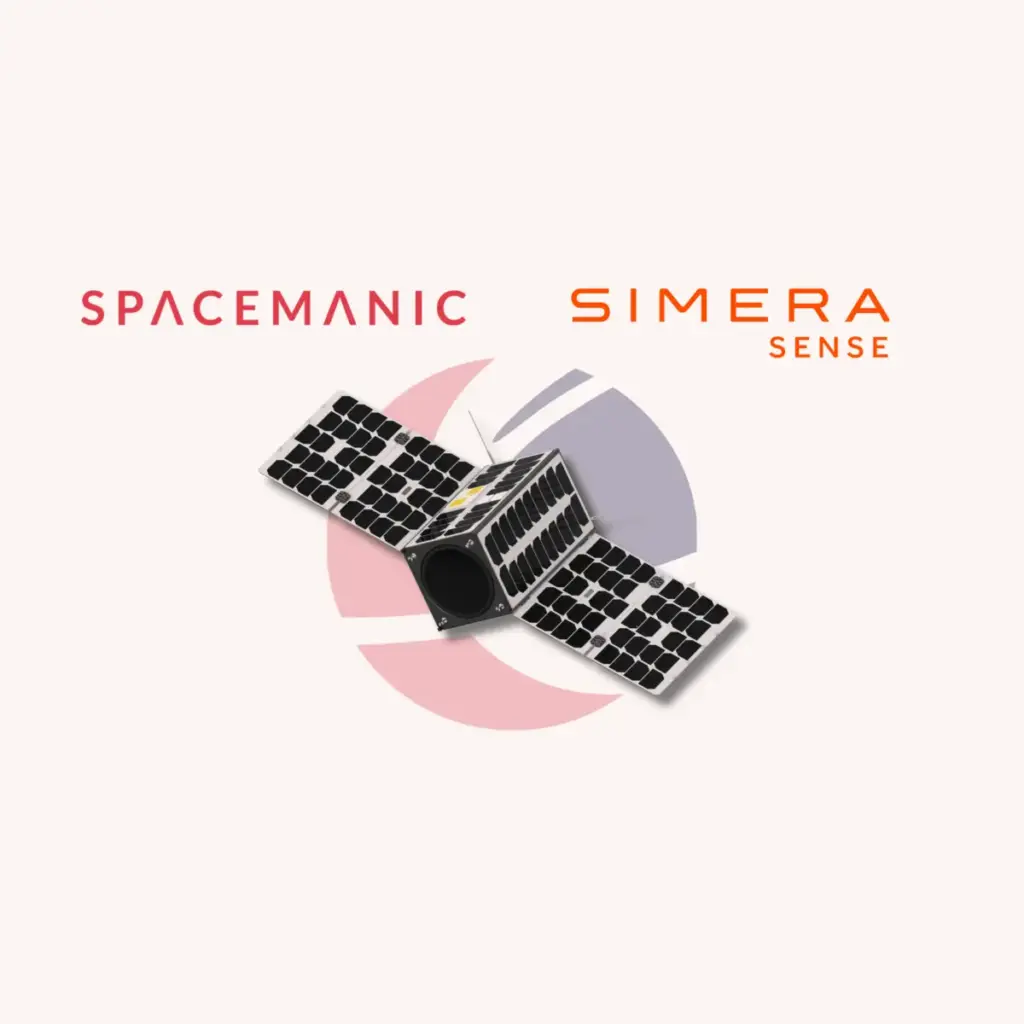
The commercial space sector and defense industries are witnessing a paradigm shift as European aerospace innovators combine their expertise to redefine what small satellites can achieve. Czech satellite manufacturer Spacemanic and Belgian optical systems leader Simera Sense have announced a strategic collaboration to deliver an advanced, dual-use satellite solution designed to compete directly with traditional, much heavier spacecraft.
At the heart of this new offering is the integration of the Simera Sense xScape200 Dual-Use (DU) camera directly into Spacemanic’s robust 16U CubeSat platform. This partnership brings high-resolution imaging capabilities typically reserved for larger, bulkier satellites down to a lightweight, compact spacecraft. The resulting system is specifically engineered for repeatable deployment and rapid constellation growth, offering an agile alternative for operators who require persistent monitoring without the prohibitive expenses traditionally associated with large satellite architectures.
The collaboration addresses a longstanding challenge in the space industry: how to achieve high-performance imaging without the massive financial and logistical burdens of traditional Earth observation missions. By merging cutting-edge optical payloads with highly optimized smallsat buses, the two companies are positioning themselves at the forefront of the burgeoning dual-use market, where commercial utility and defense readiness increasingly overlap.

Delivering High-Resolution Imaging in a Compact Form Factor
The modern space economy demands efficiency, and the xScape200 DU camera is engineered precisely with that philosophy in mind. The system combines a compact 12U form factor, low Size, Weight, and Power (SWaP) characteristics, and standardized integration protocols. This design philosophy provides both commercial enterprises and defense organizations with access to high-resolution, dual-use imaging capabilities that previously required a much larger spacecraft.
By avoiding the need for oversized platforms, operators can drastically reduce their launch costs and bypass the power-intensive mission architectures that complicate traditional Earth observation programs. The xScape200 DU allows missions to achieve high fidelity data capture while maintaining the agility and speed of deployment characteristic of smaller satellite classes. This makes it an ideal solution for organizations looking to scale up their orbital assets quickly, whether for environmental monitoring, infrastructure assessment, or security and reconnaissance operations.
Custom-Built Platforms Tailored for Advanced Payloads
A critical differentiator in this new offering is Spacemanic’s vertically integrated manufacturing model. Unlike companies that rely on off-the-shelf buses and attempt to force diverse payloads into rigid, standardized enclosures, Spacemanic designs and builds its satellite platforms, core subsystems, and deployers entirely in-house.
Owning the entire manufacturing chain allows the engineering team to shape the satellite specifically around the camera, rather than forcing the camera to adapt to a pre-existing standard form factor. This comprehensive approach encompasses the satellite’s structure and protective envelope, its mechanical, electrical, thermal, and data interfaces, and the precise mechanics of how the spacecraft integrates with its deployer.

This custom-tailored integration ensures that optical performance is never compromised by structural constraints. Thermal dissipation, data throughput, and mechanical stability—all critical factors for high-resolution imaging payloads—are optimized from the ground up, resulting in a more reliable and resilient spacecraft once it reaches orbit.
The SPACE CANNON Deployer: Flexibility and Access Right Up to Launch
To accommodate the unique dimensions of the xScape200 DU payload, Spacemanic utilizes its proprietary SPACE CANNON deployer. Engineered to accommodate CubeSats up to 16U, the system features an expanded integration envelope specifically designed to house payloads with protruding elements on the sides, along with a tuna can configuration at the bottom. This additional physical space provides the necessary clearance to support larger, more demanding payload configurations such as the xScape200 DU camera without violating standard deployment geometries.
Furthermore, the SPACE CANNON is engineered with practical operational flexibility in mind. The deployer incorporates removable side panels on all four sides, granting direct physical access to the satellite even after the integration process has been completed. This accessibility allows engineers to perform crucial final adjustments, inspections, and diagnostics right up until the moment of launch, significantly reducing pre-launch risks.
Versatility is also a key feature of the deployer’s market readiness. The SPACE CANNON is designed for seamless integration with a wide array of modern launch vehicles. This compatibility spans a diverse roster of rockets, including SpaceX’s Falcon 9, Arianespace’s Ariane 6, Avio’s Vega-C, HyImpulse’s SL1, InnoSpace’s Hanbit, Isar Aerospace’s Spectrum, Rocket Factory Augsburg’s RFA ONE, and HyPrSpace’s Baguette One. This broad compatibility ensures that operators utilizing the Spacemanic and Simera Sense solution retain immense flexibility when booking launch slots across different global providers.
Shaping the Future of Commercial and Dual-Use Markets
Together, the camera, the custom-tailored platform, and the specialized deployer form a complete, end-to-end mission solution. This integrated approach radically simplifies the journey from initial payload integration to final orbital deployment, lowering the technical barriers that often delay small satellite missions.
Beyond the immediate engineering achievements, the partnership between Spacemanic and Simera Sense represents a broader evolution in how the commercial and dual-use space markets operate. As the demand for responsive, resilient, and cost-effective space infrastructure continues to accelerate, integrated solutions that bridge the gap between high-end optical performance and smallsat agility are set to become the standard for modern orbital constellations.