










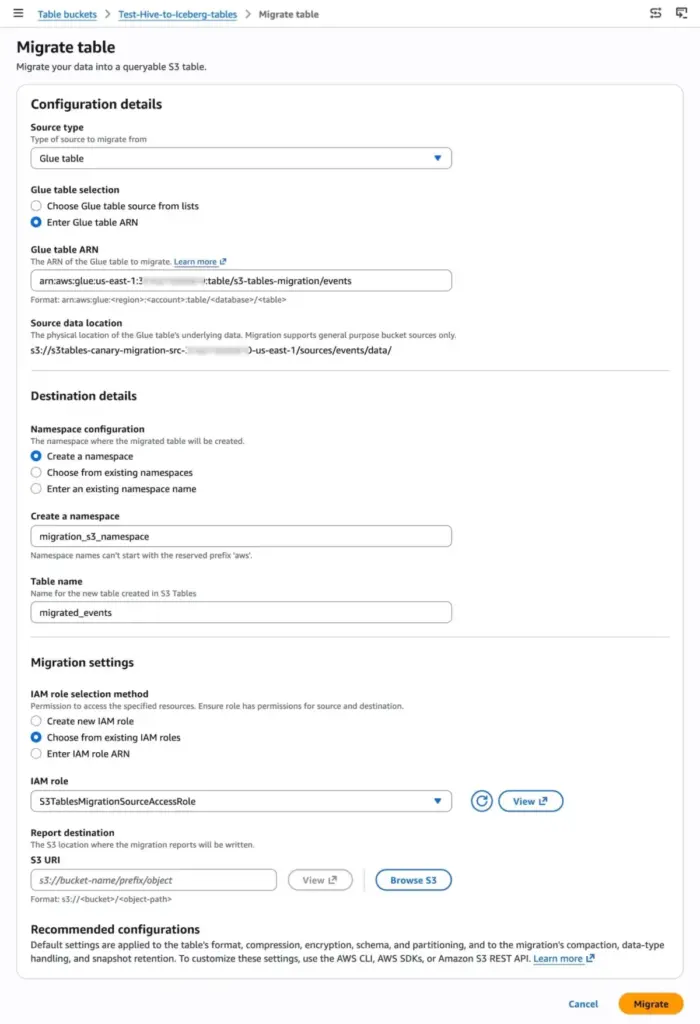
In a significant move to simplify data lake modernization, Amazon Web Services has announced the introduction of a managed, API-driven migration path for users transitioning from Apache Hive to the Apache Iceberg table format. This new capability, integrated directly into Amazon S3 Tables, is designed to eliminate the historical operational friction associated with upgrading data infrastructure, allowing organizations to modernize their analytics foundations without the need to provision new compute resources or build complex, custom migration pipelines.
For years, the Apache Hive format has served as the bedrock of data lakes. However, as modern data requirements have evolved to prioritize performance, schema evolution, and high-frequency updates, Apache Iceberg has emerged as the industry’s open-source standard for large-scale analytics. Despite this clear industry shift, many enterprises have found themselves locked into legacy Hive architectures, deterred by the high engineering overhead required to manually convert petabyte-scale datasets. The new managed migration feature from AWS effectively removes this barrier to entry, enabling a seamless transition while ensuring that production workloads remain online and operational throughout the process.
The Evolution of Modern Data Lakes
The shift toward Apache Iceberg is driven by the format’s ability to handle the complexities of modern, large-scale data environments. Unlike traditional table formats, Iceberg offers robust features such as hidden partitioning, which abstracts away the physical storage layout from the end user, and schema evolution, which allows for changes to table structures without the risk of breaking downstream queries. Perhaps most importantly, it supports time-travel queries, enabling data engineers to audit past states of a table or roll back to a specific point in time—a critical capability for debugging and compliance.


Amazon S3 Tables are purpose-built to host these Iceberg tables, providing a managed storage layer that ensures performance and cost-efficiency at scale. By integrating automated maintenance—such as file compaction and metadata optimization—directly into the storage layer, S3 Tables allow organizations to focus on their data rather than the underlying infrastructure. With features like S3 Intelligent-Tiering, these tables automatically shift data to the most cost-effective access tier based on usage patterns, ensuring that storage costs remain optimized as datasets grow into the petabyte range.
Streamlining the Migration Process
Historically, migrating a data lake from Hive to Iceberg was a daunting prospect that could consume weeks of engineering time. Teams were often required to architect custom data movement pipelines, handle complex type conversions, and manually verify data integrity—all while attempting to maintain uptime for critical business applications. The new managed migration tool inside Amazon S3 Tables automates this entire lifecycle.
The process begins with an automated compatibility assessment. Before a single byte of data is copied, the service inspects the source Hive tables registered in the AWS Glue Data Catalog and generates a comprehensive compatibility report. This report serves as a roadmap, identifying any potential issues before the migration commences. Once the assessment is complete, S3 Tables manage the heavy lifting: performing data validation, executing necessary file recompression, conducting compaction for optimal query performance, and handling the complex translation of data types between the two formats.

One of the most significant advantages of this approach is the minimal impact on production environments. Because the system supports iterative synchronization, users can continue writing to their source Hive tables while the migration is underway. The destination table remains read-only during the copy phase, and only during the final cutover—which typically takes just a few minutes—is there any interruption to write operations. This architecture allows data teams to test and validate their new Iceberg tables in parallel with existing workflows, significantly lowering the risk profile of the migration.
From a cost perspective, the managed approach offers a distinct advantage over manual, compute-heavy migration strategies. AWS has structured the pricing so that customers pay only for the data that is actually copied during the migration. There are no additional surcharges for the Hive-to-Iceberg conversion logic, and the source objects stored in S3 Intelligent-Tiering remain in their existing access tiers, preventing unnecessary cost spikes associated with moving data between storage classes.
Practical Implementation and Tooling
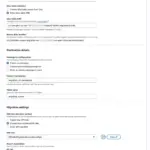
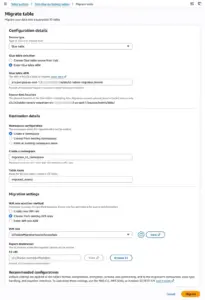
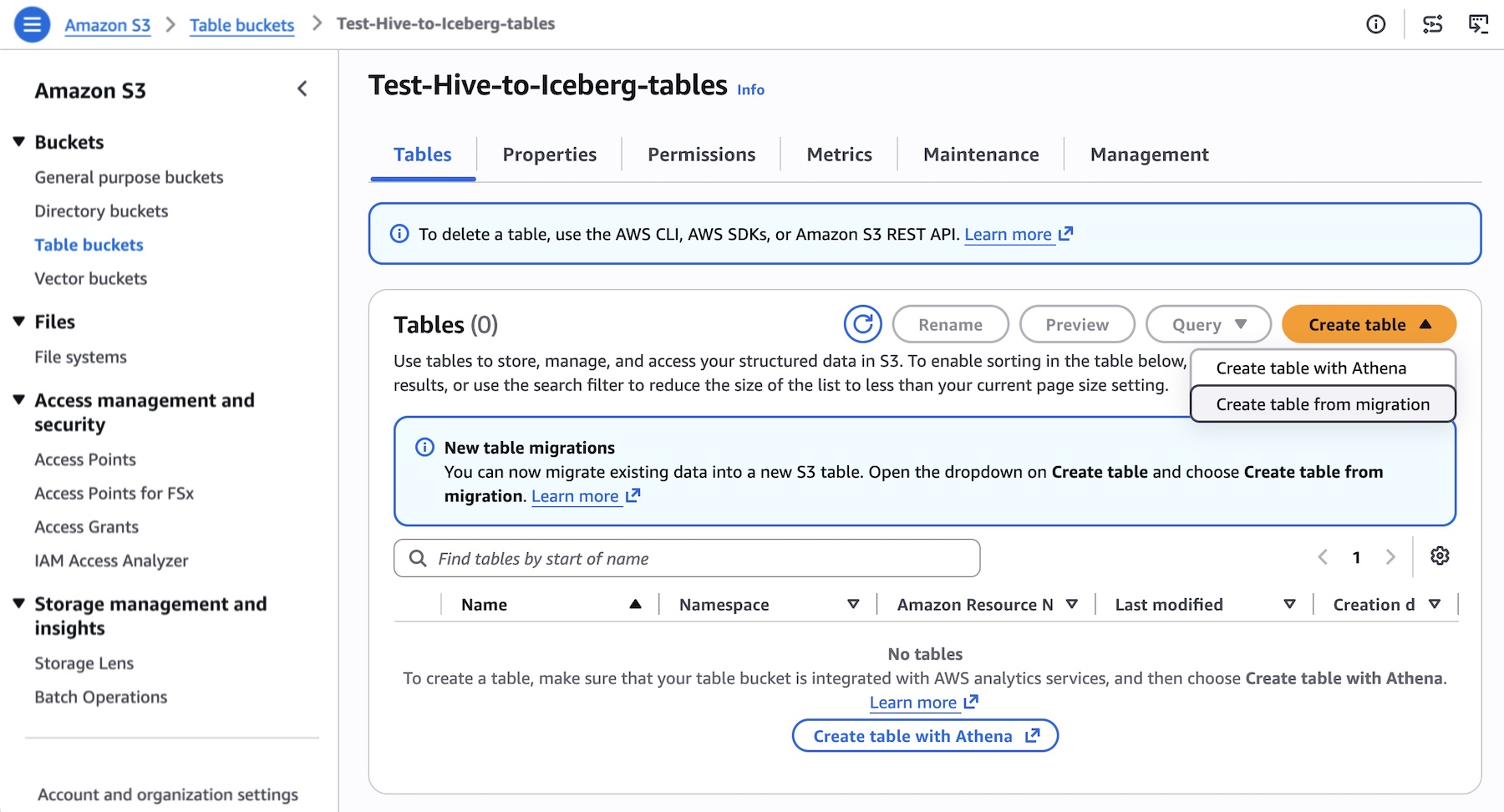
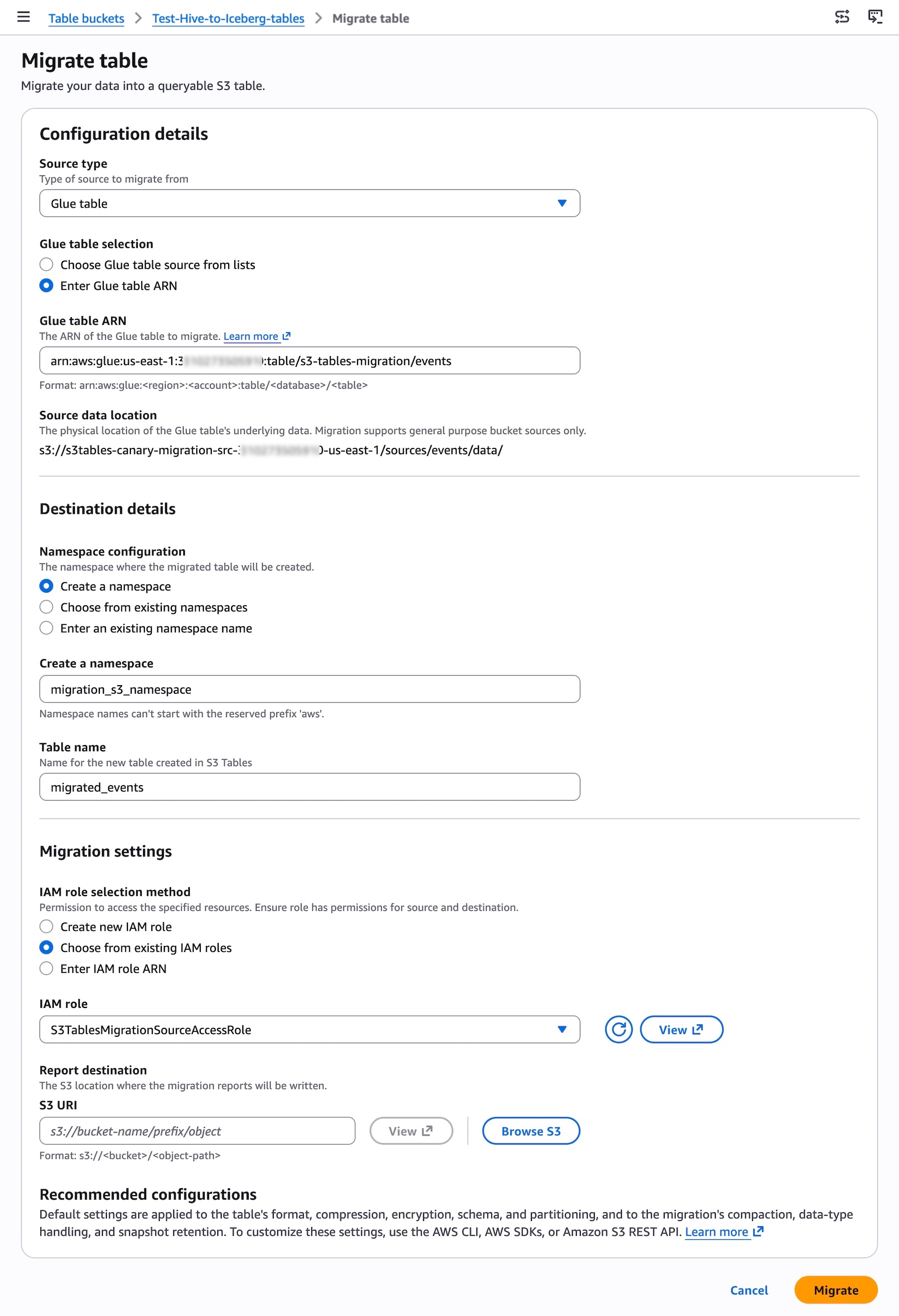
The migration process is accessible directly through the Amazon S3 console, where users can initiate a "Create table from migration" request. By selecting the target bucket and defining the namespace and table name, users can let the service handle the configuration. The default settings provided by S3 Tables are optimized for performance, ensuring that the resulting Iceberg tables are ready for high-concurrency analytical workloads immediately upon completion.
For teams that prefer infrastructure-as-code or automated orchestration, the migration capability is fully exposed via the AWS Command Line Interface (AWS CLI) and AWS SDKs. Developers can utilize the start-table-migration command to programmatically initiate jobs, providing detailed JSON configurations that specify encryption, storage class policies, and custom compaction strategies. This level of granular control allows for the migration of massive, partitioned datasets to be fine-tuned to specific business needs.
Furthermore, the integration extends to the broader AWS ecosystem. Once a table has been migrated, it is immediately queryable via Amazon Athena and available for machine learning workflows in Amazon SageMaker Unified Studio. For organizations utilizing modern AI-driven development tools, the Agent Toolkit for AWS includes specialized skills that provide step-by-step guidance and safety guardrails, assisting agents in orchestrating the migration process while adhering to best practices.
Availability and Future Outlook
As of today, the managed migration feature for Amazon S3 Tables is available across a wide range of AWS Regions, including US East (N. Virginia and Ohio), US West (Oregon), Asia Pacific (Mumbai, Singapore, Sydney, and Tokyo), and Europe (Frankfurt, Ireland, and Stockholm). At launch, the tool supports AWS Glue-registered Hive tables that use the Parquet file format, provided the source and destination reside within the same AWS account and region.
For organizations looking to navigate the complexities of this transition, the AWS documentation and the newly updated AWS MCP Server provide extensive resources for troubleshooting and planning. By lowering the barriers to adopting Apache Iceberg, this release signals a clear commitment from AWS to facilitating the next generation of data lake architecture. As data volumes continue to explode, the ability to transition seamlessly to more performant and flexible open-standard formats will be a key differentiator for data-driven enterprises, turning what was once a multi-week engineering project into a managed, efficient, and reliable operational task.