









By Iain Morris, International Editor, Light Reading
October 30, 2026
Dan Schulman sounds like he has been rewatching that classic scene from The Matrix Reloaded in which Neo fights off a multiplying swarm of Agent Smiths. "I think as I look out over the next couple of years, there’ll be something like 8.5 billion people in the world, but I think there could be at least 100 billion agents," the CEO of Verizon told analysts on his call discussing third-quarter results.
These won’t, of course, be the sinister agents of the Keanu Reeves movie with their sneering resolve to exterminate anyone unplugged from the machine. "We’ll be sure that we won’t allow agents to access our platforms unless we’re 100% certain that it’s truly a customer and not a rogue agent," continued Schulman, portraying agentic AI as a prime opportunity for Verizon to boost customer spending and grow sales.

His view that people will be vastly outnumbered by supposedly autonomous software programs—believed to be "super intelligent" by some political figures—might trouble anyone who has tracked Schulman’s bold predictions since he took the helm at the American telco about a year ago. Speaking to The Wall Street Journal in April, he reckoned artificial intelligence could lift the national unemployment rate to an astonishing 30% in the next two to five years. If he is right, that dramatic shift should already be creeping up across economic indicators—perhaps even surging.
So far, however, Schulman’s AIpocalypse forecast looks about as accurate as McKinsey’s famous prediction regarding network APIs. Almost three years ago, the consulting firm prophesied that telcos would generate up to $300 billion in additional sales over the subsequent five to seven years as those APIs spurred network usage. Without an unprecedented spike in the next two years and four months, that projection will go down as one of the worst examples of industry forecasting since Winston Churchill predicted the Gallipoli campaign would be a cakewalk.
Despite what Schulman thinks, the US rate of unemployment did not budge between April and September, holding steady at 4.2%, according to the US Bureau of Labor Statistics. There is also scant evidence that AI is either boosting broader economic productivity or directly responsible for mass labor displacement. Yet, despite the steady macroeconomic metrics, Verizon continues to cut thousands of jobs every single year.

Storming the Bastille
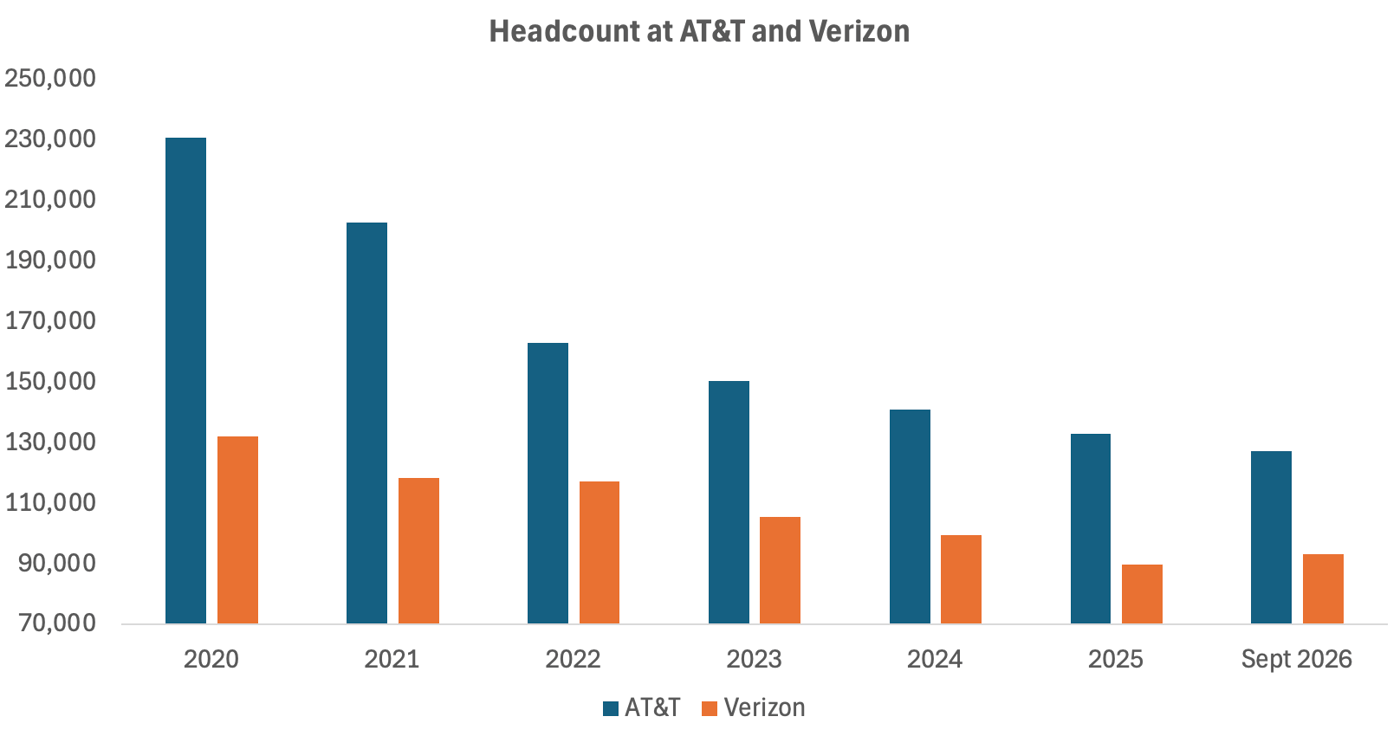
Verizon finished 2025 with 9,700 fewer employees than it had a year earlier after Schulman announced plans for 13,000 job cuts right upon his arrival at corporate headquarters. Staff numbers were then temporarily fattened by the acquisition of Frontier Communications, a broadband operator, at the start of 2026. With its previous headcount of about 13,000 people, Frontier would have given Verizon a total of about 112,600 employees at the end of 2024. Yet by June this year, Verizon employed only 97,600 people. Three months later, the figure had dropped further to 93,300, according to financial accounts published this week.
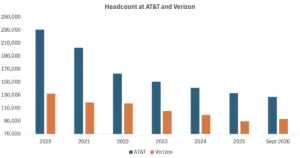
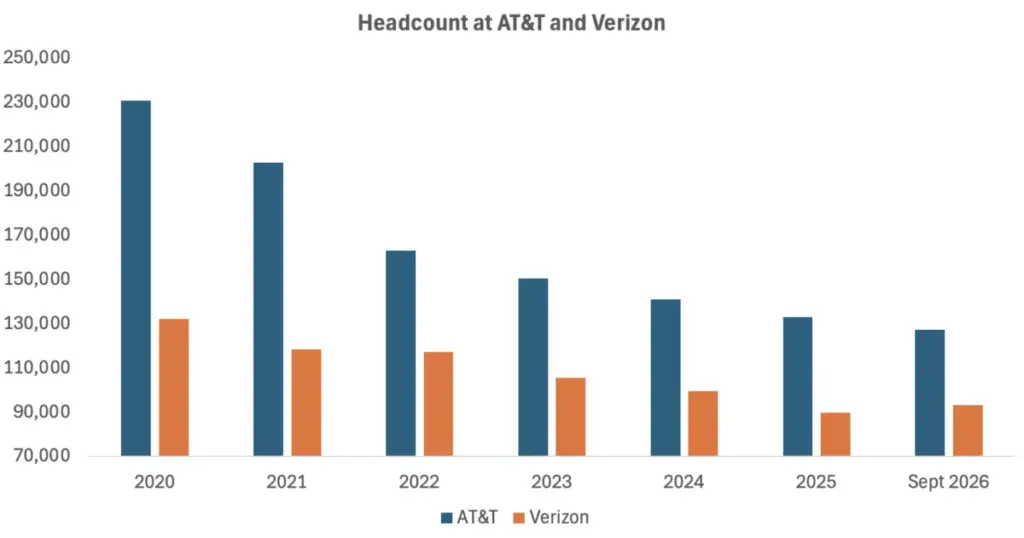
Verizon’s update followed the revelation a day earlier that rival AT&T had similarly cut another 3,700 jobs over the exact same three-month period. It means the two big US telcos combined have slashed another 8,000 jobs, amounting to nearly 4% of their total workforce, in a single quarter. Together, they employed roughly 220,500 people in September, which is fewer than AT&T alone employed in 2020. Headcount across the two major companies has fallen by a staggering 142,460 since then.
Successive quarters of layoffs have now become so normalized across the telecommunications sector that they are barely acknowledged by Wall Street. No analyst thinks to ask how Verizon could have grown annual sales by almost $10 billion between 2020 and 2025 while simultaneously offloading about a third of its workforce during this period. In 2020, Verizon generated about $970,500 in revenues per employee. Last year, that productivity figure had soared to more than $1.53 million per worker.
Investors, if not employees, might be delighted to hear this epic downsizing is all the consequence of AI and the operational efficiency it has continually promised. Layoffs used to be taken as a clear sign that a company was in deep financial trouble. But if AI truly allows major corporations to operate with a fraction of the workforce they previously needed, while generating the same or even higher revenues, profits should naturally rise and shareholders should benefit accordingly.
Unfortunately, there are numerous fundamental problems with this convenient assessment. For starters, both AT&T and Verizon were cutting headcount aggressively long before anyone had heard of Sam Altman and before generative AI had become an everyday news story. Indeed, the deepest structural cuts happened prior to the revolutionary date of November 30, 2022, when ChatGPT was released to the public—what many consider AI’s storming-of-the-Bastille moment.
Nor are the major telcos dramatically more profitable with much lower cost bases than they were several years ago. Verizon booked total operating expenses of about $25.7 billion for the recent third quarter, up slightly from $24 billion for the same period five years ago. AT&T’s equivalent figure stood at $28.2 billion for each of those quarters. Over this period, Verizon cut 17% of its workforce while AT&T’s headcount shrank by a massive 28%.
Of course, the operators would probably have been in a much worse financial position had they not made such hefty cuts. The core problem is that any labor savings have been steadily eroded by wage inflation, expensive severance packages, and the rising costs of outsourcing work to third-party vendors. What is often forgotten, too, is that labor expenses account for a relatively small fraction of any large network operator’s total costs—perhaps only a fifth of the total expenditure among major US telcos.
Difficult and Dangerous
The real blame for ongoing job cuts probably lies with the usual suspects in corporate restructuring: standard efficiency measures, the elimination of bloated layers of middle-management fat, heavier reliance on external contractors, the strategic retreat from non-core businesses like traditional TV services, the removal of duplicate roles following major mergers, the closure of physical retail stores as customers increasingly shop online, and more humdrum, traditional forms of office and network automation.
None of this offers much consolation for affected employees—or even for the remaining staff struggling with increased workloads. If operators didn’t actually need artificial intelligence to cut so many jobs over the past several years, could the rapidly advancing technology help them shrink even more drastically in the next few years? The software engineering side of the telecom business has looked especially vulnerable to an AI takeover. Agents’ ability to write code in response to a few basic prompts, and even to solve complex algorithmic problems, has improved at a frightening pace this year.
Letting autonomous agents eradicate human programmers, nevertheless, would be both difficult and dangerous. It is difficult because IT bosses within telcos still largely regard software-writing tools like GitHub Copilot as virtual assistants meant for speeding up the output of a given human coder, rather than as direct, like-for-like replacements. It is dangerous because relinquishing deep technical expertise and decision-making to AI could leave organizations overly reliant on expensive, fallible technologies that few people really comprehend. If humans are no longer trained to do those foundational jobs, institutional skills might be lost forever.
Whether AT&T and Verizon can sustain job cuts at the current rate will be highly instructive for the broader industry. In 2020, few industry observers would have expected AT&T to cut its headcount by 45% over the span of six years. Were that trend to continue unchecked, the company would enter 2032 amid the commercial rollout of 6G with around just 70,000 employees remaining.
By then, if Schulman proves to be right, autonomous agents will have led to an unprecedented "explosion in data traffic," making the Verizon network an exceptionally scarce and valuable asset, he told analysts. "And we will price it as such. You’ll see different pricing plans." Despite the bold long-term vision, Verizon’s share price fell 3% on the day it published its latest results and is down 9% over the last six months amid growing market concerns about competing satellite services like Starlink. Telecom analysts remain deeply skeptical about the AI productivity narrative, and they sound even less convinced by the sales pitch.